Scroll to Top



What will be the output of the following code?
Which searching method is the simplest form of search?
What is the worst case time complexity of inserting n2 elements into an AVL-tree with n elements initially ?
When is Depth First Search (DFS) of a graph unique?
Which of the following is/are correct inorder traversal sequence(s) of binary search tree(s)?
1. 3, 5, 7, 8, 15, 19, 25 2. 5, 8, 9, 12, 10, 15, 25 3. 2, 7, 10, 8, 14, 16, 20 4. 4, 6, 7, 9, 18, 20, 25
Consider the following directed graph:
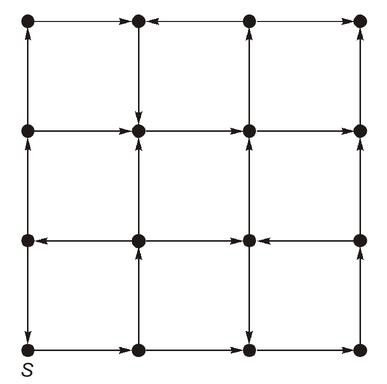
Which of the following is/are correct about the graph?
This algorithm prints all prime numbers from 2 through a given integer n > 1.
input: an integer n > 1.

output: all prime numbers from 2 through n.
let A be an array of Boolean values, indexed by integers 2 to n,

initially all set to true.
for i = 2, 3, 4, ..., not exceeding √n do

if A[i] is true

for j = i2, i2+i, i2+2i, i2+3i, ..., not exceeding n do

A[j] := false
return all i such that A[i] is true.
Let G be a simple undirected graph. Let TD be a depth first search tree of G. Let TB be a breadth first search tree of G. Consider the following statements.
(I) No edge of G is a cross edge with respect to TD. (A cross edge in G is between two nodes neither of which is an ancestor of the other in TD). (II) For every edge (u, v) of G, if u is at depth i and v is at depth j in TB, then ∣i − j∣ = 1.
Which of the statements above must necessarily be true?
Let Q denote a queue containing sixteen numbers and S be an empty stack. Head(Q) returns the element at the head of the queue Q without removing it from Q. Similarly Top(S) returns the element at the top of S without removing it from S. Consider the algorithm given below.
while Q is not Empty do if S is Empty OR Top(S) <= Head(Q) then x := Dequeue(Q); Push(S, x); else x := Pop(S); Enqueue(Q, x); end end
The maximum possible number of iterations of the while loop in the algorithm is
A Circular queue has been implemented using singly linked list where each node consists of a value and a pointer to next node. We maintain exactly two pointers FRONT and REAR pointing to the front node and rear node of queue. Which of the following statements is/are correct for circular queue so that insertion and deletion operations can be performed in O(1) i.e. constant time.
I. Next pointer of front node points to the rear node. II. Next pointer of rear node points to the front node.


Hybrid

1 Openings

FullTime

Posted 6 days ago

OnSite
1 Openings
FullTime
Posted 17 days ago

OnSite
10 Openings
FullTime
Posted 9 days ago

OnSite
2 Openings
FullTime
Posted 6 days ago
OnSite
1 Openings
FullTime
Posted 4 days ago
OnSite
2 Openings
FullTime
Posted 12 days ago
OnSite
3 Openings
FullTime
Posted 17 days ago

OnSite
1 Openings
FullTime
Posted 12 days ago
OnSite
4 Openings
FullTime
Posted 11 days ago
OnSite
1 Openings
FullTime
Posted 17 days ago