

SnapQuiz


Scroll to Top
 Ashutosh Kumar J.
 Rakshitha R.
 Ganesh K.
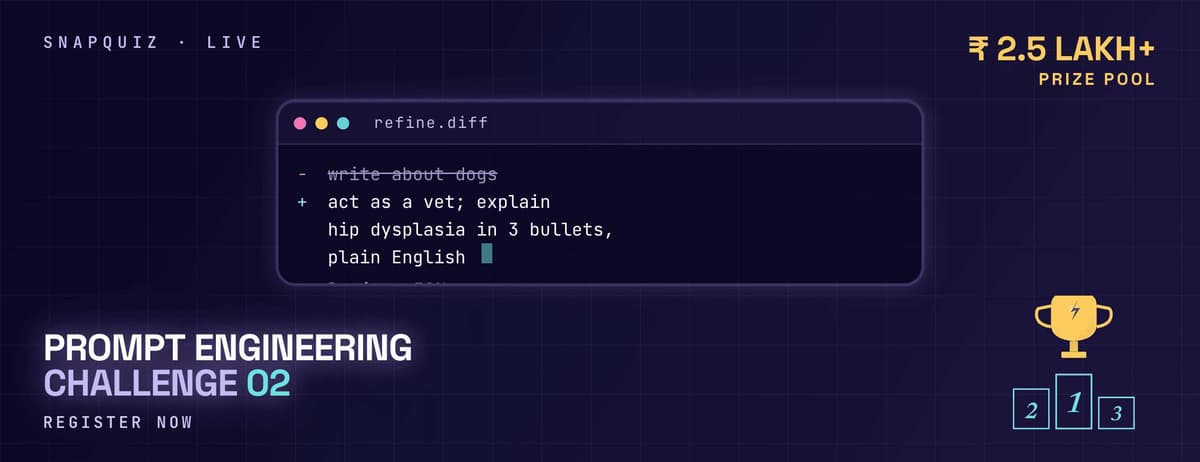
Anyone can write a prompt. This is where you find out whether you can engineer with one.
Challenge 2 puts 40 scenario-based questions in front of you — system prompts, structured output, tool use, RAG, agent loops, caching, and jailbreaks — each with a single best answer and an instant explanation. It opens gently so everyone settles in, then ramps into the calls that trip up people who've only ever copy-pasted prompts. The explanations aren't a consolation prize; they're a calibration tool that shows you precisely which instincts hold under a timer and which ones crack.
Climb the live leaderboard and leave knowing exactly where your prompt-engineering judgment stands.

 1,000
1,000 500
500 500200100
The Prompt Engineering Fundamentals Challenge 2 is a timed, 40-question prompt engineering challenge online for anyone who builds — or wants to build — with large language models. It moves past "write a clever prompt" into the skills that actually ship a working LLM workflow: system prompts, structured output, tool use, retrieval-augmented generation (RAG), agent loops, prompt caching, and defending against jailbreaks and prompt injection.
Every question is a real-world scenario with one correct answer and an instant explanation, so you learn not just what you got wrong but why. You are scored against a live leaderboard while the round is open, and rewards run all the way down to rank 10,000 — so there is a reason to fight for every position. If you can already tell a good system prompt from a fragile one, this prompt engineering test is where you prove it. And if you cannot yet, the explanations after each question turn the round into the fastest feedback loop you will get on these skills.
This challenge is built for people who use large language models for real work, not just trivia. Developers and AI engineers can benchmark their applied prompt-engineering skills under time pressure. Students and self-learners who have spent hours with ChatGPT, Claude, or Copilot can check whether they actually understand how these systems behave. Data scientists and ML practitioners moving into generative AI get a fast read on the application-layer skills that differ from model training. Founders, product managers, and technical writers shipping AI features get an honest gauge of their working knowledge. And if you are preparing for an AI or LLM engineering interview, this is timed practice on exactly the concepts those interviews probe.
You do not need to be a machine learning researcher to do well. There is no model-training math here and no need to write code during the round — the focus is the practical judgment that goes into building with LLMs day to day. If you have ever wired up a tool call, stuffed documents into a context window, watched an agent spin in circles, or tried to stop a model from following instructions hidden in a web page, you will recognise these questions. If you have not, you will leave the round knowing exactly which of those skills to pick up next.
Each question carries a weight, and harder questions are worth more, so a strong run rewards depth, not just speed. Every question is individually timed — there is no global clock you can spend however you like; when a question's timer runs out, the challenge moves on. While the round is open you can watch your position move on the live leaderboard, and final ranks are confirmed once the challenge closes. Because questions are drawn from a larger bank and ordered from easier to harder, two people rarely see the exact same sequence — but everyone gets the same gentle-to-tough ramp. Accuracy on the harder, higher-weight questions is what separates the leaders from the pack.
The practical takeaway: do not burn your attention rushing the easy opening questions, and do not panic when the difficulty climbs — that is by design, and it is where the most points live. Read each scenario carefully, because the wrong-but-tempting option is usually the common misconception, not a random distractor. Since you cannot revisit a question once its timer ends, commit to your best answer and move forward rather than second-guessing.
The questions reward applied judgment, so think like an engineer shipping a feature, not a student reciting definitions. When a question describes a failure — a RAG answer citing the wrong passage, an agent repeating the same tool call, a prompt cache that suddenly stops hitting — ask what actually changed in the system rather than reaching for the most elaborate fix. Watch for the difference between what a model guarantees and what you wish it guaranteed: JSON mode is not schema adherence, embedding similarity is not relevance, and a polite "please don't be tricked" is not an injection defense. If a topic keeps catching you out, that is the strongest possible signal of where to focus your practice afterward.
Unlike a casual ChatGPT trivia round or a generic Google Forms AI quiz, this challenge is timed, scored against a live leaderboard, and gives an instant explanation after every question. Where most online "AI quizzes" test whether you can recall a definition, these prompt engineering mcq questions test whether you can make the right call in a realistic situation — which tool to call, why a RAG answer went wrong, how to stop an agent from looping, or what just broke your prompt cache. It is closer to an interview screen than a pub quiz: conceptual, applied, and ranked.
Practicing first measurably lifts your score. If you want a warm-up, work through the GenAI Engineering: Prompt Engineering course on Abekus — it walks through the same building blocks this challenge tests (prompts, structured output, tools, RAG, and agents) at your own pace, so the timed round feels familiar rather than intimidating.
When the round closes, final ranks are locked in and rewards are issued by position. The top ranks earn the largest gem and credit hauls plus an achievement certificate and a month of Pro; ranks 11–100 earn gems, credits, and a participation certificate; and everyone down to rank 10,000 earns gems and credits. Gems lift your standing across Abekus and credits unlock premium content and features, so a good result here keeps paying off well after the challenge ends. The skills you sharpen — clean system prompts, reliable tool use, grounded RAG, controllable agents — are the same ones that carry into real LLM engineering work and interviews.
Whatever your rank, use the instant explanations as a study map. The questions you missed point straight at the concepts worth revisiting, and the GenAI Engineering: Prompt Engineering course covers each of them in depth so you come back stronger next time. Treat this challenge as a benchmark you can re-run your skills against as you grow — the leaderboard tells you where you stand today, and the explanations tell you how to climb.
2520Corporate Development Senior Manager
Coinbase
Staff Software Engineer, Payments (AirCover Insurance Platform)
Airbnb

Commercial Sales Engineer - East
Zscaler
Sales Engineer - Spain
Zscaler
Group Product Manager, Compliance Automation
Coinbase

Principal AI Scientist
Healthcare


