

SnapQuiz

Scroll to Top
 Srilatha P.
 Sunil S.
 Jyothika K.
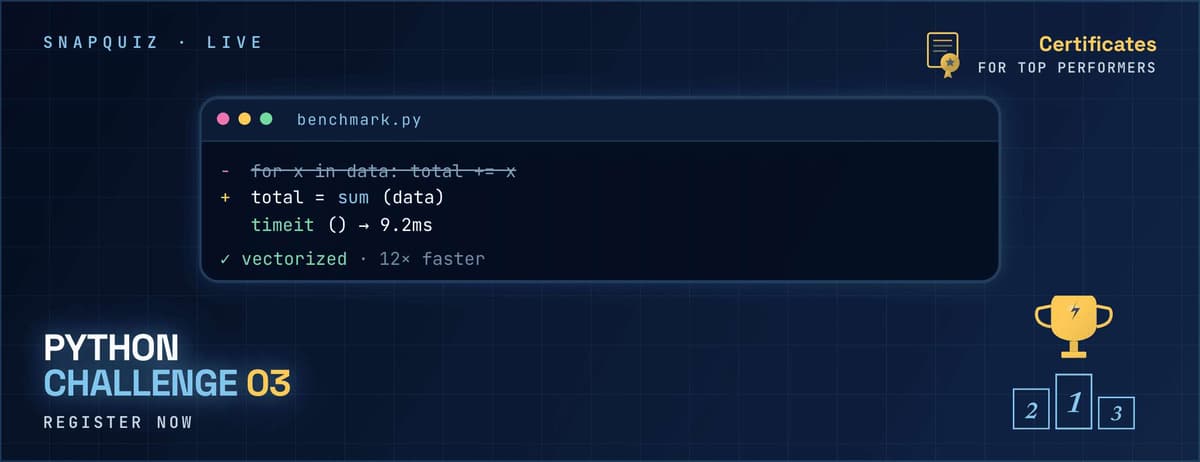
Think you know Python? This is where you find out.
Python Challenge 3 is 40 predict-the-output puzzles, each on its own timer. You read a short snippet and call what it prints, what it returns, or which error it raises. The early questions are friendly enough for a first competition; the later ones probe the corners where even experienced developers hesitate — references and mutation, scope, the object model, iterators, and the standard library.
Every answer comes with an instant explanation, so you leave with a sharper, calibrated picture of exactly which Python behaviours you have nailed and which ones still surprise you. Climb the live leaderboard, and finish knowing precisely where you stand.


Python Challenge 3 is a free Python challenge online that tests one thing: how well you can read real Python code and predict exactly what it does. It is a 40-question SnapQuiz of "predict the output" puzzles — you are shown a short snippet and you choose what it prints, what it evaluates to, or which exception it raises. There is no code to write and nothing to install; the whole challenge runs in your browser.
What makes it worth entering is the combination of breadth, pacing, and feedback. The questions span the Python fundamentals that show up in interviews, placement screens, and day-to-day work, and they ramp smoothly from gentle warm-ups to the genuinely tricky behaviours that separate confident Python developers from the rest. After every answer you get an instant explanation, and your position on the live leaderboard updates as you go.
Reading code accurately is a skill in its own right. Most day-to-day engineering is spent reading far more code than you write, and the ability to glance at a snippet and know exactly what it will do — including where it will surprise you — is what separates fluent Python developers from people who can only write it one line at a time. Python Challenge 3 turns that everyday skill into a fast, competitive game with a clear score at the end.
This is a welcoming Python quiz for anyone who wants an honest read on their fundamentals. Students preparing for campus placements can rehearse the kind of output-prediction questions that screening tests love. Self-taught learners who have finished a course or two can find out how much actually stuck. Working developers can benchmark their instincts in a few minutes and see whether the corners of the language still trip them up. Because the difficulty starts low, no prior competition experience is needed to take part and enjoy it.
Your score rewards both accuracy and speed. Every question carries a weight — harder questions are worth more points — and each one has its own countdown, so you cannot pause to look things up. Answer correctly and quickly to climb. The leaderboard updates in real time while the challenge is open, so you can watch your rank move as you progress. After the challenge closes, the final rankings are published for everyone who entered. There is a single attempt, so treat every question as it comes.
The leaderboard works in two phases. While the challenge is open, the live ranking turns it into a race: you can see exactly how a fast, correct answer moves you up against everyone else taking it at the same time. Once the round closes, those positions settle into the final published leaderboard, so you can see precisely where you placed against the whole field. Either way, the rank you leave with reflects how well you read Python under time pressure.
The 40 questions are spread across the Python topics that matter most for reading code correctly. Expect data types and truthiness (what counts as true, how booleans behave as integers), arithmetic surprises (rounding, integer versus float division, operator precedence), and string and list behaviour including slicing that clamps instead of raising. A cluster of questions covers references and mutation — the difference between rebinding a name and mutating the object it points to, aliasing, and in-place operators. Another covers functions and scope: default arguments, keyword-only parameters, argument unpacking, and the rules that decide whether a name is local. The object-model questions reach into classes, class-versus-instance attributes, method resolution, properties, dataclasses, and dunder methods. Rounding it out are iterators and generators, comprehensions, exceptions, and standard-library tools such as collections, itertools, and functools. Several questions are written like real pull-request reviews — they show a small function with a bug and ask which line is wrong or which change fixes it — so the challenge rewards engineering judgement alongside language recall.
The questions deliberately favour the behaviours people get wrong rather than trivia. You will meet the difference between is and ==, how a mutable default argument quietly keeps state between calls, why a list built with multiplication can share its inner references, how slicing past the end returns a shorter result instead of raising, and what a function actually returns when it falls off the end. Each snippet is short to read but rewards a clear mental model of how the interpreter evaluates that exact line, which is precisely the judgement timed screens are checking for.
Unlike open-ended quiz apps or generic Google Forms quizzes, this is a timed, scored Python quiz ranked against a live leaderboard, with an instant explanation after every question so you learn as you compete. It is also different from a coding-judge platform: where LeetCode or HackerRank ask you to write and run code against test cases, this challenge tests whether you can read code and predict its behaviour under time pressure — the exact skill that interview whiteboard rounds and placement screens lean on. The two are complementary: solve problems on a judge to build problem-solving, take this challenge to sharpen your mental model of how Python actually executes.
That focus on reading also shapes how you should play. Because every question is timed individually and weighted by difficulty, the smart strategy is to lock in the fundamentals quickly and bank confidence for the harder questions later, where the points and the surprises both concentrate. There is no penalty for thinking out a tricky trace, but the clock keeps moving, so a strong mental model beats second-guessing. The instant explanation after each answer means you immediately see whether your reasoning held, which is why a little practice beforehand pays off so directly.
Practising lifts your score, and the most direct preparation is the Python Fundamentals course on Abekus, which drills the same data types, sequences, functions, and object-model behaviours these questions probe. If you are specifically prepping for job screens, the Python Interview Mastery course layers on the trickier, interview-flavoured behaviour you will meet in the later questions. A short practice session on either makes the predict-the-output puzzles feel far more familiar.
When the round closes, the final leaderboard is published and rewards are distributed by position. Rank 1 earns 1,500 credits, an achievement certificate, and one month of Pro; rank 2 earns 1,000 credits and rank 3 earns 500 credits, each with an achievement certificate and one month of Pro; ranks 4 to 25 earn 200 credits, a participation certificate, and one month of Pro; ranks 26 to 100 earn 100 credits and a participation certificate; ranks 101 to 1,000 earn 25 credits; and ranks 1,001 to 10,000 earn 20 credits. Certificates can be added to your CV or LinkedIn. If you want to keep improving, run another pass through Python Fundamentals and the explanations you collected during the challenge will click into place.
Senior Software Engineer II - Platform
Samsara
Senior Data Engineer
Samsara
Senior Software Engineer II
Samsara
Applied AI Engineer
Bjak
Sr. Associate - AI and Data Engineer
Revantage
Software Engineer 5 – Agent Platform, AI Platform
Netflix


