On this page
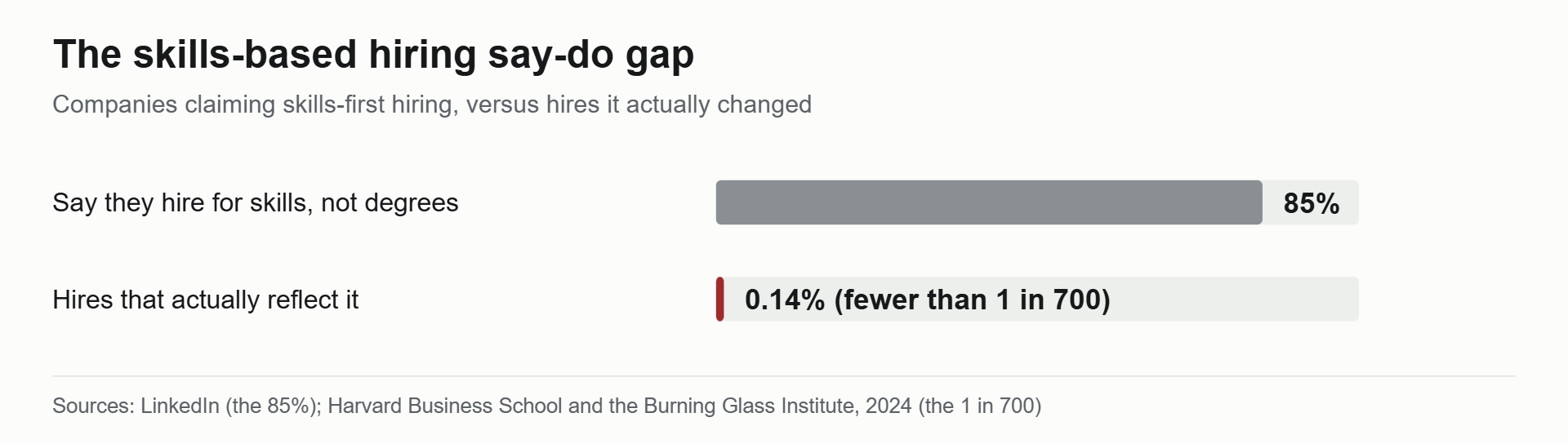
Here is the most awkward statistic in hiring right now: 85% of companies say they hire for skills, not degrees. Fewer than 1 in 700 of their new hires actually reflect it.
The 85% is LinkedIn’s figure. The gap comes from a Harvard Business School and Burning Glass Institute study published in 2024, which analysed more than 11,000 job postings — and it should stop every job seeker and every recruiter in their tracks. Because it means the “skills-first revolution” you keep reading about is, for most companies, still mostly a press release. The good news? Once you understand why the gap exists, you can be one of the rare candidates who actually benefits from it.
The skills-based hiring paradox, in numbers
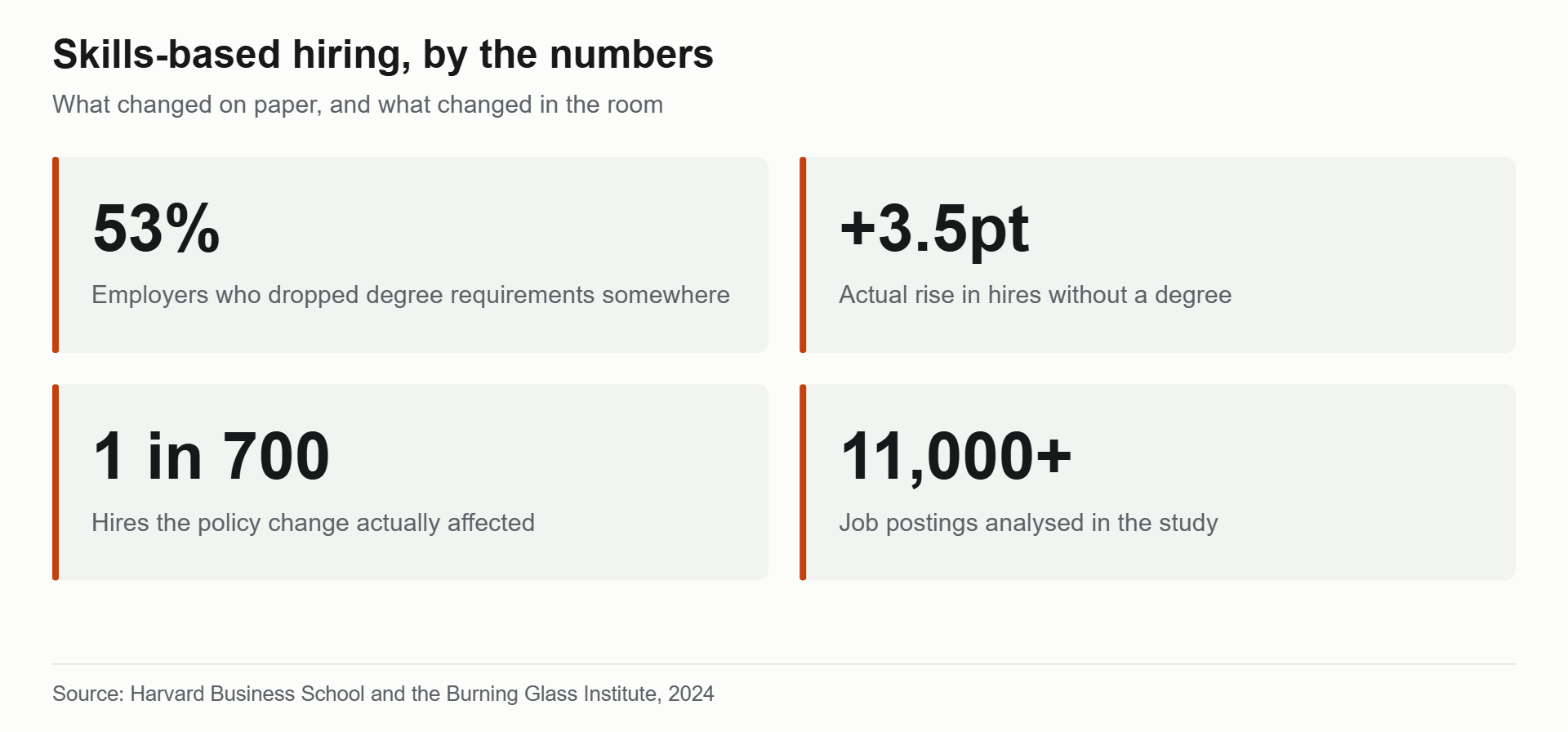
On paper, the shift looks enormous. Roughly 53% of employers have now publicly removed degree requirements from at least some roles, up from about 30% a year earlier. In one poll of 800 employers, around 80% said they would rather hire someone with relevant, demonstrable experience than a fresh graduate with a diploma and nothing else. More than 20 U.S. state governments have scrapped degree requirements for many public jobs since 2022. Giants like IBM, Google, and Bank of America have dropped four-year-degree mandates for large swaths of their openings.
India is moving in the same direction, and arguably faster. Industry analyses suggest roughly 85% of Indian employers now weigh skills over degrees when shortlisting. A growing share of Indian startups and Global Capability Centres have removed minimum CGPA cut-offs, replacing them with skills assessments and “assess-thons.” Most Indian organizations now run a hybrid model: the degree is a soft filter, a skills test is the real gate, and interviews validate both.
So why does Harvard’s data show barely any change in who actually gets hired? Because removing a line from a job description is easy. Rewiring how a company actually evaluates people is hard.
Why the policy hasn’t become the practice
When a recruiter deletes “bachelor’s degree required” but keeps screening the exact same way, nothing changes. The degree quietly comes back as a mental shortcut. Faced with 400 applicants and no reliable signal of ability, tired hiring managers fall back on the proxies they trust: brand-name colleges, familiar employers, polished resumes. Skills-based hiring collapses the moment there is no fast, trustworthy way to see a candidate’s skills.
That is the real bottleneck. It is not that employers secretly love degrees. It is that skills are genuinely hard to verify at a glance, and a self-reported “proficient in Python” on a resume carries almost zero weight. The infrastructure to prove skill — standardized, verifiable, checkable in one click — simply did not exist at scale until recently. This is exactly why analysts are calling 2026 the inflection point: the year the talk finally has the tooling to become the practice, and the only credentials that will count are the ones an employer can actually verify.
Consider what the numbers imply. Across those 11,000+ postings, dropping the degree requirement raised the share of hires without a bachelor’s degree by only about 3.5 percentage points. That is not nothing — but it is a fraction of what the headlines promised. The policy changed on the page; the behaviour barely moved in the room where decisions get made. And that is the quiet truth behind most “skills-first” announcements: the intent is real, but the muscle to act on it is still being built.
The degree never really left — it went undercover
Watch what happens in practice. A company removes the degree line, posts the role, and receives a flood of applications. With no fast way to separate the genuinely capable from the merely confident, the screener reintroduces filters that feel objective: years of experience at recognisable companies, elite university names in the education section, keyword density. Each of these correlates with — you guessed it — having had access to a degree in the first place. The requirement didn’t disappear. It went undercover as a set of proxies. The only thing that reliably breaks this loop is a candidate presenting a signal the screener can trust more than the proxy: verified, head-to-head proof of the exact skill the job needs.
What this means if you’re job hunting
Flip the paradox around and it becomes the biggest opportunity of your career. If most companies claim to hire for skills but can’t actually see them, then the candidate who shows up with undeniable, verifiable proof of skill wins by default. You are no longer competing on where you studied. You are competing on what you can demonstrably do — and most of your competition still can’t prove it.
Here is how to position yourself on the winning side of the gap:
- Stop describing skills. Start proving them. Replace vague resume claims (“strong in data analysis”) with evidence a recruiter can click and verify in seconds — a graded assessment, a ranked result, a project with measurable output.
- Compete, don’t just complete. A certificate that says you “watched a course” is weak. A verified result that shows you outperformed hundreds of other candidates on a real problem is a hiring signal. Ranked, proctored outcomes are far harder to fake and far easier to trust.
- Target the roles that reward it. Startups, GCCs, and product companies are furthest along on skills-first hiring, and they increasingly weigh the human skills AI cannot replace alongside the technical ones. They are the ones most likely to shortlist you on proof rather than pedigree.
- Make your resume machine-readable and human-obvious. Use clean, ATS-friendly formatting, mirror the exact skill keywords in the job description, and put your verifiable proof-points near the top.
- Keep the loop tight. Assess, find the gap, upskill on that specific gap, re-assess. Employers value a demonstrated trajectory, not a one-time score.
Proof beats pedigree — if you can produce the proof
This is precisely the problem Abekus skill competitions are built to solve. Instead of another PDF certificate that nobody trusts, you compete on real, role-relevant challenges and walk away with a verified result and certificate — a ranked, checkable signal of exactly what you can do. It is the click-to-verify evidence that turns a recruiter’s “skills-first” policy from a slogan into an actual reason to shortlist you.
Pair that with hands-on practice courses to close specific skill gaps before you compete, and you stop hoping someone reads between the lines of your resume. You hand them the proof.
How to tell whether an employer is actually skills-first
Since most companies say they hire for skills and few genuinely do, the practical skill is telling them apart before you spend an evening on an application. There are reliable tells, and they are all visible from the outside.
Look at what the process asks you to do. An employer who means it puts a short, role-relevant exercise early — before or instead of a resume screen. If the first thing that happens is a work sample, a take-home with a clear time box, or a live problem, that company has built the machinery to see skill. If the first three steps are resume, recruiter call, and culture chat, the degree proxy is still doing the deciding no matter what the careers page says.
Read the job description for what it measures rather than what it requires. “Five years of experience in a similar role” is a proxy. “You will be asked to debug an unfamiliar codebase and explain your reasoning” is a skill. The second kind of posting is rarer and worth far more of your time, because the bar is something you can actually clear by being good.
Check whether they publish a salary band. It correlates strongly, not because pay transparency and skills-first hiring are the same thing, but because both require a company to have decided in advance what the role is worth and what it needs. Vagueness on one usually means vagueness on the other.
And notice who is doing the outreach. If a recruiter contacts you about something specific you have demonstrably done, rather than a keyword on your profile, someone looked. Those conversations convert at a completely different rate than cold applications, which is the strongest argument for making your evidence easy to find in the first place.
Where does that leave the rest? Apply, but budget the effort honestly. Send a tight application to the proxy-driven employers and spend your real preparation on the ones whose process can actually see what you can do.
Frequently asked questions
What is skills-based hiring?
Skills-based hiring evaluates candidates on demonstrated ability rather than credentials such as a degree or years at a recognisable employer. In practice it means a role-relevant assessment, work sample or structured exercise early in the process, used to decide who advances rather than to confirm a decision already made.
Does removing degree requirements actually change who gets hired?
Usually not by much. Harvard Business School and the Burning Glass Institute analysed over 11,000 postings and found that dropping the degree requirement raised the share of hires without a bachelor degree by only about 3.5 percentage points, with fewer than 1 in 700 hires affected at some large firms.
Which companies actually practise skills-based hiring?
The tell is process, not policy. Employers who mean it put a short role-relevant exercise before or instead of the resume screen. Startups, Global Capability Centres and product companies tend to be furthest along, and published salary bands are a reasonable proxy for a company that has defined the role properly.
How do you prove a skill without a degree?
With evidence a stranger can check in seconds: a graded assessment, a ranked result from a proctored challenge, or a project with a measurable outcome and a link. The specific form matters less than whether someone other than you is vouching for it.
Is a degree still worth it in 2026?
Yes, but for narrower reasons than before. It still opens doors and remains a hard requirement in regulated professions. What has changed is that it no longer substitutes for demonstrable ability, and a degree with no evidence attached increasingly loses to evidence with no degree.
The bottom line
Skills-based hiring is real, but for now it is mostly aspirational — a policy that is racing ahead of practice. The companies mean it; they just don’t yet have an easy way to act on it for every candidate. The people who win in this window are not the ones with the fanciest degrees or the ones who wait for the system to fix itself. They are the ones who make their skills impossible to ignore and effortless to verify.
Be that candidate. Enter a skill competition on Abekus, earn a verified result, and turn “we hire for skills” into a job offer.
Sources
- Harvard Business School and the Burning Glass Institute, Skills-Based Hiring: The Long Road from Pronouncements to Practice (2024) — analysis of 11,000+ job postings. Accessed September 2026.
- LinkedIn — the 85% of employers reporting a skills-first priority. Accessed September 2026.