On this page
Everyone job hunting in India has been told that referrals matter. Almost nobody has been told what to actually type, which is why most people either never ask or send something that gets ignored.
The maths is worth understanding before you write anything. Referrals make up a small slice of total applications but a disproportionate share of actual hires — SHRM reports that referrals remain the top source of hires, and widely cited industry analyses put a referred candidate’s odds at several times those of someone applying cold. The reason is unglamorous: a referred application gets read by a human being. Nothing else in the process guarantees that.
So the question of how to ask for a referral is not a soft-skills question. It is the highest-return twenty minutes in your week. Here is why most requests fail, and six messages you can adapt.
Why most referral requests get ignored
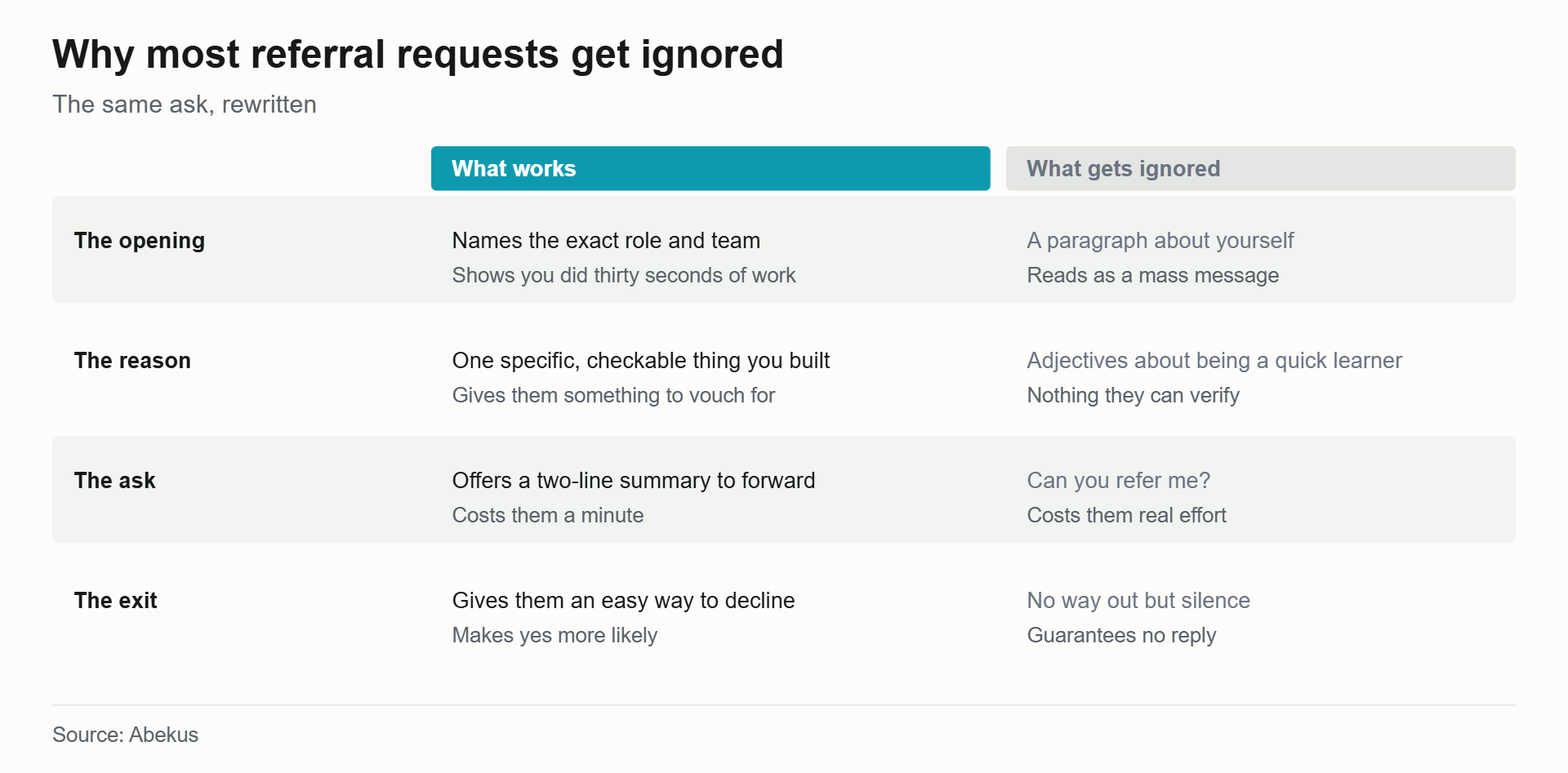
Three reasons, and they are all fixable.
You asked for too much. “Can you refer me?” asks a stranger to attach their professional reputation to someone they have never spoken to. Most people will not do that, not because they are unkind but because a bad referral costs them something real. Ask for something smaller first and the referral often follows on its own.
The message is about you. Most requests are a paragraph of the sender’s background followed by a request. Read from the other side, that is a stranger making work for you. The messages that get replies give the recipient something — a specific reason you contacted them rather than anyone else, and a version of the ask that takes them under a minute.
You made them do the assembly. If someone agrees to refer you and then has to find your resume, work out which role you meant, and write a justification, you have converted a yes into a chore. The good version arrives pre-packaged.
The six scripts
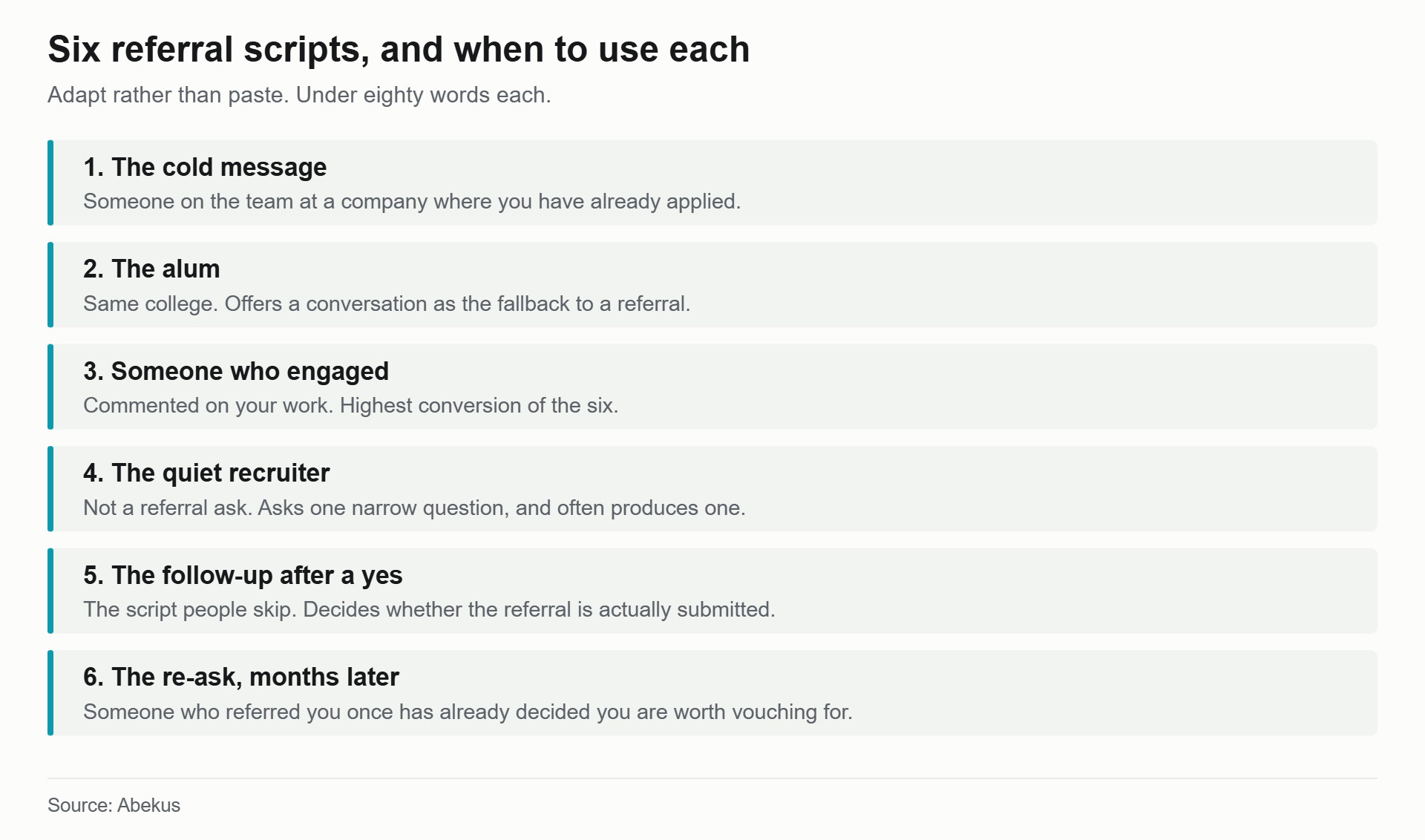
Adapt these rather than pasting them verbatim — a message that reads as a template gets treated as one. Keep them short. On LinkedIn especially, anything past about eighty words stops being read.
1. The cold LinkedIn message to someone at the company
Hi [Name] — I’m applying for the [role] opening on the [team] team at [company]. I’ve spent the last few months working on [one specific relevant thing], so the [specific part of the JD] part is exactly what I want to be doing. Would you be open to a referral? Happy to send my resume and a two-line summary you can forward, so it takes you a minute rather than ten.
What makes this work: it names the role, gives one concrete reason you are credible, and explicitly reduces their effort. The last sentence does more than the rest combined.
2. The alum
Hi [Name] — [college] alum here, [year] batch. I saw you’re at [company] on the [team] team. I’m targeting [role] roles and I’ve been building [thing] to get there. Would you be up for a quick referral, or if you’d rather not refer someone you don’t know, even ten minutes on what the team actually looks for would help a lot.
The second half is the important bit. Giving them an honourable way to decline the referral makes the yes more likely, and the conversation is often worth more anyway.
3. Someone who engaged with your work
Hi [Name] — thanks for the comment on my [post/project], that point about [their point] was useful and I ended up changing [thing] because of it. I noticed [company] is hiring for [role]. Would a referral be something you’d consider? No problem at all if not.
This is the highest-converting version, because a relationship already exists, however thin. If you are not posting anything publicly, this script is unavailable to you — which is an argument for posting.
4. The recruiter who went quiet
Hi [Name] — following up on the [role] application from [date]. I know volumes are high, so no expectation of a detailed reply. One question if you have a moment: was the gap on my side experience, or the specific [skill] requirement? Either answer helps me aim better.
Not a referral request, but it belongs here, because it is the message that most often produces one. Asking a narrow, answerable question rather than “any update?” gets a reply surprisingly often, and recruiters who cannot help you with one role sometimes route you to another.
5. The follow-up after a yes
Thanks [Name], really appreciate it. Here’s what you need — resume attached, role is [exact title, requisition ID if there is one], and two lines you can paste if the form asks why you’re referring me: “[Name] has been working on [specific thing] and has [specific evidence]. Relevant to the [X] part of this role.” Anything else you need from me, just say.
This is the script people skip, and it is the one that determines whether the referral actually gets submitted. Make the yes cost them ninety seconds.
6. The re-ask, months later
Hi [Name] — you kindly referred me for [role] at [company] back in [month]. That didn’t work out, but I wanted to say thanks, and to mention I’ve since [specific thing you did]. If anything opens up on your team I’d love another shot. Either way, glad to stay in touch.
Most people never send this and it is close to free. Someone who referred you once has already decided you are worth vouching for.
What to do when nobody replies
Assume a low reply rate and send more messages rather than better ones after a point. Ten well-targeted requests producing two replies is a normal, good outcome. If you send three and get nothing, that is not evidence of anything.
Space follow-ups by about a week and send exactly one. If there is still nothing, move on — a second follow-up converts almost never and costs you the option of asking again later.
One thing worth checking before you spend a week on referrals for a particular role: whether the role is real at all. A meaningful share of listings are never filled, and chasing referrals into a posting that was never open is a specific kind of wasted effort — it is worth running a two-minute check on the listing first.
The thing that actually makes strangers say yes
Underneath all six scripts is one mechanism: you are asking someone to take a small risk on you, and the way to make that easy is to be verifiable.
“I’m a hard worker and a quick learner” is a claim they cannot check, so referring you is a leap of faith. “I built this, here’s the link, here’s what it does” is checkable in thirty seconds, and referring you becomes a low-risk favour rather than a gamble. That is the entire difference, and it explains why the same message works for one person and not another.
Which means the real preparation for asking for a referral is not the wording. It is having one thing worth pointing at. If you do not have that yet, build it first — the messages will work far better a month later.
Where to find the right person to ask
All six scripts assume you have found somebody, which is the step most guides skip entirely. Finding the right person takes about five minutes per role once you know where to look.
Start with the team, not the company. Search LinkedIn for the company name plus the job title in the posting, then filter to people who are actually in that function. A referral from someone three departments away is worth much less, because the hiring manager will not know them either.
Use the alumni filter. On LinkedIn, your college page has an alumni view that lets you filter by where people work and what they do. This is the single most underused feature available to Indian students, and it turns a cold message into a warm one for free.
Prefer people two to five years ahead of you. They remember what it was like, they are senior enough to have a referral link, and they are not so senior that your message is one of forty that day. A vice president is a worse target than someone in their third year.
Look at who is already visible. People who post about their work, answer questions, speak at meetups or maintain open-source projects have already signalled that they are willing to engage with strangers. They reply at a much higher rate than someone whose profile has been dormant for two years.
Do not message the recruiter and a team member with the same text. They sometimes compare notes, and a message that is obviously duplicated undoes the specificity that made it work.
One person per company is enough. Messaging four people at the same employer reads as a scattergun and occasionally reaches the same inbox twice, which is worse than not asking at all.
Where referrals fit in the rest of the search
Referrals are a multiplier on applications you were going to make anyway, not a replacement for them. The sequence that works is: find the role, check it is real, apply through the company’s own careers page, then find one person on that team and send script one. That takes about fifteen minutes per role and converts at a completely different rate from firing applications into a portal.
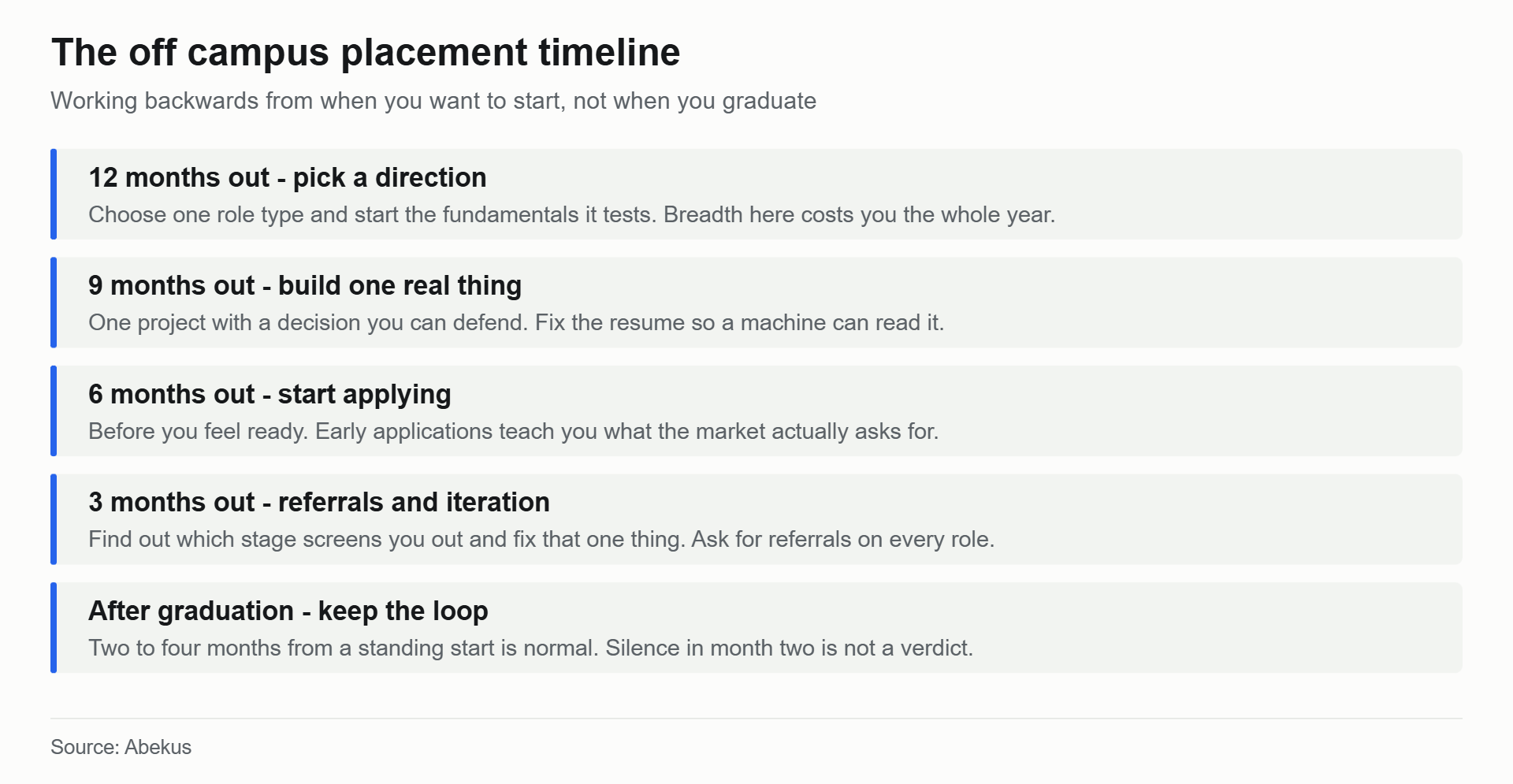
If you are doing this without a campus placement behind you, referrals matter more, not less — they are the closest thing to the access a campus drive would have given you. The rest of that process is covered in the off campus placement guide.
Frequently asked questions
How do you ask someone for a referral on LinkedIn?
Keep it under eighty words. Name the exact role and team, give one specific and checkable reason you are credible, then offer to send a resume and a two-line summary they can forward. Reducing their effort matters more than describing your background.
Is it rude to ask a stranger for a referral?
No, provided you make it easy to say no. Most people are willing to help if the request is specific and low effort. What reads as rude is a long message about yourself with a vague ask, or following up more than once when there has been no reply.
What should I send after someone agrees to refer me?
Everything they need in one message: your resume, the exact job title and requisition ID, and two lines they can paste into the referral form. Most referrals fail at this step, not at the ask, because a yes quietly turns into a chore and never gets submitted.
How many referral requests should I send?
Expect a low reply rate and plan for volume. Ten well-targeted requests producing two replies is a normal outcome. Three requests with no reply tells you nothing at all, so do not rewrite your approach on that basis.
Do referrals actually increase your chances of getting hired?
Substantially. SHRM reports referrals remain the top source of hires, and widely cited analyses put referred candidates well ahead of cold applicants. The main mechanism is simple: a referred application is read by a person, which no other channel guarantees.
Sources
- SHRM, Employee Referrals Remain Top Source for Hires. Accessed September 2026.
- Comparative conversion figures for referrals against other channels are widely cited across recruiting industry analyses; treat the specific ratios as indicative rather than precise.