
On this page
- The decision is made in week four, not week twelve
- What is actually being assessed in the first fortnight
- The two interns
- How to ask questions without becoming a cost
- Build the case your manager will have to make
- Ask in week eight
- If there is no offer at the end
- The short version
- Frequently asked questions
- Sources
Internships have quietly stopped being a summer activity and become one of the main ways Indian companies hire. Employers are strengthening internship-to-hire programmes precisely because a twelve-week trial tells them more than any interview can, which means the internship you are about to start is closer to an extended assessment than to a course.
That is good news if you understand how the decision gets made, and expensive if you assume it happens at the end. It mostly does not.
The decision is made in week four, not week twelve
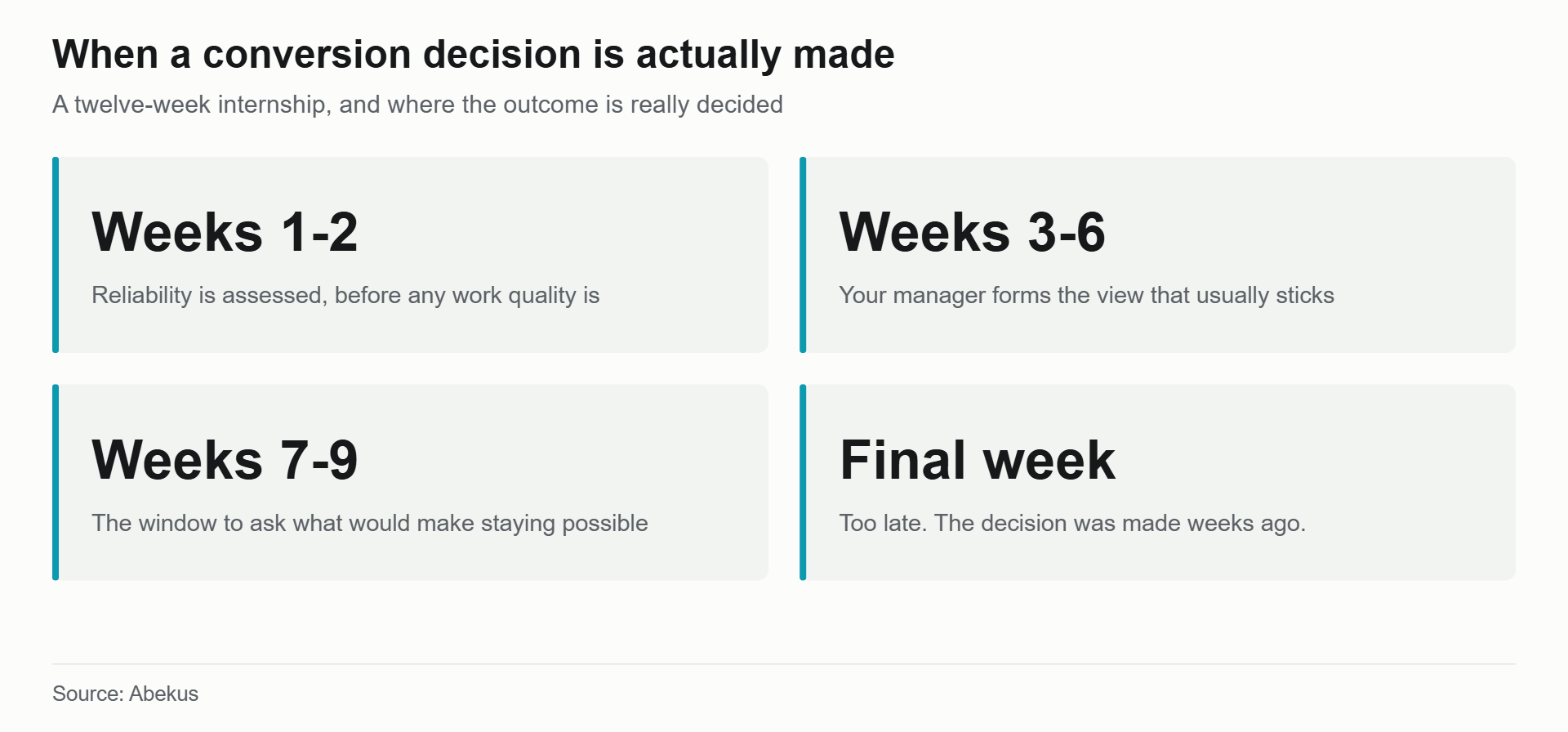
Managers form a view of an intern early and revise it slowly. By around week four or five most have decided, privately, whether you are someone they would keep. Everything after that is confirmation, and reversing an early impression takes considerably more than forming one.
This has an uncomfortable implication. The classic intern strategy — settle in quietly for a month, then push hard in the final stretch to be memorable — is almost exactly backwards. The quiet month is when the assessment happens, and the final push arrives after the conclusion.
So front-load. The first two weeks should be your most deliberate, not your most cautious.
What is actually being assessed in the first fortnight
Not your technical ability. Everyone assumes it is, and it almost never is, because your manager already saw enough of that to hire you for the internship.
What is being assessed is whether having you around makes their week easier or harder. Concretely: do you turn up when you said you would, do you say when you are stuck rather than disappearing for two days, do you need the same thing explained twice, and can you be given something without it coming back needing rework.
Those sound like low bars. They are, and a surprising share of interns do not clear them, which is exactly why clearing them puts you ahead early. The intern who is reliable in week two has already won most of what there is to win.
The two interns
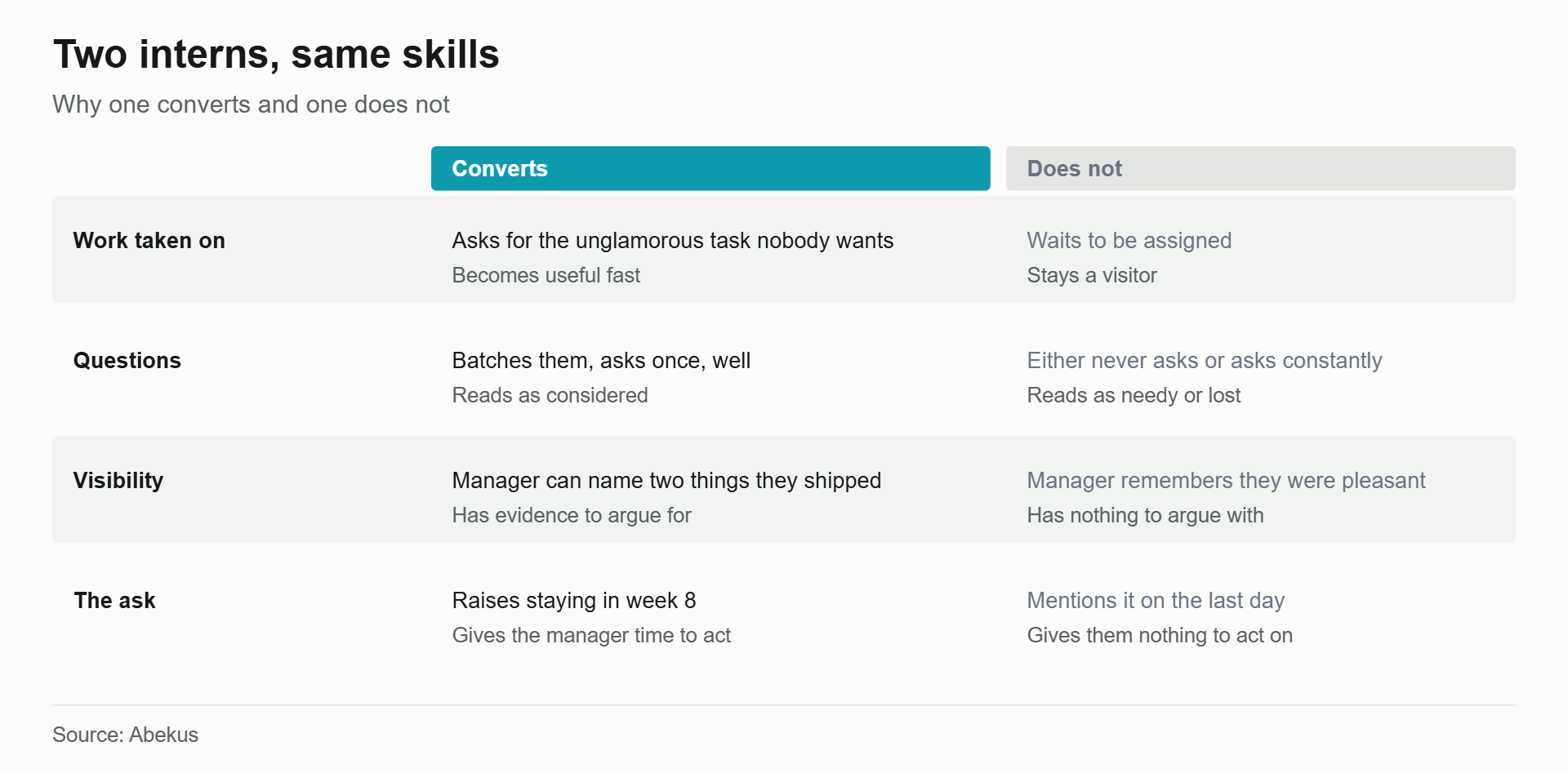
The row that decides most outcomes is the first one. Every team has work nobody wants: the documentation that is out of date, the flaky test, the spreadsheet somebody has to reconcile every month. It is unglamorous, it is genuinely useful, and volunteering for it converts you from a visitor into someone who reduces the team’s load.
It is also the fastest way to learn how the system actually works, because the boring jobs are where the real mechanics live.
How to ask questions without becoming a cost
Interns fail in two opposite directions. Some never ask, disappear for three days, and produce something wrong. Others ask continuously and become an interruption.
The version that works: batch your questions, try for twenty minutes first, and when you ask, show what you already tried. “I think it is X because of Y, but Z does not fit — am I looking at the wrong thing?” costs your manager ten seconds and makes you look like someone who thinks. “How do I do this?” costs them ten minutes and makes you look like a task.
Ask early rather than late, though. Being stuck for a day and saying so is fine. Being stuck for a day and hiding it is the thing that actually damages you.
Build the case your manager will have to make
A conversion is rarely your manager’s decision alone. They usually have to argue for a headcount to someone who has never met you, and what they need is two or three specific things they can point at.
So make sure those exist, and make sure they know about them. That means shipping something small and complete rather than being partway through something large when the internship ends. It means keeping a short weekly note of what you did, with numbers where they exist. And it means your manager having seen you handle one thing that went wrong, because “handled a problem sensibly” is the most persuasive item on that list.
Send a brief summary near the end — four or five lines on what you built, what it changed, and what you learned. Not for your ego. Because it is the document your manager will paraphrase when arguing for you, and writing it for them makes saying yes easier.
Ask in week eight
The single most common mistake is raising the subject on the last day, when there is nothing anyone can do.
Around two thirds of the way through, say plainly that you would like to stay and ask what would make that possible. That question does three things: it tells your manager you are interested, which they genuinely may not know; it surfaces the actual constraint, which might be headcount or a specific skill gap; and it leaves enough runway to act on the answer.
If the answer is that there is no headcount, that is not a rejection and it is useful information — ask whether they would be a reference and whether they know teams that are hiring. A manager who would have kept you is one of the strongest referrals available, which is worth knowing how to ask for properly.
If there is no offer at the end
Most internships do not convert, and the reasons are usually structural rather than personal. Headcount freezes, a team reorganising, a budget that closed in the quarter you happened to be there.
What you should leave with, regardless: a written reference or a LinkedIn recommendation while you are still fresh in their memory, the contact details of two or three colleagues, and a clear account of what you built with a number attached. That last one converts the internship into the thing it is actually worth — a concrete answer to what you have done, which is the question that decides most fresher applications.
Then keep the rest of the process running. An internship is evidence, not a plan, and the off campus route should be moving in parallel throughout rather than starting when the internship ends.
The short version
Be deliberate in the first fortnight rather than the last. Volunteer for the work nobody wants. Ask questions in batches, showing your working. Ship something small and complete. Keep a weekly note with numbers. Say you want to stay in week eight, not on the last day. And leave with a reference and two contacts whatever happens.
None of that is about being the most talented intern in the building. It is about being the one whose manager has something specific to argue with.
Frequently asked questions
What is a PPO and how do you get one?
A pre-placement offer is a full-time job offered on the strength of your internship rather than through a separate hiring round. Conversion usually turns on reliability, shipping something complete, and your manager having two or three specific things they can point to when arguing for headcount.
When is the internship conversion decision made?
Earlier than most interns expect. Managers typically form a view by around week four or five and revise it slowly. The final weeks mostly confirm a conclusion already reached, which is why the first fortnight deserves more deliberate effort than the last.
Should I ask my manager about a full-time role?
Yes, and around two thirds of the way through rather than on your last day. Say you would like to stay and ask what would make it possible. That surfaces the real constraint while there is still time to act on it, and many managers genuinely do not know you are interested.
What if my internship does not convert?
Most do not, usually for structural reasons like headcount freezes rather than anything about you. Leave with a written reference while you are fresh in memory, contact details for two or three colleagues, and a clear account of what you built with a number attached.
How do I stand out as an intern?
Volunteer for the unglamorous work nobody wants, because it is genuinely useful and teaches you how the system actually functions. Be reliable before you try to be impressive, batch your questions and show what you already tried, and ship something small and complete rather than something large and unfinished.
Sources
- Deloitte India, campus talent research 2026 — on employers strengthening internship-to-hire programmes as a primary funnel. Accessed September 2026.
- Conversion timing and behavioural patterns are Abekus analysis based on how entry-level hiring decisions are structured, not on survey data.