
Festive Season Jobs 2026: Which Ones Are Actually Worth Taking

On this page Why this festive season is different The new roles nobody is writing about How to tell a stepping stone from a dead end How to actually convert a seasonal contract What to check before you sign If you are a fresher using this as a bridge The short version Frequently asked questions Sources Somewhere between two and two and a half lakh festive season jobs are opening across India right now, and most advice about them amounts to a list of companies that are hiring. That is the least useful thing anyone can tell you, because the real question is not where the openings are. It is which of them leave you better off in February than you were in September. Some festive roles are genuinely a way in. Others are six weeks of exhausting work that ends exactly where it started. They pay similarly and the job ads look almost identical, which is precisely why the distinction is worth learning before you sign anything. The season is bigger than last year, and a fifth of it goes to freshers. Why this festive season is different Festive hiring in India is expected to rise 15 to 20% this year, generating between 200,000 and 250,000 seasonal and gig roles across e-commerce, quick commerce, retail, logistics, hospitality and consumer services. Two things about that number matter more than its size. The first is where it lands. Tier 2 and Tier 3 cities are expected to take 45 to 50% of festive hiring, with demand in those markets growing faster than in the metros. Jaipur, Lucknow, Indore, Surat, Nagpur, Bhubaneswar, Coimbatore, Chandigarh and Kochi are all named as growth markets. If you are not in a metro, this is the part of the year when that stops being a disadvantage. The second is that employers have changed how they hire for it. Rather than the old pattern of panicked, volume-driven recruitment two weeks before the peak, companies are now starting preparation twelve to fourteen weeks out with structured workforce planning. That sounds like a detail about them. It is actually a detail about you: structured hiring means assessments, defined roles and managers who are planning for what happens after the season, which is exactly the environment in which a seasonal contract can turn into something permanent. The new roles nobody is writing about Ask most people what a festive job is and they will say delivery or warehouse packing. Those are still the largest categories, and delivery and last-mile executives, warehouse associates, pickers and packers do see the strongest raw demand. But the interesting growth is in roles that did not really exist five years ago: dark-store inventory controllers, returns and refunds specialists, customer-resolution executives, marketplace operations, catalogue management, order management, and fraud and transaction support. These matter disproportionately for one reason. They are desk roles inside an operations team, which means you learn a system rather than a route. A returns specialist learns how reverse logistics actually works. A catalogue executive learns how a marketplace is structured. Someone in order management learns where a supply chain breaks and who fixes it. All of that is knowledge that transfers to a permanent job, and none of it is available to someone who spent the same six weeks moving boxes faster than anyone else. They are also less crowded, because most applicants do not know they exist. How to tell a stepping stone from a dead end The pay is similar. What happens afterwards is not. Four questions, answerable before you accept. Who employs you? If the contract is with the company itself, even on a fixed term, you are on their systems and their managers can convert you. If it is with a staffing agency or a per-task gig platform, conversion is possible but structurally much harder, because the company is buying capacity rather than hiring people. Will you learn a system or a speed? Roles that teach you a tool, a process or a piece of domain knowledge leave you with something. Roles that only measure how fast you move leave you with a line on a resume that every other applicant also has. Is there a named manager? Ask who you report to. If the answer is a specific person on a specific team, there is somebody who can recommend you in January. If the answer is a shift rota, there is not. Has this employer converted seasonal staff before? Just ask. “Do people from the festive intake sometimes stay on?” is a completely normal question, and the answer — including how comfortably it is answered — tells you a great deal. If three of the four answers are wrong, the role is a paycheque rather than a step, which is a perfectly reasonable thing to take. Just take it knowing what it is, and do not spend the six weeks expecting it to become something. How to actually convert a seasonal contract Conversion is rarely a decision someone makes about you at the end. It is a decision they make about three weeks in, and then confirm later. Be reliable before you are impressive. In seasonal operations the single scarcest quality is someone who turns up, on time, every scheduled day. Managers running a peak-season team spend most of their attention on absence. Being the person who never causes that problem puts you ahead of most of the intake by week two, without doing anything clever. Learn one thing nobody asked you to learn. The inventory system, the escalation path, why a particular category always has returns problems. Then say something useful about it. This is what moves you from a body on a shift to a person with a view. Write down what you did, weekly. Numbers if you have them: orders processed, resolution time, error rate. You will not remember them in January, and they are the difference between “I worked at a warehouse during Diwali” and a specific claim on your resume —
Six Weekend Projects That Get Freshers Hired (And Why Tutorials Don’t)
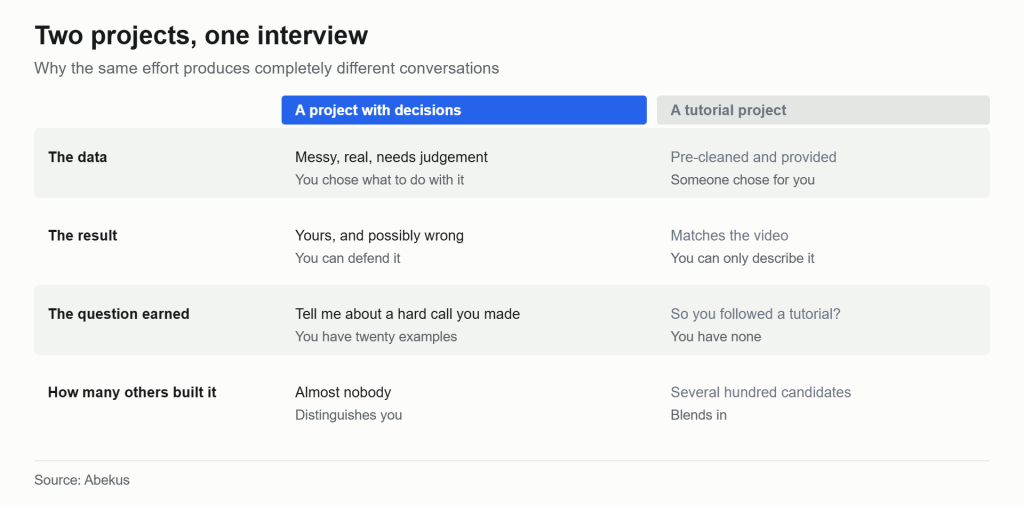
On this page What interviewers are actually testing 1. Clean somebody’s genuinely messy data 2. Try to reproduce a number from the news 3. A small tool that fixes your own annoyance 4. Automate something for an actual person 5. Break something on purpose and diagnose it 6. A one-page decision memo The rules that make any project work What to skip Where this fits Frequently asked questions Sources Every fresher is told to build a portfolio. Almost nobody is told what to build, which is why the same three tutorial projects appear on thousands of resumes: a to-do app, a movie recommender, and a Titanic survival model. Those are worse than having nothing. Not because they are badly built, but because an interviewer has seen them four hundred times and knows exactly which tutorial produced them. A project everyone has done cannot distinguish you, and it quietly signals that you followed instructions rather than made decisions. The useful way to choose portfolio projects for freshers is to work backwards from the interview. A project’s real job is to earn you a question you can answer better than anyone else in the queue. Here are six that do, each buildable in a weekend or two, and none of which has a tutorial. What interviewers are actually testing Junior interviews are not really checking whether you can write code. That gets tested in the online round. The conversation is checking three things that are much harder to fake: whether you can make a decision when the answer is not given, whether you notice when something is wrong, and whether you can explain either of those to someone who was not there. A tutorial project cannot demonstrate any of them, because every decision was made for you. That is the whole problem, and it is why the fix is not “build something more impressive” but “build something where you had to choose”. Same weekend, same effort, completely different interview. 1. Clean somebody’s genuinely messy data Build: find a real, ugly public dataset — India’s Open Government Data platform is full of them — and turn it into something usable. The deliverable is the clean file plus a documented list of every judgement call you made and why. What it proves: that you can act under ambiguity. Real data has duplicate rows that are not quite duplicates, dates in four formats, and categories that overlap. Every one of those is a decision with no correct answer. The question it earns: “Tell me about a time the data was wrong.” You will have twenty examples and a written record. Most candidates have nothing. 2. Try to reproduce a number from the news Build: take a statistic from a recent article — ideally one about your own city or state — find the underlying public data, and try to reproduce the figure. Write up what you got and where the gap came from. What it proves: analytical scepticism, which is rare and highly valued. You will usually not reproduce it exactly, and the explanation of why is the entire deliverable. Different date range, different denominator, a definition that shifted. The question it earns: “How do you know your analysis is right?” Almost nobody has a real answer to this. You will. This one is also the most interesting to talk about, which matters more in an interview than people admit. 3. A small tool that fixes your own annoyance Build: something you personally use every week. A script that renames your files sensibly, a tracker for something you keep in your head, a bot that tells you when a form opens. Small and finished, not ambitious and abandoned. What it proves: that you ship. Also that the project is genuinely yours — you can talk about it indefinitely because you use it, and interviewers can tell the difference between that and a rehearsed summary within about two questions. The question it earns: “What would you do differently?” You will have a real answer, because you have lived with your own design mistakes. 4. Automate something for an actual person Build: find someone who is not technical — a shopkeeper, a college society treasurer, a relative running a small business — and automate one thing they currently do by hand. What it proves: requirements gathering, which is the skill nobody practises and every employer needs. Your stakeholder will describe the problem wrongly the first time. Working out what they actually need is the job. The question it earns: “Tell me about working with a non-technical stakeholder.” For most freshers this question is fatal. For you it is the best story you have. This is the project I would build first if I could only build one. It is also the one with a real user, which means a real outcome you can state. 5. Break something on purpose and diagnose it Build: take a working open-source project, break it in three different ways, then document the symptom, how you tracked it down, and the fix. A wrong config, a bad dependency version, an off-by-one in a loop. What it proves: debugging, which is what junior engineers spend most of their time doing and which no course teaches. The question it earns: “Walk me through how you’d debug this.” You will describe a method rather than guessing, and the difference is immediately obvious to whoever is listening. 6. A one-page decision memo Build: not a dashboard. Pick a question with a real answer — should this shop stock more of X, which of these two routes is actually faster — and answer it in one page. A recommendation, the evidence, and one line on what would change your mind. What it proves: communication and judgement together, which is the scarcest pair in the market and the one AI is furthest from replacing. Dashboards show data. A memo takes a position. The question it earns: “How do you present findings to someone senior?” The honest answer for
How to Ask a Stranger for a Referral (Six Scripts That Get Replies)
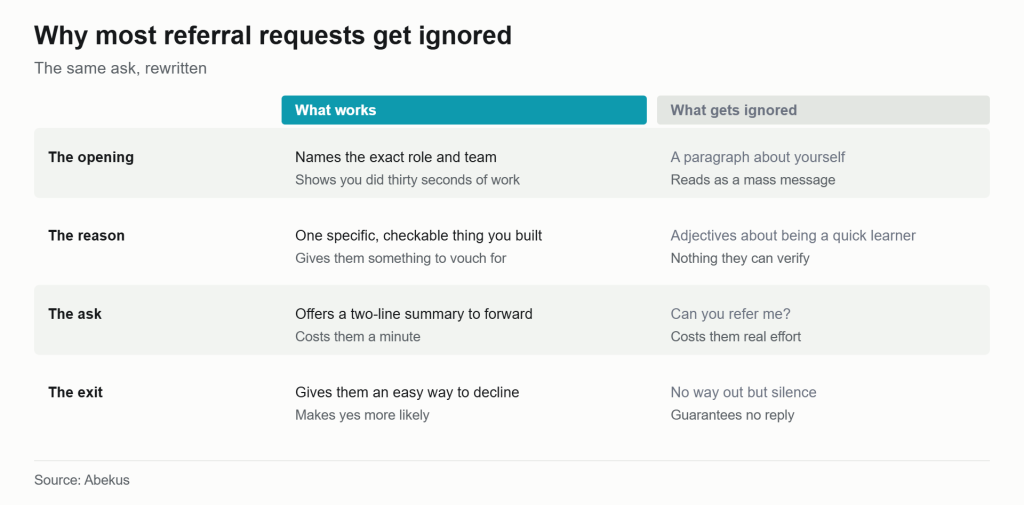
On this page Why most referral requests get ignored The six scripts What to do when nobody replies The thing that actually makes strangers say yes Where to find the right person to ask Where referrals fit in the rest of the search Frequently asked questions Sources Everyone job hunting in India has been told that referrals matter. Almost nobody has been told what to actually type, which is why most people either never ask or send something that gets ignored. The maths is worth understanding before you write anything. Referrals make up a small slice of total applications but a disproportionate share of actual hires — SHRM reports that referrals remain the top source of hires, and widely cited industry analyses put a referred candidate’s odds at several times those of someone applying cold. The reason is unglamorous: a referred application gets read by a human being. Nothing else in the process guarantees that. So the question of how to ask for a referral is not a soft-skills question. It is the highest-return twenty minutes in your week. Here is why most requests fail, and six messages you can adapt. Why most referral requests get ignored Three reasons, and they are all fixable. You asked for too much. “Can you refer me?” asks a stranger to attach their professional reputation to someone they have never spoken to. Most people will not do that, not because they are unkind but because a bad referral costs them something real. Ask for something smaller first and the referral often follows on its own. The message is about you. Most requests are a paragraph of the sender’s background followed by a request. Read from the other side, that is a stranger making work for you. The messages that get replies give the recipient something — a specific reason you contacted them rather than anyone else, and a version of the ask that takes them under a minute. You made them do the assembly. If someone agrees to refer you and then has to find your resume, work out which role you meant, and write a justification, you have converted a yes into a chore. The good version arrives pre-packaged. The same request, rewritten. The difference is entirely in how much work it makes for the reader. The six scripts Adapt these rather than pasting them verbatim — a message that reads as a template gets treated as one. Keep them short. On LinkedIn especially, anything past about eighty words stops being read. 1. The cold LinkedIn message to someone at the company Hi [Name] — I’m applying for the [role] opening on the [team] team at [company]. I’ve spent the last few months working on [one specific relevant thing], so the [specific part of the JD] part is exactly what I want to be doing. Would you be open to a referral? Happy to send my resume and a two-line summary you can forward, so it takes you a minute rather than ten. What makes this work: it names the role, gives one concrete reason you are credible, and explicitly reduces their effort. The last sentence does more than the rest combined. 2. The alum Hi [Name] — [college] alum here, [year] batch. I saw you’re at [company] on the [team] team. I’m targeting [role] roles and I’ve been building [thing] to get there. Would you be up for a quick referral, or if you’d rather not refer someone you don’t know, even ten minutes on what the team actually looks for would help a lot. The second half is the important bit. Giving them an honourable way to decline the referral makes the yes more likely, and the conversation is often worth more anyway. 3. Someone who engaged with your work Hi [Name] — thanks for the comment on my [post/project], that point about [their point] was useful and I ended up changing [thing] because of it. I noticed [company] is hiring for [role]. Would a referral be something you’d consider? No problem at all if not. This is the highest-converting version, because a relationship already exists, however thin. If you are not posting anything publicly, this script is unavailable to you — which is an argument for posting. 4. The recruiter who went quiet Hi [Name] — following up on the [role] application from [date]. I know volumes are high, so no expectation of a detailed reply. One question if you have a moment: was the gap on my side experience, or the specific [skill] requirement? Either answer helps me aim better. Not a referral request, but it belongs here, because it is the message that most often produces one. Asking a narrow, answerable question rather than “any update?” gets a reply surprisingly often, and recruiters who cannot help you with one role sometimes route you to another. 5. The follow-up after a yes Thanks [Name], really appreciate it. Here’s what you need — resume attached, role is [exact title, requisition ID if there is one], and two lines you can paste if the form asks why you’re referring me: “[Name] has been working on [specific thing] and has [specific evidence]. Relevant to the [X] part of this role.” Anything else you need from me, just say. This is the script people skip, and it is the one that determines whether the referral actually gets submitted. Make the yes cost them ninety seconds. 6. The re-ask, months later Hi [Name] — you kindly referred me for [role] at [company] back in [month]. That didn’t work out, but I wanted to say thanks, and to mention I’ve since [specific thing you did]. If anything opens up on your team I’d love another shot. Either way, glad to stay in touch. Most people never send this and it is close to free. Someone who referred you once has already decided you are worth vouching for. Six situations, six messages. Most people only ever try the first one. What to do when nobody
Off-Campus Placement Is Now the Main Route, Not the Backup Plan
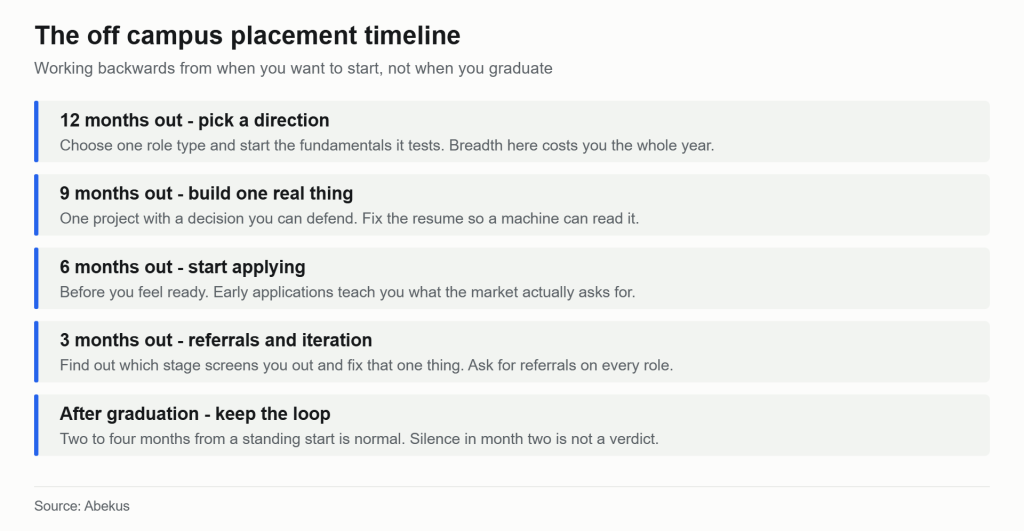
On this page Why off campus is the main route now, not the fallback The off campus placement timeline What to have ready before you apply anywhere Where off campus jobs actually come from The months where nothing happens A realistic set of expectations Frequently asked questions Sources Most Indian students still treat off campus placement as the consolation prize — the thing you fall back on when the campus drive does not work out. That framing is now wrong, and it costs people months. The reality is that only a minority of graduates get hired through a campus drive that actually suits them. Some colleges get almost no serious recruiters. Many drives are for a single service company with one role and a bond. Plenty of good students clear nothing simply because three companies visited and all three wanted something else. If any of that describes your situation, off campus is not your backup plan. It is your plan. The good news is that the market is on your side more than it has been in years. Fresher hiring in India grew 16% year on year according to Naukri’s JobSpeak data, with the growth spread across metro and non-metro cities rather than concentrated in Bengaluru. A TeamLease EdTech survey of 1,051 employers put fresher hiring intent at 73% for the first half of 2026. The market you are applying into is growing. That is not the hard part. The bad news is that almost all off campus advice is a list of job portals, which is the least useful part of the process. What actually decides the outcome is timing and preparation. Here is the sequence that works. Why off campus is the main route now, not the fallback Three things changed at once. Companies that used to run large campus drives increasingly hire in smaller, rolling batches through the year, because they would rather hire twenty people they have assessed properly than two hundred they have not. Global Capability Centres, which are now the largest engine of white-collar hiring in India, mostly do not run traditional campus drives at all — they recruit continuously and they screen on demonstrated skill. And the assessment itself moved online. Once the first round is a test rather than a room, there is no logistical reason to restrict it to students at a particular college. That is genuinely good for you if your college is not on anyone’s preferred list, and it is the single biggest structural shift in Indian fresher hiring in a decade. What follows from that is a different kind of preparation. Campus placement rewards being available on the day the company visits. Off campus rewards being ready before you apply, because there is no queue to stand in and no second chance next semester — the application either clears the screen or it does not. The off campus placement timeline The most common mistake is starting too late. People begin applying in their final semester, when the roles they want closed their intake months earlier. Work backwards from when you want to start working, not from when you graduate. Starting at six months out is late. Starting at twelve is not early. What to have ready before you apply anywhere Four things. Not a long list, but each one is a gate, and applying without them wastes the application. A resume a machine can read. Single column, standard headings, no tables, no graphics, no photo. Skills named exactly as job descriptions name them — write SQL, not “database querying”. Save as PDF unless the form says otherwise. This is not about beating an applicant tracking system, which does not auto-reject people the way the internet claims; it is about a human recruiter finding what they need in six seconds. One thing you built that you can talk about for ten minutes. Not three half-finished tutorials. One project with a real input, a real output, and at least one decision you had to make and can defend. This is what separates you from the identical resumes around you, and it is the thing interviewers actually probe. A LinkedIn profile that matches your resume. Recruiters check. A mismatch in dates or titles reads as carelessness at best. Fill the headline with what you do rather than “aspiring software engineer seeking opportunities”, which tells a recruiter nothing and appears on tens of thousands of profiles. Evidence a stranger can verify in one click. A score, a ranked result, a repository, a live link. Anything that answers the question “is this claim true” without the recruiter having to take your word for it. In a market where a large share of applications are AI-assisted, this is the part that is genuinely scarce. Where off campus jobs actually come from Not all channels are equal, and most people spend their time on the worst one. Ranked roughly by how often effort turns into an interview: Referrals. A referred application is read by a person, which no other channel guarantees. Widely cited industry analyses put referrals at a small share of applications but a large share of hires. This is the highest-return activity available to you and almost nobody does it properly. Company careers pages, applied to early. Roles get the most attention in their first 72 hours. A posting you find on day one is a different proposition from the same posting on day thirty. Hiring challenges and coding competitions. Several companies hire directly off results. The pool is smaller and self-selecting, and performance is the application, which removes the resume screen entirely. Off campus drives run by companies directly. Announced on their careers pages and LinkedIn, often with a fixed test window. Set alerts rather than checking manually. Job boards. Useful for discovery, poor for conversion, because everyone else is there too. Use them to find out a role exists, then apply through the company’s own site and look for a referral. The general principle: the more a channel filters on