
On this page
Somewhere between two and two and a half lakh festive season jobs are opening across India right now, and most advice about them amounts to a list of companies that are hiring. That is the least useful thing anyone can tell you, because the real question is not where the openings are. It is which of them leave you better off in February than you were in September.
Some festive roles are genuinely a way in. Others are six weeks of exhausting work that ends exactly where it started. They pay similarly and the job ads look almost identical, which is precisely why the distinction is worth learning before you sign anything.
Why this festive season is different
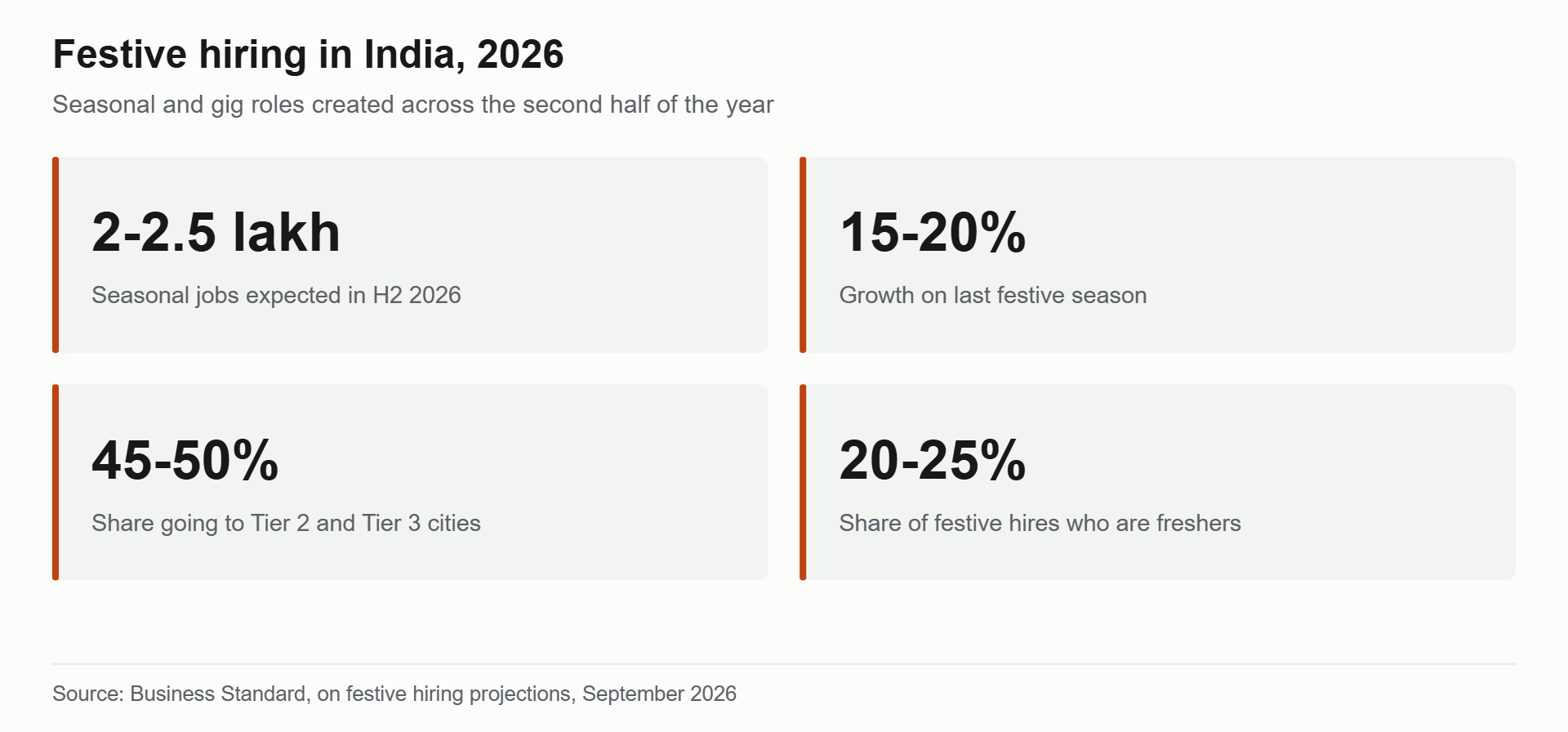
Festive hiring in India is expected to rise 15 to 20% this year, generating between 200,000 and 250,000 seasonal and gig roles across e-commerce, quick commerce, retail, logistics, hospitality and consumer services.
Two things about that number matter more than its size.
The first is where it lands. Tier 2 and Tier 3 cities are expected to take 45 to 50% of festive hiring, with demand in those markets growing faster than in the metros. Jaipur, Lucknow, Indore, Surat, Nagpur, Bhubaneswar, Coimbatore, Chandigarh and Kochi are all named as growth markets. If you are not in a metro, this is the part of the year when that stops being a disadvantage.
The second is that employers have changed how they hire for it. Rather than the old pattern of panicked, volume-driven recruitment two weeks before the peak, companies are now starting preparation twelve to fourteen weeks out with structured workforce planning. That sounds like a detail about them. It is actually a detail about you: structured hiring means assessments, defined roles and managers who are planning for what happens after the season, which is exactly the environment in which a seasonal contract can turn into something permanent.
The new roles nobody is writing about
Ask most people what a festive job is and they will say delivery or warehouse packing. Those are still the largest categories, and delivery and last-mile executives, warehouse associates, pickers and packers do see the strongest raw demand.
But the interesting growth is in roles that did not really exist five years ago: dark-store inventory controllers, returns and refunds specialists, customer-resolution executives, marketplace operations, catalogue management, order management, and fraud and transaction support.
These matter disproportionately for one reason. They are desk roles inside an operations team, which means you learn a system rather than a route. A returns specialist learns how reverse logistics actually works. A catalogue executive learns how a marketplace is structured. Someone in order management learns where a supply chain breaks and who fixes it. All of that is knowledge that transfers to a permanent job, and none of it is available to someone who spent the same six weeks moving boxes faster than anyone else.
They are also less crowded, because most applicants do not know they exist.
How to tell a stepping stone from a dead end
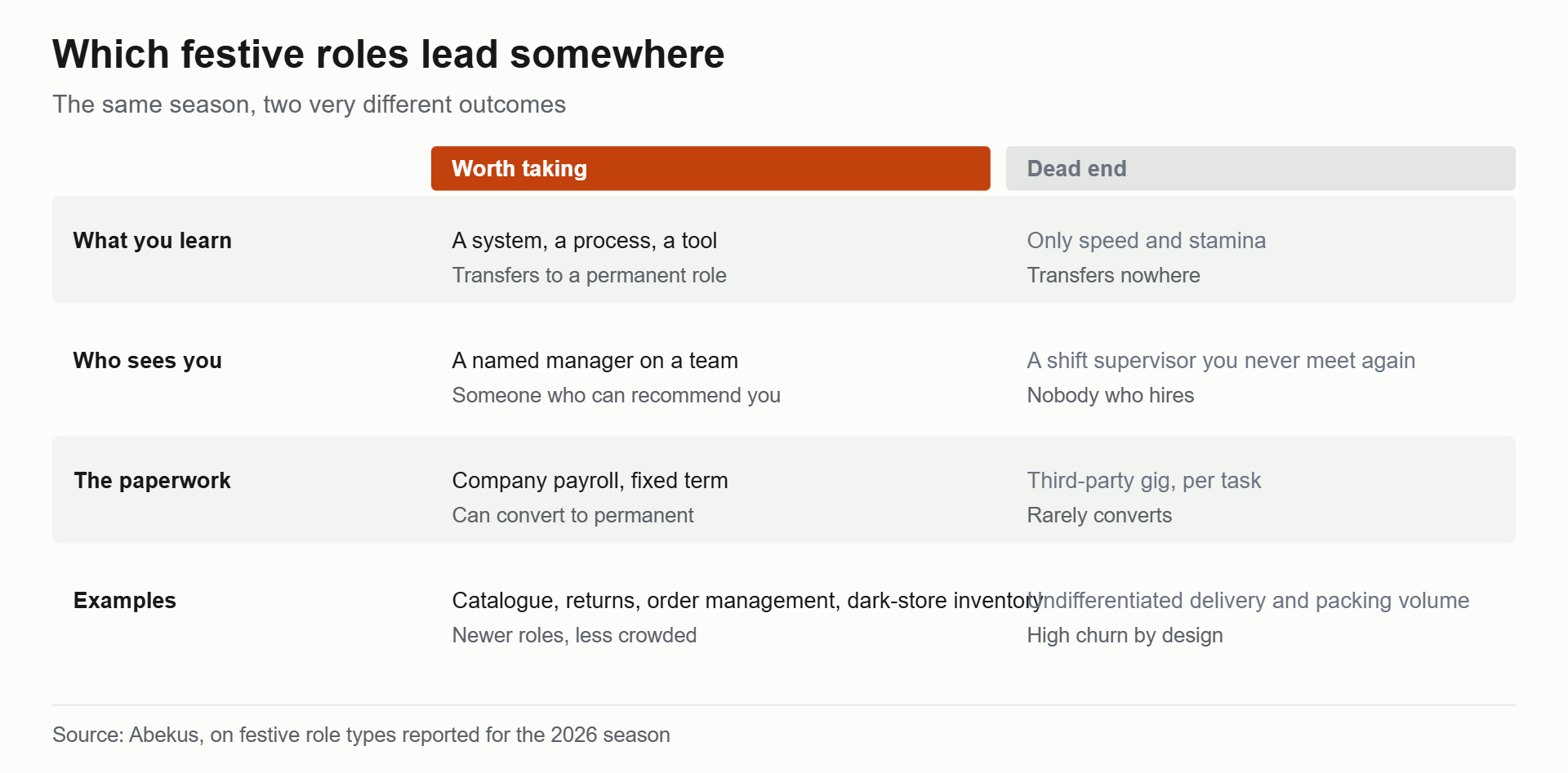
Four questions, answerable before you accept.
Who employs you? If the contract is with the company itself, even on a fixed term, you are on their systems and their managers can convert you. If it is with a staffing agency or a per-task gig platform, conversion is possible but structurally much harder, because the company is buying capacity rather than hiring people.
Will you learn a system or a speed? Roles that teach you a tool, a process or a piece of domain knowledge leave you with something. Roles that only measure how fast you move leave you with a line on a resume that every other applicant also has.
Is there a named manager? Ask who you report to. If the answer is a specific person on a specific team, there is somebody who can recommend you in January. If the answer is a shift rota, there is not.
Has this employer converted seasonal staff before? Just ask. “Do people from the festive intake sometimes stay on?” is a completely normal question, and the answer — including how comfortably it is answered — tells you a great deal.
If three of the four answers are wrong, the role is a paycheque rather than a step, which is a perfectly reasonable thing to take. Just take it knowing what it is, and do not spend the six weeks expecting it to become something.
How to actually convert a seasonal contract
Conversion is rarely a decision someone makes about you at the end. It is a decision they make about three weeks in, and then confirm later.
Be reliable before you are impressive. In seasonal operations the single scarcest quality is someone who turns up, on time, every scheduled day. Managers running a peak-season team spend most of their attention on absence. Being the person who never causes that problem puts you ahead of most of the intake by week two, without doing anything clever.
Learn one thing nobody asked you to learn. The inventory system, the escalation path, why a particular category always has returns problems. Then say something useful about it. This is what moves you from a body on a shift to a person with a view.
Write down what you did, weekly. Numbers if you have them: orders processed, resolution time, error rate. You will not remember them in January, and they are the difference between “I worked at a warehouse during Diwali” and a specific claim on your resume — the kind of concrete outcome that actually moves a first offer.
Ask, explicitly, before the season ends. Not on the last day. Around two thirds of the way through, tell your manager you would like to stay and ask what would make that possible. Most seasonal workers never say this, so most managers assume everyone is leaving.
Stay reachable afterwards. Connect with your manager and two colleagues before you finish. Conversions often happen six weeks later when someone resigns, and they go to whoever is easiest to contact.
What to check before you sign
Seasonal contracts are where a lot of first-time workers get caught out, and the problems are predictable.
Confirm whether pay is fixed, per-task or per-delivery, and if variable, what a realistic day actually earns rather than the headline. Check whether the shift includes travel time. Establish who pays for fuel, phone data or equipment if the role needs them. Find out the actual end date and whether there is any notice on either side. And confirm whether you are on payroll with statutory deductions or engaged as a contractor, because that changes your take-home and your paperwork.
None of this is unusual to ask. An employer who is annoyed by the questions has told you something useful for free.
If you are a fresher using this as a bridge
Freshers are expected to make up 20 to 25% of festive hires this year, which is a lot of people in the same position as you: needing something on the resume, needing money, and worried that six weeks of seasonal work is a detour.
It is only a detour if you let it be one. A festive stint is a real answer to the hardest question a fresher faces — what have you actually done — provided you can say what you learned and point to a number. It also runs alongside the rest of your search rather than replacing it, and the season conveniently ends just as the January hiring cycle begins.
What it should not do is absorb the whole of your attention. Keep applying through it, keep the off campus process running in parallel, and treat the seasonal role as evidence you are accumulating rather than as the plan itself.
The short version
Take the role that puts you on a company’s payroll, under a named manager, learning a system. Prefer the newer operations roles over the obvious ones, because they teach more and fewer people apply. Ask about conversion two thirds of the way through rather than at the end. And write down your numbers while you still remember them.
Two and a half lakh people will work a festive job this season. A much smaller number will still be working there in March, and the difference is mostly decided in the first three weeks.
Frequently asked questions
What are festive season jobs in India?
Festive season jobs are temporary roles created to handle the demand spike around Diwali and the surrounding months, mainly in e-commerce, quick commerce, retail, logistics and hospitality. India is expected to add between 200,000 and 250,000 of them in the second half of 2026, up 15 to 20% on last year.
Do festive season jobs become permanent?
Some do. Conversion is far more likely if you are on the company payroll rather than a staffing agency, report to a named manager, and work in an operations role that teaches you a system. Ask explicitly about two thirds of the way through the season rather than on your last day.
Which festive jobs pay best for freshers?
Pay is broadly similar across seasonal roles, so the better question is which leave you employable afterwards. Desk-based operations roles such as catalogue management, returns handling, order management and dark-store inventory teach transferable knowledge that delivery and packing roles generally do not.
Are festive jobs available outside metro cities?
Increasingly yes. Tier 2 and Tier 3 cities are expected to take 45 to 50% of festive hiring this season, with faster growth than the metros. Jaipur, Lucknow, Indore, Surat, Nagpur, Bhubaneswar, Coimbatore, Chandigarh and Kochi are all named as growth markets.
Is a festive job worth putting on a resume?
Yes, if you can say what you learned and attach a number such as orders processed or resolution time. A seasonal role answers the hardest question a fresher faces, which is what you have actually done. Recorded vaguely, it adds little; recorded specifically, it is real evidence.
Sources
- Business Standard, Festive season likely to generate 200,000-250,000 jobs in H2 2026 — volumes, growth rate, Tier 2 and 3 share, fresher share. Accessed September 2026.
- Business Standard, Festive season hiring: 5 job roles likely to see strongest demand — role types and emerging operations roles. Accessed September 2026.