
On this page
- The numbers behind the half-life of skills
- Why “just get a degree” stopped being the answer
- What “continuous upskilling” actually looks like
- Which skills actually expire, and which do not
- A 90-day routine for keeping one skill current
- Frequently asked questions
- Turning the half-life problem into an advantage
- Sources
Here’s an uncomfortable thought to start your morning with: the professional skills you’re most proud of right now have a shorter shelf life than a carton of milk left on the counter. Not a metaphor for “someday.” A shelf life measured in months.
The half-life of skills is now short enough that it has quietly become a career planning problem rather than a training-department one, and most people are still treating it as somebody else’s job.
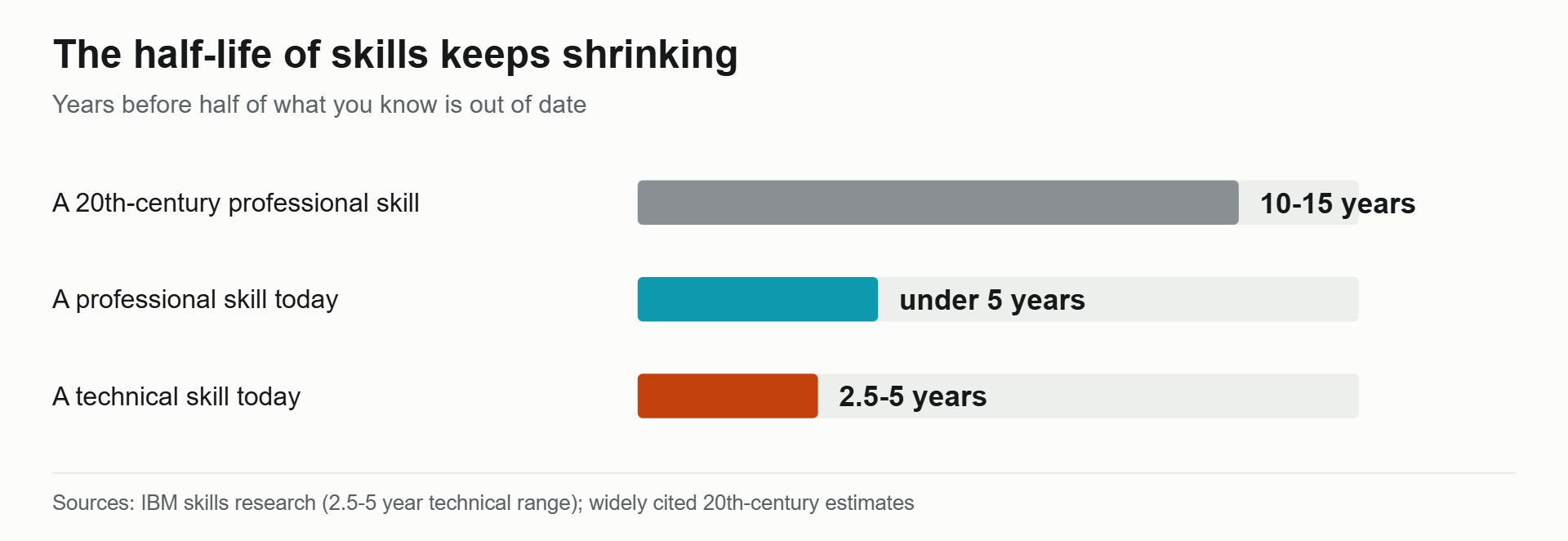
For most of the 20th century, a skill you learned in your twenties could quietly carry you into your fifties. Estimates put the “half-life” of a professional skill—the time it takes for half of what you know to become obsolete—at somewhere between 10 and 15 years. Today that window has collapsed to under five years, and IBM’s research puts technical skills in a band of 2.5 to 5 years, with fast-moving tools and frameworks at the short end. In other words, a good deal of what a software engineer, data analyst, or marketer knows today will be outdated well before the decade is out.
That’s not a reason to panic. But it is a reason to fundamentally rethink how you treat your own career—because the people who thrive in 2026 aren’t the ones who learned the most in college. They’re the ones who never stopped.
The numbers behind the half-life of skills
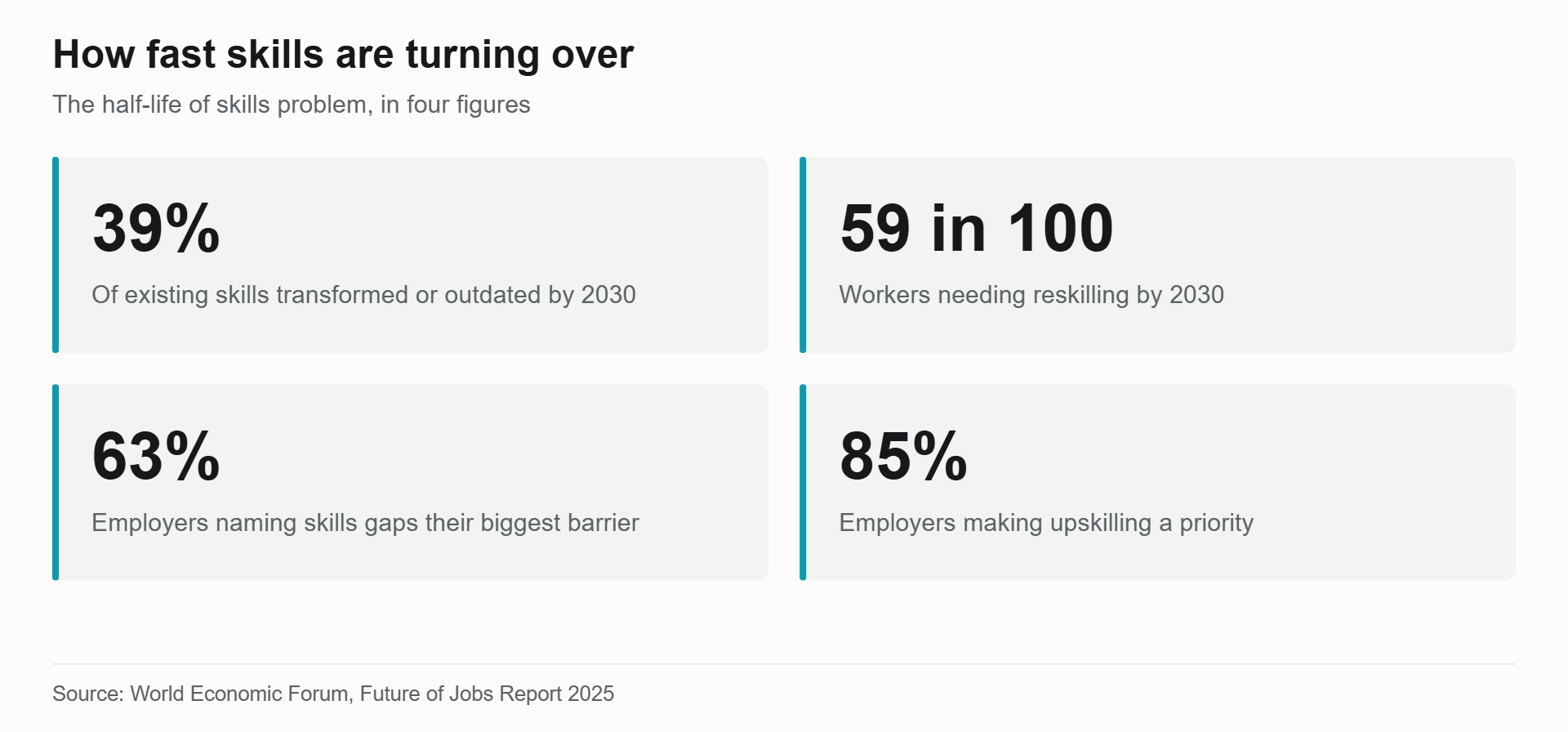
This isn’t doom-scrolling territory; it’s what the biggest workforce studies of the year are actually reporting. The World Economic Forum’s Future of Jobs Report 2025 found that workers can expect 39% of their existing skill sets to be transformed or become outdated between 2025 and 2030. That’s nearly two out of every five things you know professionally—gone or rewritten inside five years.
The same report estimates that 59 out of every 100 workers will need reskilling or upskilling by 2030, yet 11 of them are unlikely to get the training they need. Employers feel the squeeze too: 63% of them name skills gaps as the single biggest barrier to transforming their business over the next five years—ahead of regulation, capital, or infrastructure. It’s why 85% of employers now say upskilling their workforce is a top priority.
In India, the pressure is even sharper. Talent shortages have climbed to 82% of employers in 2026, against 72% globally, with AI model development and AI literacy topping the list of hardest-to-find skills. Industry analyses have repeatedly warned of a shortfall of AI-capable professionals in India unless reskilling accelerates. The confidence gap is the telling part: relatively few Indian organisations believe their workforce is genuinely ready to use AI well, even as the large majority of employees are already using generative AI tools at work.
Read those together and a strange picture emerges. Demand for skills is exploding. Confidence in existing skills is falling. The gap between the two is where careers are quietly being made or lost.
Why “just get a degree” stopped being the answer
For decades, the career formula was linear: earn a credential, get hired, coast on that credential. The credential was the proof, and the proof lasted. That model assumed skills aged slowly. They no longer do.
A degree still opens doors, but it increasingly describes what you knew on graduation day—a snapshot with a timestamp that keeps getting older. Employers have noticed. This is exactly why skills-based hiring has surged: companies are learning to hire for what you can do today rather than what a certificate said you could do three years ago. The India Skills Report 2026 pegged overall employability at around 56%, meaning nearly half of job-seekers still don’t demonstrate the skills employers actually want—despite most of them holding degrees.
The lesson isn’t that education is worthless. It’s that a one-time education, treated as a finish line, is a liability in a world where knowledge has a 2.5-year half-life. The finish line has to become a habit.
What “continuous upskilling” actually looks like
The phrase “continuous learning” gets thrown around until it means nothing. So let’s make it concrete. Upskilling that actually protects your career in 2026 tends to share a few traits, and you can start most of them this week:
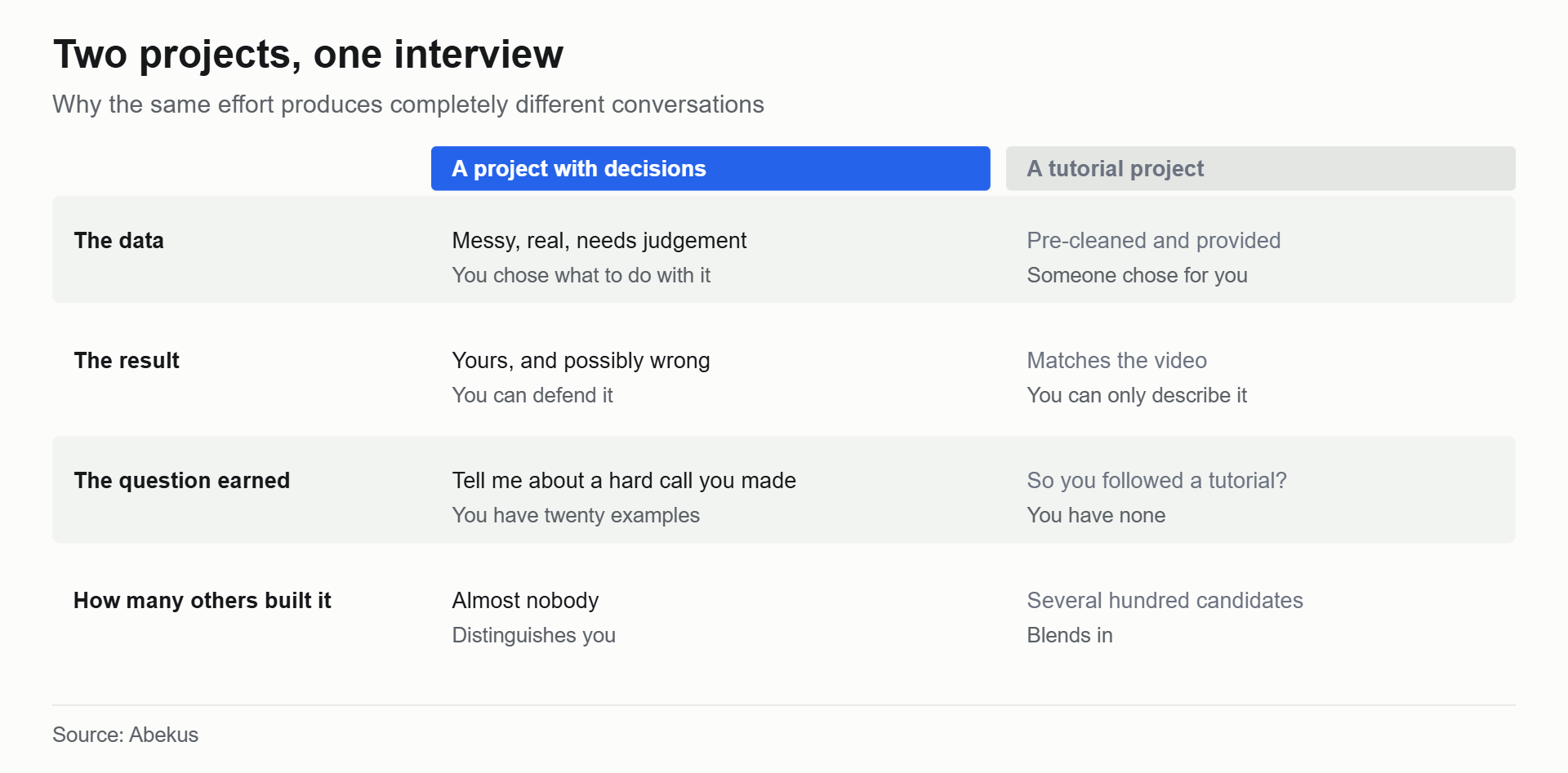
- Practice over passive consumption. Watching tutorials feels productive but fades fast. Skills stick when you actually build, solve, and apply—repeatedly. Aim for hands-on reps, not hours of video.
- Short, frequent cycles beat annual crash courses. Because skills decay continuously, learning has to be continuous too. Thirty focused minutes a few times a week compounds far more reliably than a once-a-year bootcamp.
- Layer AI literacy onto your core craft. You don’t need to become a machine-learning engineer. But being the marketer, accountant, or recruiter who uses AI fluently is now a genuine differentiator—and one of the fastest-appreciating skills on the market.
- Prove it, don’t just claim it. Anyone can list “proficient in X” on a résumé. Far fewer can show verified evidence. In a skills-based hiring world, demonstrable proof beats self-reported confidence every time.
- Track the decay. Revisit skills you learned even a year ago. Tools, frameworks, and best practices shift; a quick refresh keeps yesterday’s strength from becoming today’s blind spot.
That last point about proof deserves attention, because it’s where most people fall short. The market is flooded with people who say they have skills. What’s scarce—and therefore valuable—is verified, current evidence that you actually do.
Which skills actually expire, and which do not
The half-life figure is an average, and averages hide the useful part. Not everything you know decays at the same rate, and knowing which of your skills are perishable is what turns a scary statistic into a plan.
Fastest to expire is anything tied to a specific tool or version. The syntax of a framework, the layout of a particular dashboard, the quirks of one vendor’s API: these can go stale in a year, sometimes less, and they are also the easiest to relearn. Losing them feels alarming but costs little, because the second time you learn a tool of that kind you are really just remapping something you already understand.
Slower to expire is domain knowledge. How lending decisions actually get made, why a particular kind of user churns, what breaks in a supply chain under stress. This ages over years rather than months, and it compounds, which is why people who stay in one industry often out-earn better technologists who keep switching.
Slowest of all are the fundamentals and the human skills. How to break a vague problem into testable pieces. How to tell a real signal from noise. How to explain a trade-off to someone who does not share your assumptions. These barely decay at all, which is precisely why the market has started paying more for them.
The practical consequence is a rule for where to spend your learning time. Tool knowledge should be acquired just in time, when a project needs it, and not stockpiled. Domain knowledge is worth deliberate reading, because it is the part your competitors skip. Fundamentals deserve genuine study, because they are the only thing you learn once and keep.
Most people invert this. They collect tool certificates, which is the fastest-decaying asset available, and neglect the two categories that hold value. If you audit your last year of learning and find it was mostly tool names, that is the single highest-leverage thing to change.
A 90-day routine for keeping one skill current
Continuous learning fails for most people because it is framed as a permanent obligation with no finish line. A bounded cycle works better. Here is one that fits around a job.
Weeks 1 to 2: find the gap, honestly. Pick one skill your next role actually requires and test yourself on it before studying anything. Take a graded assessment or attempt a real problem cold. The point is a baseline you did not choose flatteringly, because the gap you imagine is rarely the gap you have.
Weeks 3 to 8: reps, not lectures. Three sessions a week of roughly forty minutes, spent building or solving rather than watching. The ratio that matters is time spent producing versus time spent consuming, and it should be at least two to one. If you finish a week with nothing you made or solved, that week did not count.
Weeks 9 to 10: build one thing end to end. Small and complete beats large and abandoned. Something with a real input, a real output and a decision you had to make. This is what becomes the evidence later, so keep notes on what broke and what you changed — that record is more useful in an interview than the finished artefact.
Weeks 11 to 12: prove it and write it down. Re-test against your week-one baseline so the improvement is measurable, then write four or five sentences on what you built, the trade-off you made, and the result. That paragraph goes on your resume and into your answer when someone asks what you have been working on.
Then stop, and pick the next skill. Two of these cycles a year keeps you ahead of a five-year half-life comfortably, and it is a far more sustainable proposition than a vague commitment to learn continuously forever. The people who stay current are not studying constantly. They are running short, finished cycles on purpose.
Frequently asked questions
What is the half-life of a skill?
The half-life of a skill is the time it takes for half of what you know to become obsolete. For most of the twentieth century this was estimated at 10 to 15 years for a professional skill. Today it is under five years, and shorter still for anything tied to a specific tool.
How long do technical skills last?
IBM research places technical skills in a 2.5 to 5 year band, with the fastest-moving tools and frameworks at the short end and broader engineering fundamentals at the long end. Version-specific knowledge can go stale within a year, though it is also the quickest to relearn.
Which skills do not expire?
Fundamentals and human skills barely decay: breaking a vague problem into testable pieces, telling signal from noise, and explaining a trade-off to someone who does not share your assumptions. Domain knowledge about how an industry actually works ages over years rather than months, and it compounds.
How often should you upskill?
Little and often beats an annual crash course, because skills decay continuously. A workable pattern is two focused 90-day cycles a year on one skill each, with three sessions a week spent building rather than watching. That comfortably outpaces a five-year half-life.
Is a degree still useful if skills expire so fast?
Yes, for the parts that do not expire. A degree teaches fundamentals and how to learn, which hold their value. What it cannot do is prove what you can do today, which is why employers increasingly want current evidence alongside the credential rather than instead of it.
Turning the half-life problem into an advantage
Here’s the reframe worth holding onto: a collapsing skills half-life is terrifying if you’re standing still, but it’s an enormous opportunity if you’re moving. When 39% of skills expire every five years, the person who keeps refreshing theirs doesn’t just stay employable—they leapfrog peers who are coasting on aging credentials. Scarcity of skilled people is your leverage, not your threat.
This is precisely the gap Abekus is built to close. Our practice-based skill courses are designed around doing rather than watching—short, active cycles that keep your abilities current instead of letting them quietly expire. And when you want to turn effort into proof, Abekus skill competitions let you benchmark yourself against real peers and walk away with verified results and certificates you can put in front of employers—exactly the kind of current, demonstrable evidence that skills-based hiring rewards.
The half-life of skills isn’t going to slow down. Automation, AI, and shifting business needs will keep rewriting the rulebook faster than any single degree can keep up. But that’s not a reason to feel behind. It’s an invitation to build the one meta-skill that never expires: the habit of getting better, on purpose, over and over again.
Milk goes bad whether or not you pay attention. Your skills only go bad if you stop refreshing them. This week, pick one skill that matters to your next role and put in the reps.
Ready to stop letting your skills expire? Start building—and proving—what you know at Abekus Skill Builder.
Sources
- World Economic Forum, Future of Jobs Report 2025 — skills transformation, reskilling need and employer priorities to 2030. Accessed September 2026.
- ManpowerGroup, Global Talent Shortage Survey, India report 2026 — 82% of Indian employers reporting difficulty filling roles. Accessed September 2026.
- IBM skills research — the 2.5 to 5 year band for technical and HR skills. Accessed September 2026.