

SnapQuiz


Scroll to Top
 Ashutosh Kumar J.
 SriHarshaReddy T.
 GOVINDA R.
This challenge cuts through the "I've watched the tutorials" crowd.
Forty questions probe what you actually retained — data structures, functions, control flow, strings, and the Pythonic idioms that separate copy-paste from real fluency. Every answer comes with an instant explanation, so you leave the round knowing exactly which parts of the language you have locked in and which still trip you up. Climb the live leaderboard as you play, and find out where your Python really stands the moment you submit.

 2,500
2,500 1,000
1,000 50010050
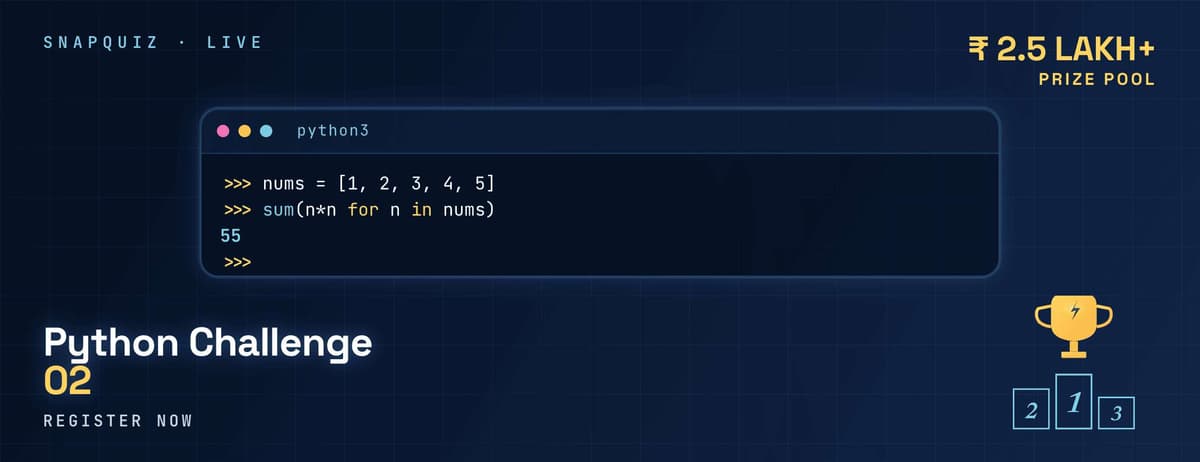
Python Challenge 2 cuts through the "I've watched the tutorials" crowd. Plenty of people can follow along with a video and feel like they know Python; far fewer can predict what a snippet prints, pick the right data structure under time pressure, or spot the bug in a loop without running it. This timed Python quiz is built to tell the difference. In one 40-question round it works through data types, control flow, functions, the core data structures, strings, and the Pythonic idioms that show up in real code — the same fundamentals that interviews and placement screens lean on.
Every question is followed by an instant explanation, you are ranked on a live leaderboard as you play, and strong finishers walk away with certificates, credits, gems, and Pro access. There is nothing to install and entry is free — you just need a browser and 40 focused minutes. The questions are conceptual and read-and-reason rather than long coding tasks, so you spend your time predicting what code does and choosing the right tool, not fighting an editor or a compiler.
If you have written some Python — finished an introductory course, built a few scripts, or solved a handful of exercises — and now want to know whether the fundamentals actually stuck, this challenge is built for you. It is a low-pressure way to convert a vague sense of familiarity into a measured score. Students preparing for campus placements use it as a timed mock for the Python section of technical screens. Developers coming from JavaScript, Java, C++, or other languages use it to find the Python-specific gaps — truthiness, mutable defaults, slicing, comprehensions — that trip up people who assume the language works like the one they already know. Self-taught learners and bootcamp graduates use it to benchmark themselves against everyone else who enters the same round. Because the difficulty sits at the fundamentals level, you do not need to know decorators, async, or the internals of the interpreter; a solid grasp of everyday Python is enough to do well, and the instant explanations fill in whatever you are missing. The one group it does not suit is people who have never written a line of Python — they will get more out of a course first and entering once the basics feel familiar.
The 40 questions are spread across the everyday building blocks of the language, so no single corner of Python decides your rank. You will not be asked to write long programs, debug a sprawling codebase, or memorise rarely used standard-library modules; instead the questions check whether you can read code and predict its behaviour, and whether you know which tool fits which job. That is the understanding that separates someone who has watched the lectures from someone who can actually write Python. Here is what the questions cover.
Your score is built from the questions you answer correctly across the 40-question round. As you play, a live leaderboard updates in real time, so you can see where you stand against everyone else taking the challenge in the same round. Once the round closes, final ranks are published and locked in. Because this is a single-attempt challenge, the questions you answer in your one sitting are the questions that count — there is no pausing and no retry within the round. The instant explanation after every question does not change your score; it is there so that you understand the reasoning while it is fresh, which is exactly what makes the round worth taking even before the ranks are posted.
Because every entrant answers the same questions under the same time limit, the leaderboard is a fair head-to-head: your placement reflects how your Python fundamentals compare with everyone else who showed up for that round, not how much time you had to look things up. That is the difference between a ranked challenge and an untimed practice quiz — the clock and the shared question set are what make the rank mean something.
Coding-judge platforms like LeetCode and HackerRank test whether you can write and submit working code against hidden test cases, usually one harder problem at a time. This challenge tests something different and complementary: conceptual Python recall under time pressure — can you read a snippet and predict the output, know why a mutable default argument bites you, or pick the right data structure without running anything? That is precisely the kind of question a fast technical screen or an MCQ round throws at you. Compared with open-ended quiz apps like Sporcle or a Google Form quiz, this challenge is timed, scored against a live leaderboard, and explains every answer, so it is honest calibration rather than trivia. If you want to grind algorithmic coding problems, use LeetCode; if you want to know whether your Python fundamentals hold up when the clock is running, this format is built for that.
Scores on this challenge track closely with how well you know the everyday language, so a short refresher pays off directly on the leaderboard. If you want to warm up first, work through the Python Fundamentals course on Abekus — it covers the exact building blocks the challenge tests, from data structures and functions to comprehensions and exception handling, so tightening those up is one of the fastest ways to lift your rank. A focused session before you enter the round usually pays for itself the moment the questions start.
When you finish, your answers and explanations are yours to review, and your final rank is confirmed once the round closes. The top three ranks earn an achievement certificate you can add to your profile and share, and ranks 4 through 100 earn a participation certificate; all of the top 100 also receive credits, gems, and a month of Pro access, while ranks down to 10,000 earn credits and gems. Whatever your rank, you come away with a clear, question-by-question read on which parts of Python you have locked in and which deserve another pass. That read is arguably more useful than the prizes: it turns a vague sense of familiarity into a specific list of topics worth revisiting, which is exactly what you want before an interview or an exam. Many people treat the challenge as a checkpoint — enter, see where the gaps are, spend a focused session closing them, and carry that sharper Python into whatever comes next. When you are ready, enter Python Challenge 2 and see where you land.
Certificates + Pro access: Winners in higher ranks receive achievement/participation certificates and a 1-month Pro Subscription. Additionally, Top 100 receive a Pro Subscription worth ₹498.
2520
Senior Software Engineer-Python, LangGraph,OpenAI Agents SDK, RAG,LLM
JDA

Enterprise Solutions Engineer - Mexico
ElevenLabs
Software Engineer II- Python, LangGraph,OpenAI Agents SDK, RAG,LLM
JDA

GPU Engineer
Vultr
Forward Deployed Engineer – Software Engineer
ElevenLabs

SW Engineer
Visa


