

On this page
- What exactly is a ghost job?
- Why would a company post a job it won’t fill?
- Just how common are they? The numbers are ugly
- Why this hurts Indian job seekers more than most
- How to spot a ghost job before you waste your time
- Where ghost jobs cluster, and what to do about the ones you already applied to
- The real fix: stop applying blind, start proving your skills
- Frequently asked questions
- A smarter 2026 job-search playbook
- Sources
You spent 40 minutes tailoring your resume, wrote a fresh cover letter, answered nine screening questions, and clicked “Submit.” The listing looked perfect. There’s just one problem: the job may never have existed.
Welcome to the strangest feature of the 2026 hiring market. A large slice of the roles you’re applying to aren’t real openings at all. They’re ghost jobs — listings that stay live with no intention of hiring anyone soon. And if you don’t learn to spot them, you’ll burn months of effort chasing vacancies that were never there.
What exactly is a ghost job?
A ghost job is a posting that a company keeps advertising even though it isn’t actively trying to fill the role. Sometimes the position was quietly frozen. Sometimes it was already filled internally weeks ago. Sometimes it’s pure theatre: the company wants to look like it’s growing, build a pipeline of resumes for “someday,” or keep current employees feeling replaceable.
Whatever the motive, the effect on you is the same. You apply, you wait, and you hear nothing — because there was never a hiring manager on the other end waiting to read your application.
Why would a company post a job it won’t fill?
It feels irrational until you see the incentives. Some firms keep listings live to build an “always-on” pipeline so they can move fast if a real vacancy opens. Others post to project growth and momentum to investors, customers, or competitors. A few use open roles to benchmark salaries or to quietly test whether a current employee is replaceable. And plenty are simple neglect — the role got filled or frozen, and nobody took the posting down.
None of these motives care about your time, which is why the burden of filtering falls entirely on you. The good news: once you know the patterns, ghosts are easier to spot than they look.
Just how common are they? The numbers are ugly
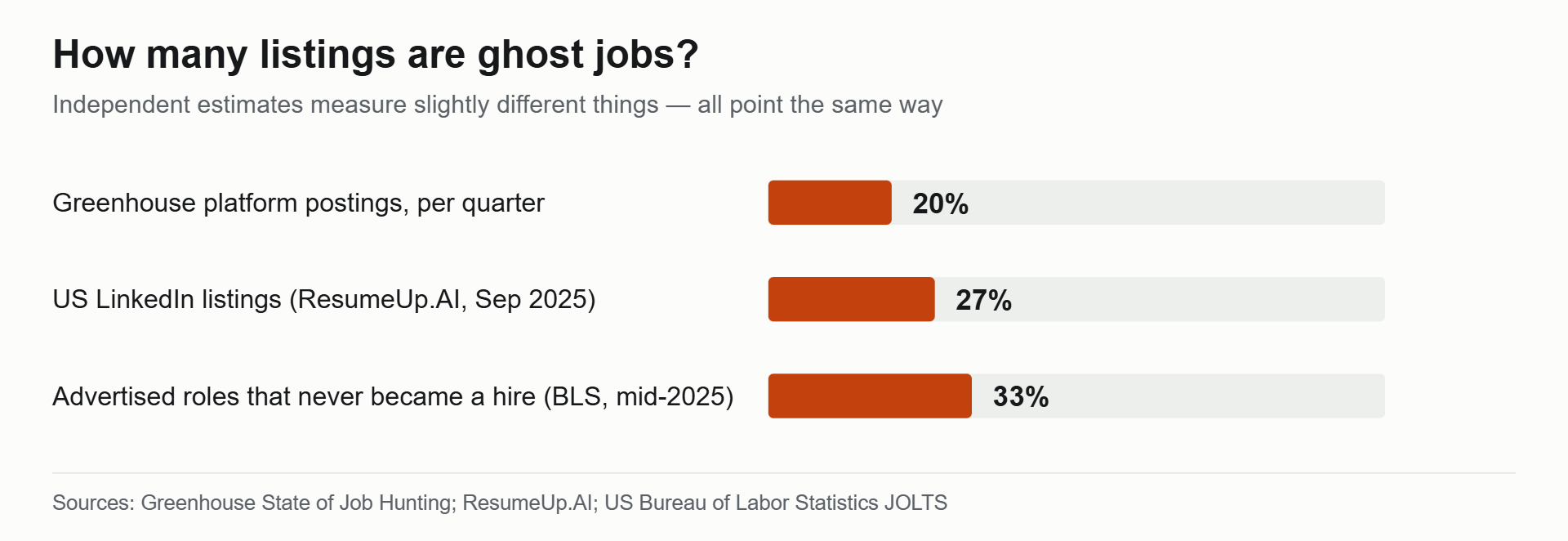
This isn’t a fringe complaint from frustrated applicants. The data is startling. Research summarised across the recruiting industry estimates that somewhere between 18% and one-third of active online job listings are ghost jobs. A September 2025 analysis by ResumeUp.AI concluded that roughly 27% of U.S. LinkedIn listings are likely phantom postings, while applicant-tracking firm Greenhouse puts the figure at 18–22% of postings in any given quarter.
Employers are surprisingly candid about it. A widely cited ResumeBuilder.com survey found that four in ten companies admitted to posting a fake job listing in the past year, and a striking 93% of HR professionals said their employer runs ghost postings — 45% of them “regularly.”
The macro data tells the same story. An analysis of U.S. Bureau of Labor Statistics figures from mid-2025 showed employers reporting about 7.4 million openings but making only 5.2 million hires — meaning roughly one in three advertised roles never turned into an actual hire.
Why this hurts Indian job seekers more than most
Here’s where it gets personal for anyone job hunting in India. The ghost-job problem collides with a brutal supply-and-demand squeeze. Applications per open role have more than doubled since early 2022, and popular postings now routinely attract 250 to 1,000 applicants each. In that crush, only about 2–3% of applications convert to an interview — and that’s before you subtract the listings that were never real.
Do the math and it’s demoralising: for every 100 applications, 97 end in an automated rejection or silence, and a healthy chunk of those were ghosts from the start. Surveys suggest over 70% of job seekers have been ghosted by an employer at least once, and the average phantom-listing chase quietly eats around nine hours of effort.
The instinct most people have — apply to more jobs, faster — is exactly the wrong response. Spraying applications into a market where a third of the targets are fake just multiplies your disappointment. The winning move in 2026 is the opposite: apply to fewer, realer things, and make yourself impossible to ignore.
How to spot a ghost job before you waste your time
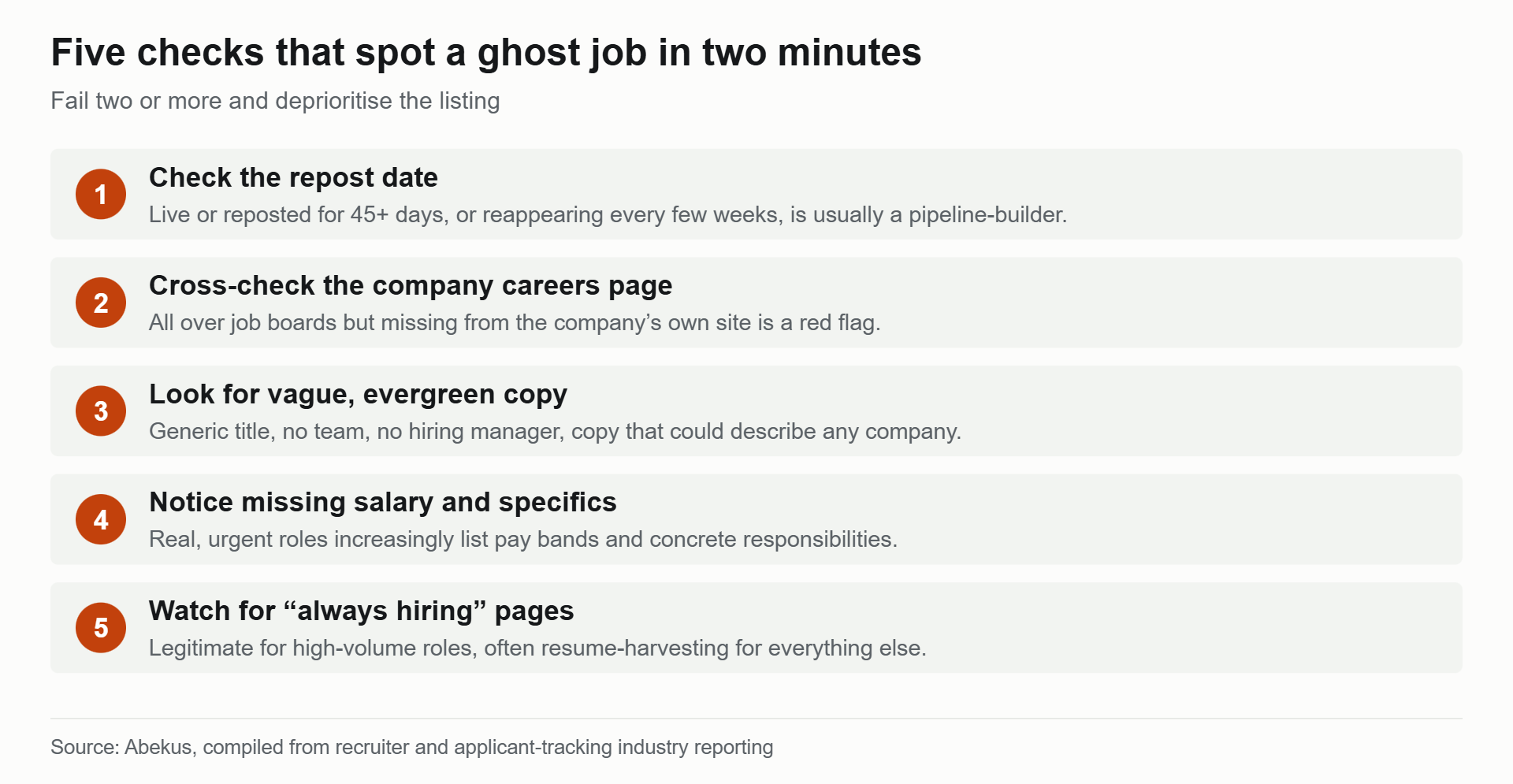
You can’t verify every listing, but a few quick checks will filter out most phantoms in under two minutes:
- Check the repost date. A role that’s been “posted” and reposted for 45+ days, or that reappears every few weeks, is usually a pipeline-builder, not a live opening.
- Cross-check the company careers page. If the role is all over job boards but missing from the company’s own site — or vice versa with no recent update — be suspicious.
- Look for vague, evergreen descriptions. Generic titles, no team name, no hiring manager, and copy that could describe any company are classic ghost-job tells.
- Notice missing salary and specifics. Real, urgent roles increasingly list pay bands and concrete responsibilities. Perpetual mystery is a red flag.
- Watch for “always hiring” pages. Legitimate for high-volume roles, but often a resume-harvesting funnel for everything else.
If a listing fails two or more of these, deprioritise it. Your energy is a finite resource — spend it where a human is actually waiting.
And when a real opening does come through, be ready for the screen on the other side of it. A growing share of first rounds are now run by software rather than a person, so it is worth knowing how to beat an AI interview before you get there.
Where ghost jobs cluster, and what to do about the ones you already applied to
Ghost jobs are not spread evenly across the market, and knowing where they concentrate saves you the most time. They cluster in high-volume, generalist roles where a company benefits from a standing pool of resumes: sales, support, entry-level analyst and generic engineering titles. They cluster at large organisations with many locations, where a posting can sit live in one region long after the role was filled in another. And they cluster on aggregator boards that scrape listings from elsewhere, because nobody on the aggregator side has any incentive to take a dead posting down.
The inverse is also useful. Postings that name the hiring manager, describe the specific team and its current project, include a pay band, or come with a recruiter actively messaging candidates are almost never ghosts. Someone has put their name against that role. That signal is worth more than the company brand.
As for the applications already sitting in the void: do not withdraw them, but do stop waiting on them. A ghost posting will never send you a rejection, so treat anything past three weeks of silence as closed for planning purposes. If you genuinely want that employer, the productive move is sideways rather than forward. Find the team on LinkedIn, look for someone doing the job you applied for, and ask them whether the role is actually open. People answer this question honestly far more often than you would expect, because everyone in the market has been on your side of it.
And keep one number in view. If you are averaging fewer than three interview conversations per fifty applications, the problem is unlikely to be your resume. It is far more likely that a large share of what you are applying to was never a real opening, and that your effort belongs somewhere it can actually be seen.
The real fix: stop applying blind, start proving your skills
Filtering out ghosts is defence. Here’s the offence — and it happens to line up with the biggest hiring shift underway in India.
Recruiters are moving away from resume-and-degree filtering toward skills-first hiring. According to reporting on the India Skills Report 2026, national employability has climbed to around 56%, and a majority of Indian employers now treat skills assessments as the primary evaluation criterion rather than the CGPA on your marksheet. A growing number of Indian startups and Global Capability Centres have dropped minimum-CGPA requirements in favour of role-based skill tests, simulations, and live “assess-thons.” Verified skill badges and certification portfolios are increasingly treated as being on par with the resume itself.
That trend is your escape hatch from the ghost-job black hole. When you can demonstrate a skill with proof, you stop being applicant number 847 in a queue and start being someone a recruiter actively reaches out to.
This is exactly what skill competitions on Abekus are built for. Instead of firing resumes into listings that may not exist, you compete on real, role-relevant challenges and walk away with verified results and certificates that companies can trust — and several companies now hire directly off those verified outcomes. You can also sharpen the underlying skills first through Abekus practice courses, so you show up to a competition ready to rank.
Frequently asked questions
What is a ghost job?
A ghost job is a listing a company keeps advertising with no intention of filling it soon. The role may be frozen, already filled internally, or posted purely to collect resumes. You apply, wait, and hear nothing, because no hiring manager is waiting to read it.
How can you tell if a job posting is fake?
Check five things: how long it has been live or how often it is reposted, whether it appears on the company own careers page, whether the description is vague and evergreen, whether pay and specifics are missing, and whether it sits on an always-hiring page. Two failures means deprioritise it.
Why do companies post ghost jobs?
To build an always-on pipeline of resumes, to project growth to investors and competitors, to benchmark salaries, or to test whether a current employee is replaceable. Plenty are simple neglect: the role was filled or frozen and nobody took the posting down.
What percentage of job postings are ghost jobs?
Estimates run from roughly 18% to about a third, depending on what is measured. Greenhouse reports 18 to 22% of postings on its own platform per quarter, one analysis found about 27% of US LinkedIn listings, and US labour data showed roughly one in three advertised roles never became a hire.
Should you still apply to a possible ghost job?
If it fails two or more of the five checks, spend the time elsewhere. If you genuinely want that employer, apply but treat it as low probability, and find someone on the team to ask whether the role is really open. Silence past three weeks means closed.
A smarter 2026 job-search playbook
Put it together and your strategy looks very different from the spray-and-pray default. Cut your application volume and vet every listing for ghost-job signals first. Redirect the hours you save into building and proving in-demand skills — AI workflows, data, cloud, and the specific tools your target roles ask for. Let verified results do the talking so recruiters come to you, and keep a tight, ATS-ready resume for the genuinely live roles that pass your filter.
The job market in 2026 isn’t broken because you aren’t trying hard enough. It’s noisy, crowded, and full of listings that were never real. The people getting hired aren’t the ones applying to the most jobs — they’re the ones who can prove what they can do.
Stop chasing ghosts. Start proving your skills. Enter a skill competition on Abekus, earn a verified result, and turn your ability into an offer companies can actually see.
Sources
- Greenhouse, State of Job Hunting report — 18 to 22% of platform postings per quarter. Accessed September 2026.
- US Bureau of Labor Statistics, Job Openings and Labor Turnover Survey (JOLTS) — openings versus hires. Accessed September 2026.