
On this page
- The robot recruiter is already mainstream
- Why the AI interview feels rigged (because sometimes it is)
- Why “gaming” the AI is a trap
- The real fix: bring proof the algorithm can’t ignore
- How to beat AI interview rounds in 2026
- Rejected by an algorithm with no feedback? Do this
- Frequently asked questions
- The bottom line
- Sources
The recruiter who decides your future may not have a pulse. In 2026, there is a very real chance that the first “person” to interview you for your next job is a piece of software staring back at you through your own webcam, scoring your eye contact, your pauses, and whether you smiled at the right moment. And if you fumble that 15-minute one-way video, no human may ever watch the tape.
This isn’t a dystopian thought experiment. It’s the front door of the job market right now, and most candidates are walking through it blindfolded. Knowing how to beat AI interview rounds has become a core job-search skill rather than a niche one. The good news: once you understand how the robot recruiter actually works, you can beat it. Let’s break down what’s happening and exactly what to do about it.
The robot recruiter is already mainstream
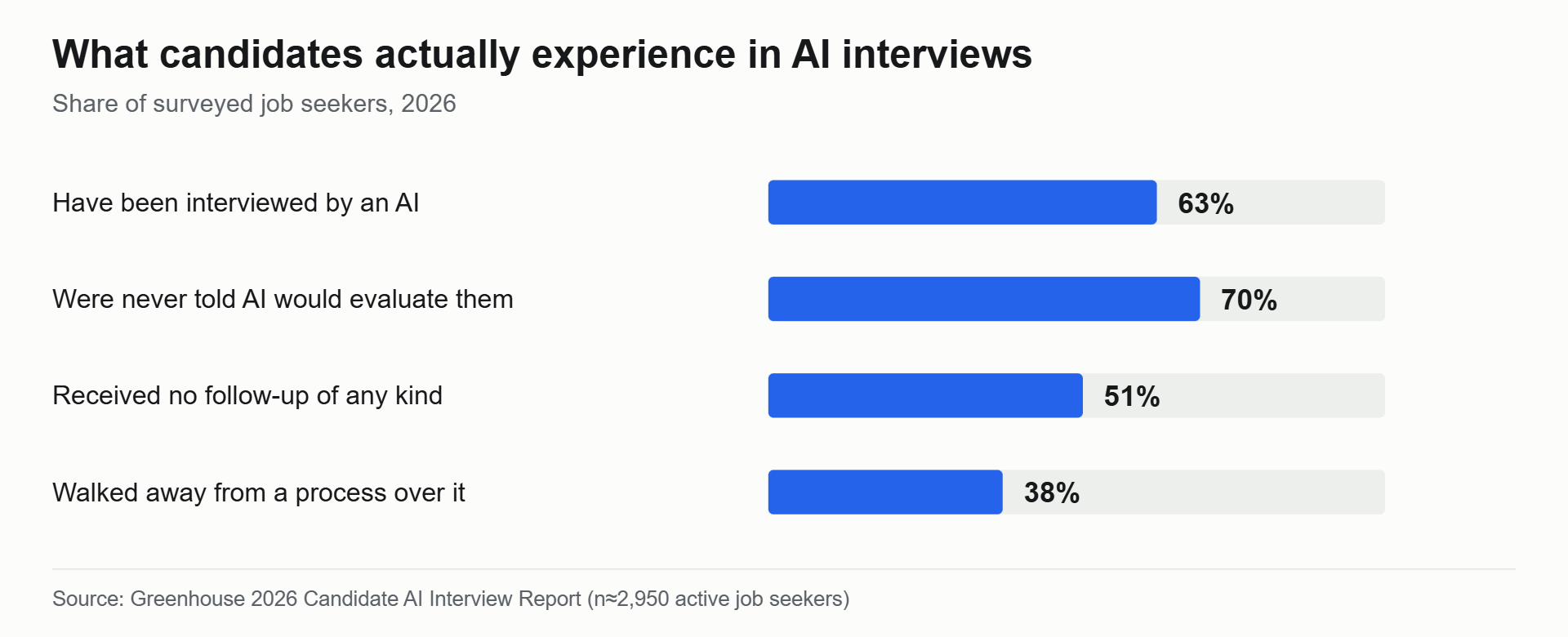
According to Greenhouse’s 2026 Candidate AI Interview Report, which surveyed nearly 3,000 active job seekers, 63% of candidates have now been interviewed by an AI, up 13 percentage points in just six months. That is not a fringe trend. That is the majority of the job market, and it is accelerating faster than almost any hiring shift in the last decade.
In India, the adoption is even more aggressive. Industry trackers estimate that the vast majority of large Indian employers now use AI somewhere in hiring, and one-way video interviews have become the default filter for high-volume roles. Campus and fresher hiring is where this bites hardest: recruiters routinely compress a funnel of 5,000 applications into a handful of shortlists using AI assessments, automated video screens, and proctored coding rounds, cutting time-to-hire by up to 70%. For a fresher applying to twenty companies, that can mean twenty conversations with a machine before a single human sees your face.
Why the AI interview feels rigged (because sometimes it is)
Here is the part nobody tells you. An Enhancv survey of 1,066 job seekers found that 50.5% had been rejected at least once in the past year with zero human feedback, and of those, nearly 64% believed an algorithm made the call. Even more striking, 70% of candidates in the Greenhouse study were never clearly told upfront that AI would be evaluating them. You are being scored, and most of the time you don’t even know the exam has started.
And these systems grade on things that have nothing to do with whether you can do the job. Candidates in the Enhancv survey reported being penalised for natural pauses, for saying “um,” for not holding their eyes on the camera lens, for failing to “align with an ideal personality profile” that was never defined. One applicant was literally told they seemed like AI. This is why one-way interviews are notoriously unfair to neurodivergent candidates and anyone who doesn’t perform confidence on cue: the rubric rewards a smooth on-camera actor, not the best engineer, analyst, or marketer in the pool.
Little wonder that 38% of candidates told Greenhouse they walked away from a hiring process entirely because it involved an AI interview. Walking away feels like taking back control. But every job you abandon is a job someone less qualified and more camera-comfortable just walked into. Worth checking one thing first, though: a share of the roles you are being screened for were never real openings at all, which is a separate problem worth learning to spot ghost jobs for.
Why “gaming” the AI is a trap
The tempting response is to fight fire with fire. Roughly half of candidates now use AI somewhere in their job hunt, and a small but growing share admit to using it live during interviews to feed themselves answers. Interestingly, that live-cheating rate is highest among senior executives, not fresh graduates.
But quietly running an AI co-pilot during your interview is a losing long game. Detection tools are improving fast, “proof of humanity” checks are becoming standard, and even if you get hired on borrowed answers, you now have to actually do the job you faked your way into. The candidates who win in 2026 aren’t the ones with the best cheat setup. They’re the ones who can walk in with something the machine can’t argue with: independently verified proof that they can do the work.
The real fix: bring proof the algorithm can’t ignore
Notice what the smartest Indian employers are actually screening for. Even as they lean on AI filters, roughly three in four planned to hire freshers in the first half of 2026, and they increasingly say they want projects, portfolios, and demonstrable ability, not just a degree and a certificate. That is the crack in the wall.
An AI interview is trying, badly, to answer one question: can this person actually do the thing? If you show up with objective, third-party-verified evidence that you can, you shift the conversation off “did you smile at the camera” and onto “here is my proof.” A résumé claim is easy for an algorithm to discount. A verified result from a competitive, proctored skill assessment is a lot harder to wave away, and it’s exactly the kind of signal recruiters say they’re hunting for.
This is where Abekus skill competitions change your position. Instead of hoping a one-way video captures your ability, you compete in structured, proctored challenges and walk away with a verified result and certificate you can attach to any application, drop into your profile, or bring up the moment an interview, human or otherwise, asks what you can do. It’s proof of skill that travels with you, generated under exactly the kind of fair, standardised conditions an AI screen only pretends to offer. And if you want to sharpen those skills before you compete, the Abekus practice courses let you drill the real, job-relevant abilities employers are testing for.
How to beat AI interview rounds in 2026
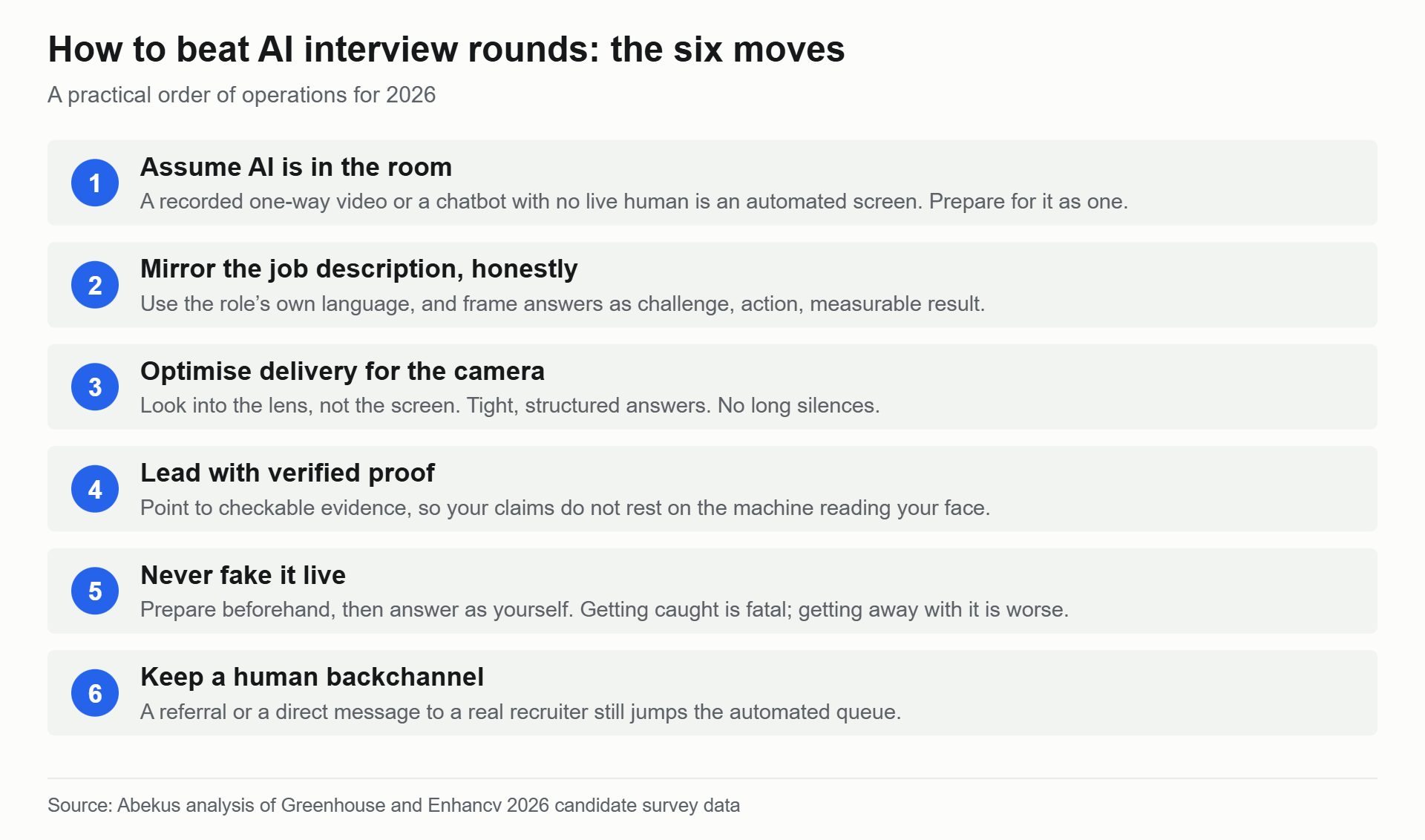
You can’t opt out of the robot recruiter, but you can stop losing to it. Here’s a practical playbook:
- Assume AI is in the room. If an interview is a recorded, one-way video or a chatbot with no live human, treat it as an automated screen and prepare accordingly. When in doubt, ask the recruiter directly whether AI is used and whether you can request a human interview, which 46% of candidates say they want as an option.
- Mirror the job description, honestly. AI screens score for relevance and context, so use the exact language of the role when you describe your experience, and frame every answer as challenge, action, and measurable result.
- Optimise your delivery for the camera. Look into the lens, not the screen. Keep answers tight, structured, and free of long silences. It feels artificial, but you’re performing for a rubric, so give it what it scores.
- Lead with verified proof. Reference concrete, checkable evidence of your ability, such as verified competition results, portfolio projects, or proctored assessments, so your claims don’t rest on the machine’s interpretation of your face.
- Never fake it live. Don’t run an AI co-pilot mid-interview. Prepare beforehand, then answer as yourself. Getting caught is fatal, and getting away with it is worse.
- Keep a human backchannel. A referral or a direct message to a real recruiter remains the single most reliable way to jump the automated queue.
Rejected by an algorithm with no feedback? Do this
Half of the candidates in the Enhancv data got a rejection with no human explanation attached, and most of them assumed a machine made the call. That silence is the most demoralising part of the process, and it is where people quietly give up. It is also the moment where a small amount of deliberate effort separates you from everyone else in the pile.
Start by asking. A short, unemotional note to the recruiter asking which stage you were screened out at, and whether the assessment was automated, is entirely reasonable. Many will not reply. Some will, and what they tell you is worth more than another twenty applications, because it tells you whether you are losing at the resume parse, the automated screen, or the human interview. Those three failures need completely different fixes, and guessing wrong wastes months.
Then check your evidence, not your wording. If you were filtered before any human saw you, rewriting your cover letter will not help. What helps is making the specific, checkable skill the role asked for visible in the first third of your resume, and having something a recruiter can click to verify it. If you were rejected after a one-way video, the problem is more likely delivery than substance, and that is fixable with practice recordings you actually watch back.
Finally, keep a log. Note the company, the stage you reached, whether AI was involved, and what you changed afterwards. Ten entries in and the pattern is usually obvious. Without the log, every rejection feels like the same rejection, and you learn nothing from any of them.
Frequently asked questions
Can you tell if an interview is being conducted by AI?
Usually yes. If it is a recorded one-way video, a chatbot with no live person, or you get no chance to ask questions, treat it as an automated screen. Greenhouse found 70% of candidates were never told upfront, so it is fair to ask the recruiter directly.
Is it cheating to use AI during an interview?
Running an AI co-pilot live during an interview is treated as cheating by most employers, and detection is improving fast. Around 22% of job seekers admit to it. Prepare beforehand instead: getting caught ends the process, and getting away with it means starting a job you cannot do.
Can you ask for a human interview instead of an AI one?
Yes, and it is a reasonable request. Ask the recruiter whether AI is used in evaluation and whether a human round is available. Not every employer will agree, but many will, and roughly 46% of candidates say they want that option offered.
Do AI interviews reject candidates automatically?
Some score and rank candidates without a human reading every answer. In a survey of 1,066 candidates, 50.5% had been rejected with no human feedback at all, and most assumed an algorithm decided. Ask which stage screened you out, because the fix differs at each one.
How should you look at the camera in an AI video interview?
Look into the lens, not at your own image on screen. These systems often score eye contact, so watching yourself reads as looking away. Keep answers tight and structured, and avoid long silences, which can be scored as hesitation rather than thought.
The bottom line
The AI interview isn’t going away, and pretending otherwise just hands the job to someone who prepared. Learning how to beat AI interview rounds is simply part of learning to job hunt now. The candidates who thrive in 2026 will be the ones who stop treating hiring as a personality performance and start treating it as a proof problem. Machines are easy to fool and easy to be fooled by. Verified skill is neither.
So before the next robot recruiter fires up your webcam, make sure you’re carrying evidence it can’t dismiss. Enter an Abekus skill competition, earn a verified result, and walk into your next interview, human or AI, with proof of what you can actually do.
Sources
- Greenhouse, 2026 Candidate AI Interview Report (n≈2,950 active job seekers). Accessed September 2026.
- Enhancv, AI Hiring in 2026: Half of Job Seekers Were Rejected Without a Word (n=1,066 candidates). Accessed September 2026.