
On this page
Everyone is watching the wrong hiring boom. While the headlines obsess over startup layoffs and Big Tech freezes, the largest engine of white-collar hiring in India is quietly running at full throttle inside buildings most job seekers never think to apply to: Global Capability Centres. GCC jobs in India are now the biggest white-collar hiring story in the country, and almost nobody is preparing for them.
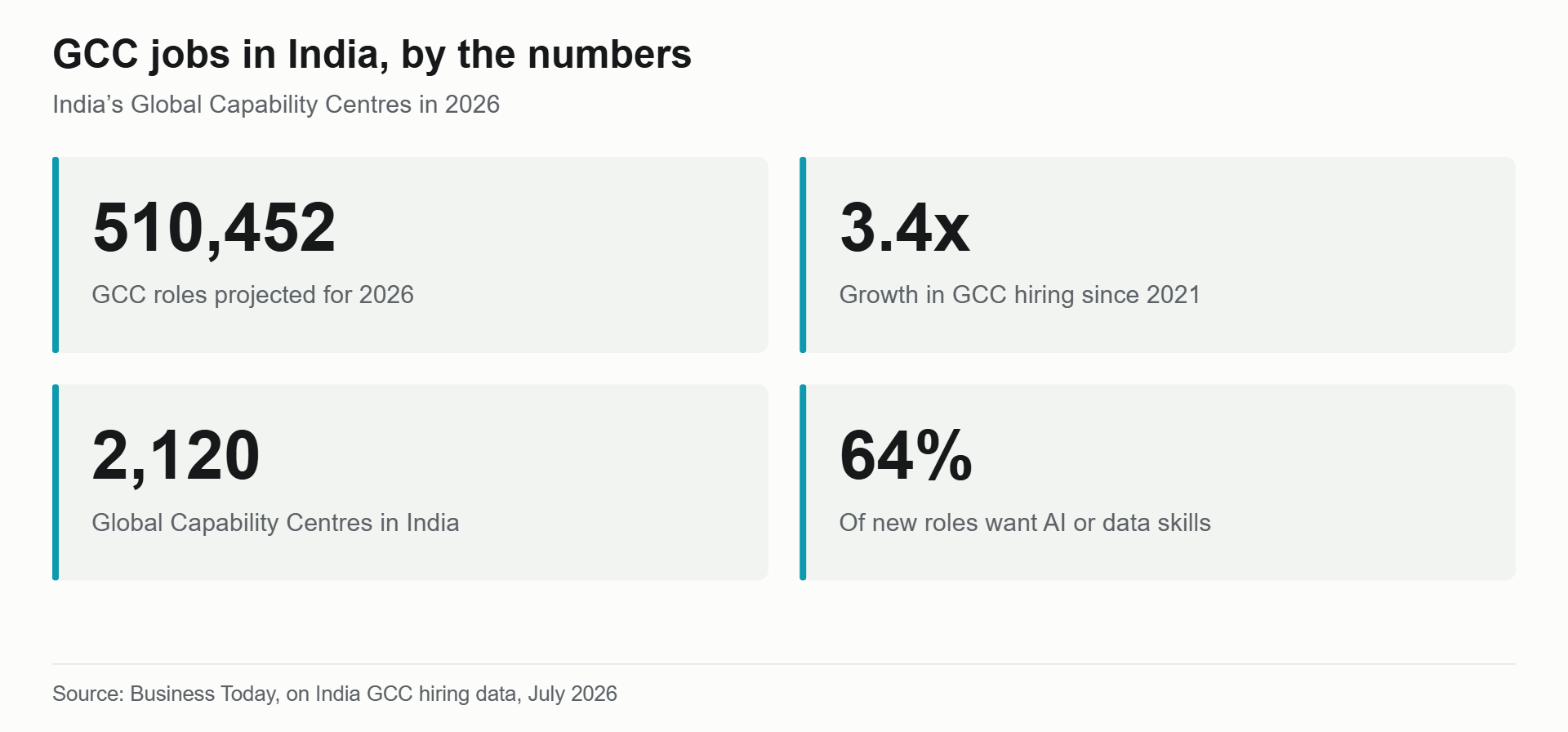
These are the in-house technology and operations arms that multinationals — from banks to pharma giants to retailers — build in India to run their global business. And in 2026 they are hiring at a scale that makes the rest of the market look sleepy. India’s GCC hiring is projected to reach roughly 510,000 jobs this year, a 3.4-fold jump since 2021, according to industry data reported by Business Today. In just the first six months of 2026, GCCs recorded nearly 228,000 hires — up 11% year-on-year.
Here’s the twist that should change how you plan your career: nearly two in three of those new roles demand skills that a degree certificate alone can no longer prove you have.
The scale is genuinely staggering
India is now home to around 2,120 GCCs employing more than 1.76 million professionals and generating close to $70 billion in annual revenue. To put that in perspective, that headcount rivals the entire workforce of India’s traditional IT services majors combined — except GCCs are growing faster and, on average, paying more for specialised skills.
And this is not a peak. By 2030, analysts expect India to host between 2,100 and 2,400 GCCs — with sector revenue crossing $100 billion a year. The centre of gravity of global corporate technology work is shifting to India in real time, and the hiring numbers are the clearest signal of it. A decade ago, the “back office” tag stuck to these centres. Today many GCCs own end-to-end product development, run global AI research, and make decisions that used to sit in headquarters overseas.
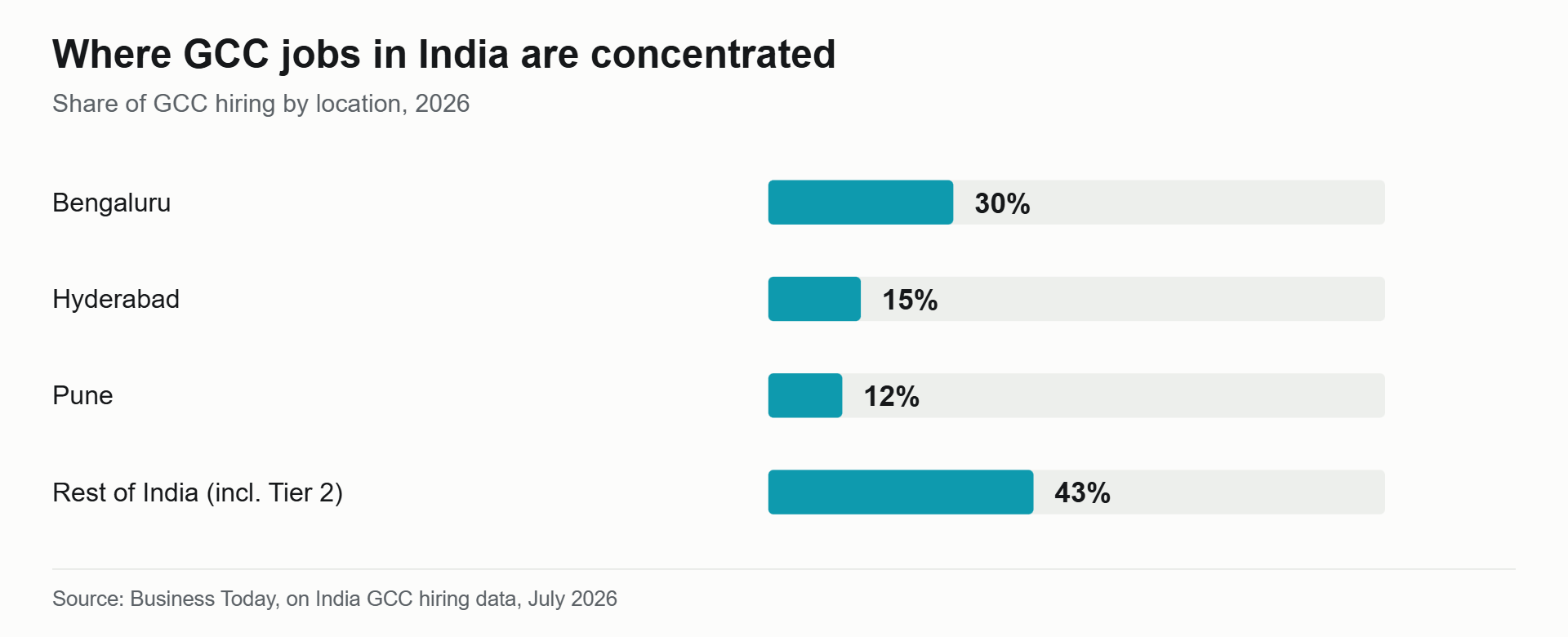
Geography matters here too. Bengaluru still dominates with about a 30% share of GCC hiring, but the fastest growth is happening in Tier 2 cities, expanding at 23% year-on-year. Hyderabad (15%), Pune (12%), Mumbai, Chennai and Delhi NCR round out the map. If you assumed you had to relocate to a metro to touch this opportunity, that assumption is already out of date.
The demand is also concentrated. Technology and software plus banking and financial services together account for roughly 56% of all GCC hiring, followed by healthcare and life sciences, manufacturing, retail and automotive. In other words, this is broad-based hiring across the real economy — not a single sector’s bubble.
Why 64% of these jobs want proof, not promises
Now the part almost no one is preparing for. Roughly 64% of all new GCC roles created in 2026 require AI, data science or intelligent automation skills. The AI, data science and analytics function itself is the fastest-growing corner of the GCC world, expanding at about 38% year-on-year.
These are not employers screening for “10 years at a brand-name company.” They are screening for whether you can actually do the work — build the model, clean the pipeline, automate the workflow, ship the analysis. That is a fundamentally different bar than the one most Indian job seekers were trained to clear.
And the market is straining against it. Nearly 74% of recruiters in India say it has become harder to find qualified candidates over the past year. A recent LinkedIn survey found 84% of Indian professionals feel unprepared for how AI is reshaping their roles. So we have a paradox: half a million high-quality jobs opening up, and most candidates unable to prove they’re ready for them.
That gap is not a wall. For anyone willing to build and demonstrate the right skills, it’s an open door.
The uncomfortable truth about your resume
A GCC hiring manager reviewing hundreds of applications for a data or automation role has learned to distrust the resume. Everyone lists “Python,” “SQL,” “machine learning,” and “stakeholder management.” When every applicant claims the same skills, those claims stop carrying information. What the recruiter actually wants is signal — evidence that survives contact with a real problem.
This is why verified, results-based proof of skill is quietly becoming the most valuable thing on an application. Not a course you watched. A challenge you completed, scored, and can point to. The candidate who shows up with a ranked result on a real data problem instantly separates from the stack of identical-looking CVs.
Good news for freshers
If you’re a fresher worried that AI is eating entry-level jobs, GCCs flip the script. Because these centres hire in volume and increasingly recruit for demonstrated ability rather than pedigree, a candidate from a modest college with strong, provable AI and data skills can leapfrog peers from bigger-name institutions who coasted on the brand. The playing field tilts toward whoever can prove they can do the work — and that is something you can control.
How to land GCC jobs in India in 2026
If you want a slice of these 510,000 roles — whether you’re a fresher, a services-company engineer looking to jump, or a mid-career professional pivoting into data and AI — the playbook is refreshingly concrete:
- Target the AI/data/automation core. Two-thirds of new roles want these skills. Pick one lane — data analytics, ML engineering, or process automation — and go deep rather than broad.
- Build proof, not just knowledge. Complete hands-on challenges that produce a verifiable score or certificate you can attach to applications. Recruiters trust demonstrated results far more than self-reported skills.
- Look beyond the metros. Tier 2 hiring is growing at 23% a year. Hyderabad, Pune and emerging hubs are hungry for talent and less crowded with applicants.
- Match yourself to roles by skill, not keyword. The best-fit GCC job is often one your resume keywords would never surface. Use skill-based matching to find roles that actually fit what you can do.
- Keep upskilling on a clock. With 64% of roles tied to fast-moving AI skills, treat learning as a rolling habit, not a one-time credential.
How a GCC role actually differs from an IT services job
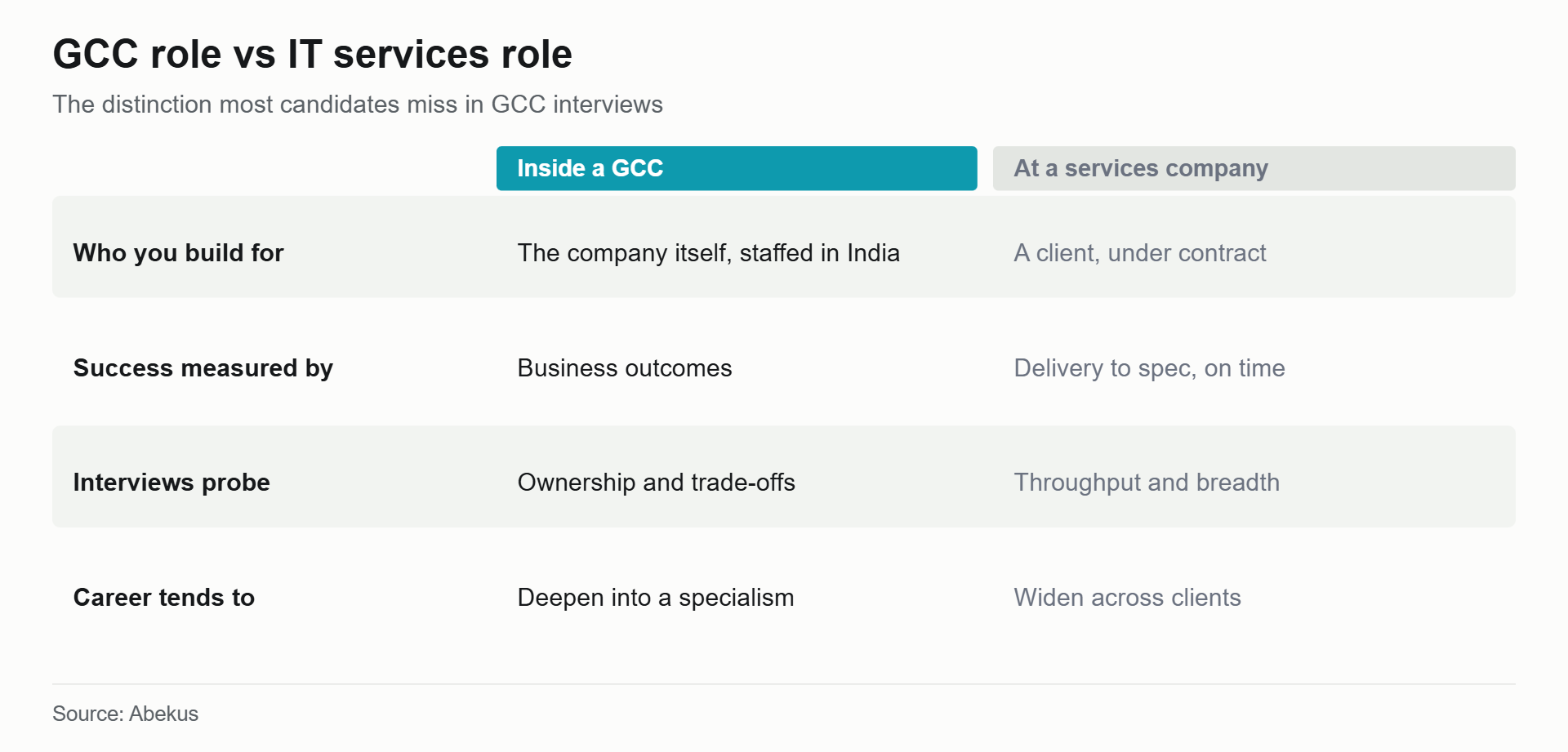
This is the part most candidates get wrong about GCC jobs in India, and it costs them in interviews. A Global Capability Centre is not an outsourcing vendor. It is the company itself, staffed in India. That single distinction changes almost everything about the work and about how you should present yourself for it.
In a services company you are usually delivering against a client’s specification, on a client’s timeline, for a contract that eventually ends. Success is measured in delivery: was it on time, on budget, to spec. In a GCC you are inside the business that owns the product. The roadmap is your employer’s roadmap, the users are your employer’s users, and success is measured in outcomes rather than deliverables — did the thing you built actually move a number the business cares about.
Three practical consequences follow. First, GCC interviews probe ownership rather than throughput. Expect to be asked why you built something the way you did, what you would change, and what the trade-off cost you — not how many tickets you closed. Have two or three pieces of work you can talk about at that depth, even if they are small. Note too that GCCs hire at volume, which means an automated first round is common, so it is worth knowing how to beat an AI interview before you reach a human.
Second, domain knowledge counts more than it does in services. A GCC inside a bank wants someone who understands a little about how banking works, not only how to write the code. Reading for a week about your target sector is unusually high-leverage preparation, and almost nobody does it.
Third, the career path is different in shape. Services careers often widen — more clients, more technologies, larger teams. GCC careers tend to deepen, and increasingly they lead into global roles, because many of these centres now own products end to end rather than supporting decisions made elsewhere. If you want to specialise, that is an advantage. If you like variety, it is a genuine trade-off worth thinking about before you switch.
Frequently asked questions
What is a GCC job in India?
A GCC, or Global Capability Centre, is a multinational own in-house technology and operations arm based in India. A GCC job means working directly for that company rather than for an outsourcing vendor, on the company own products, roadmap and users.
How many GCC jobs are there in India?
India GCCs are projected to hire around 510,000 people in 2026, a 3.4-fold rise since 2021, with roughly 228,000 of those hires landing in the first half of the year. The country now hosts about 2,120 GCCs employing more than 1.76 million professionals.
What skills do GCC jobs in India require?
Roughly 64% of new GCC roles created in 2026 require AI, data science or intelligent automation skills. Beyond the technical base, GCCs screen for ownership: whether you can decide what to build and defend the trade-offs, not simply deliver against a specification someone else wrote.
Which cities have the most GCC jobs in India?
Bengaluru leads with about 30% of GCC hiring, followed by Hyderabad at 15% and Pune at 12%, with Mumbai, Chennai and Delhi NCR also significant. Tier 2 cities are the fastest-growing segment at 23% year on year, so relocating to a metro is no longer essential.
Is a GCC job better than an IT services job?
It depends what you want. GCC roles sit inside the company that owns the product, so success is measured in business outcomes and careers tend to deepen into a specialism. Services careers widen across clients and technologies. Neither is better; they reward different things.
Turn the skills gap into your advantage
The candidates who win GCC offers in 2026 won’t be the ones with the fanciest college names — that argument is already over. They’ll be the ones who can walk into a screening and prove, with evidence, that they can do AI and data work today.
That’s exactly the gap Abekus is built to close. You can sharpen job-ready AI, data and analytics skills through hands-on practice courses, then turn that learning into hard proof by entering skill competitions that give you verified results and certificates recruiters actually trust. And instead of firing resumes into the void, you can let skill-based job matching connect you to roles that fit what you can genuinely do — GCC roles included.
Half a million GCC jobs in India are opening. Most people will keep polishing resumes for them. You can show up with proof instead.
Sources
- Business Today, At 5.1 lakh jobs, India Global Capability Centre hiring boom scales new peak, July 2026 — hiring volumes, centre count, sector and city split. Accessed September 2026.