
On this page
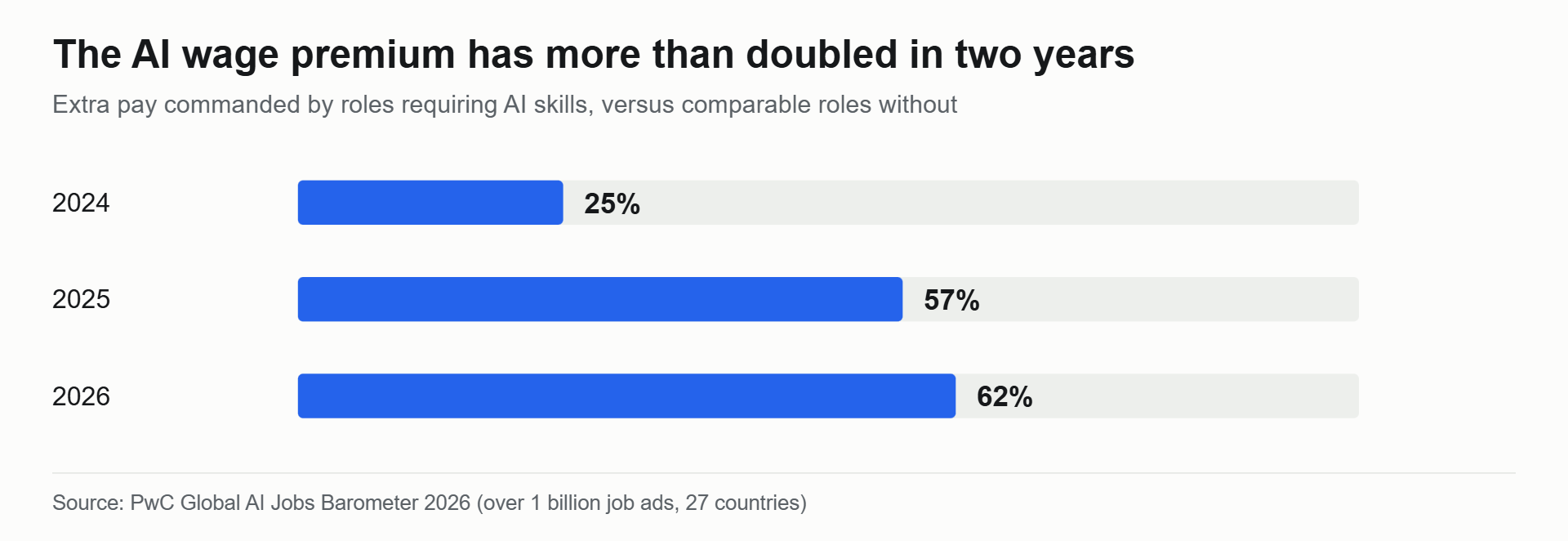
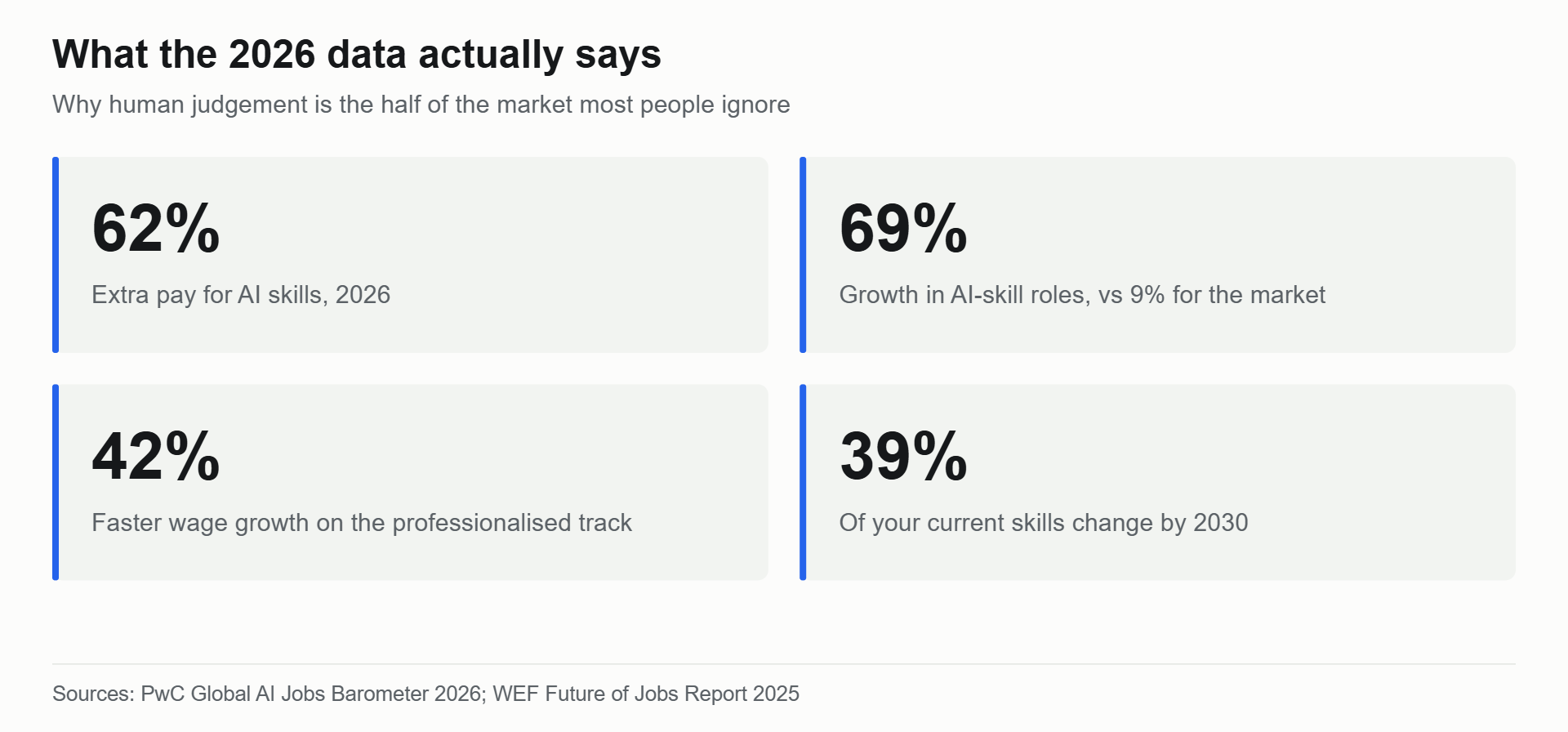
Here is the career advice everyone is repeating in 2026: learn AI or get left behind. And the money seems to prove it. According to PwC’s 2026 Global AI Jobs Barometer — an analysis of more than one billion job advertisements across 27 countries — the wage premium for AI skills has climbed from 25% in 2024 to 57% in 2025 to a staggering 62% today. Jobs demanding AI skills are growing nearly eight times faster than the market overall.
So of course you should learn to work with AI. But here is the plot twist buried in that same report, the one nobody is putting on a LinkedIn carousel: as AI gets better at the technical stuff, the skills that are becoming more valuable, more rewarded, and impossible to automate are the deeply human ones. Judgement. Communication. Leadership. Creativity. The things you cannot download in a weekend bootcamp.
If you are betting your entire career on stacking AI certificates while ignoring these, you are optimising for the wrong half of the market. The skills AI cannot replace are becoming the part employers screen hardest for — and the part almost nobody prepares for deliberately.
The labour market just split into two tracks
PwC’s headline finding for 2026 is that AI has cleaved the job market in two. On one track are roles being “professionalised” by AI — jobs where the technology amplifies expert human judgement. On the other are roles being “democratised,” where AI flattens the barrier to entry. The professionalised track is growing twice as fast and has seen 42% faster wage growth since 2021.
The difference between the two tracks is not who uses AI. Almost everyone will. The difference is who brings something AI cannot: context, taste, the ability to decide what to build and why, and the interpersonal skill to bring other people along. PwC’s own recommendation is blunt — invest in human-intensive skills such as empathy, judgement, creativity, and leadership alongside AI fluency, not instead of it.
The most striking data point is what is happening to junior roles. PwC found that the most AI-exposed entry-level jobs are now seven times more likely to demand traditionally senior skills like leadership than the least-exposed junior roles. Read that again. AI is not just automating grunt work off the bottom of the ladder — it is quietly rewriting the job description of a “fresher” to expect the judgement of a manager.
Why “human skills” stopped being soft
We used to call these “soft skills,” a term that always sounded like a consolation prize. The 2026 data retires that idea for good. The World Economic Forum’s Future of Jobs Report finds that analytical thinking is now the single most sought-after core skill on earth, listed as essential by seven out of ten companies. Right behind it: resilience, flexibility and agility, followed by leadership and social influence. Technical skills in AI and big data are growing fastest in demand, but these human capabilities remain the stable core that employers build teams around.
There is a good reason for this. As AI commoditises the production of code, copy, analysis, and design, the bottleneck moves. When everyone on your team can generate a decent first draft in thirty seconds, the person who wins is the one who can tell the good draft from the plausible-but-wrong one, frame the problem correctly in the first place, and persuade a room to act. Those are judgement and communication problems, not typing problems.
The WEF report also delivers a quiet warning to anyone who assumes their current skill set is safe. Workers can expect that 39% of their existing skills will be transformed or outdated between 2025 and 2030. The encouraging news is that this “skill instability” has actually slowed from a peak of 57% in 2020, partly because half of all workers have now completed some reskilling. The people staying ahead are the ones treating learning as a permanent habit, not a one-time event.
The trap for Indian graduates
This two-track split lands hardest in India, where the gap between credentials and capability is already wide. The India Skills Report 2026 puts national employability at 56.35% — genuinely improved, but still leaving nearly half of graduates judged not job-ready, even as companies complain they cannot fill open roles. It is the paradox that has defined Indian hiring for a decade: millions of degrees, not enough demonstrable skill.
AI makes this paradox sharper, not softer. A degree certificate has never been able to prove that you can think clearly under pressure, communicate an idea, or exercise judgement on a messy real-world problem. In 2026, when a recruiter assumes AI wrote your resume and half your cover letter, the certificate proves even less. What cuts through is demonstrated ability — evidence that you have actually done the thinking, not just described it.
And that is precisely the kind of skill that is hardest to fake and hardest to teach through passive video courses. You do not build judgement by watching. You build it by repeatedly making decisions, getting feedback, and adjusting — the same way you build any durable skill.
How to build the skills AI can’t replace
You cannot cram empathy or analytical thinking the night before an interview. But you can build them deliberately, and you can build proof along the way. Here is a practical way to start:
- Pick two durable skills to compound, not ten to sample. Analytical thinking and clear communication are the highest-leverage pair for almost any role. Depth beats a scattered list of half-finished courses.
- Practise on real problems with feedback loops. Judgement grows through reps. Work through applied exercises and case-style challenges where you make a call and immediately see whether it held up — not lectures you passively absorb.
- Pair every human skill with an AI skill. The winners in PwC’s data are not “AI people” or “people people” — they are both. Learn to direct AI tools and to judge their output critically.
- Generate proof, not just claims. Anyone can write “strong communicator” on a resume. Far fewer can point to a verified result, a ranked performance, or a portfolio that shows the thinking. Evidence is the new credential.
- Treat learning as a standing habit. With 39% of skills set to churn by 2030, the goal is not to “finish” upskilling. It is to make small, regular practice normal.
This is where a skills-first platform earns its place in your routine. Abekus is built around exactly this loop — learning by doing rather than by watching. Its practice courses let you build analytical and applied skills through hands-on problems with real feedback, so you are exercising judgement instead of just collecting completion certificates. It is the difference between knowing about a skill and being able to show it.
How to actually show a human skill on a resume
The advice to build judgement and communication is easy to agree with and hard to act on, because these are exactly the skills that sound like padding when you write them down. “Strong communicator” and “strategic thinker” are on every resume in the pile, which is precisely why they carry no information. The fix is not better adjectives. It is replacing the claim with a small piece of evidence.
Take communication. Instead of claiming it, describe a moment where it changed an outcome: you rewrote a technical explanation for a non-technical stakeholder and a decision that had been stalled for three weeks got made. That is a sentence a recruiter can picture, and it demonstrates the skill rather than asserting it.
Take judgement. The strongest version is a decision you made with incomplete information, plus what it cost and what you would do differently. Candidates avoid this because it involves admitting a trade-off, but a trade-off is the only proof that judgement was actually exercised. Anyone can describe a project where everything went well; the person who can explain why they chose the worse-looking option and were right is demonstrably thinking.
Take analytical thinking, the skill the World Economic Forum now ranks first. The evidence is a problem you framed before you solved it — where the useful work was realising the question was wrong. If you can show that you changed what was being measured rather than just measuring it faster, you have shown the thing the report is talking about.
The same logic applies in the interview, where most of these skills are actually assessed whether or not anyone says so. When an interviewer asks about a difficult project, they are not checking whether the project succeeded. They are watching how you reason about it out loud — whether you can hold two competing considerations at once, admit what you did not know at the time, and still reach a defensible position. That is a live demonstration of judgement, and it is why rehearsed success stories land so flatly — a point that matters even more when the first round is automated, as covered in how to beat an AI interview: a story with no tension in it gives the interviewer nothing to evaluate.
So prepare differently. For each of your two or three examples, know the moment where it could have gone the other way, and be ready to say what you weighed. Candidates worry this makes them look uncertain. It does the opposite. The skills AI can’t replace are precisely the ones that show up in how you handle an unresolved question, and an interviewer who sees that will trust the rest of your resume more, not less.
One rule holds across all three: attach a number wherever one honestly exists, and never invent one where it does not. A specific outcome with a modest number beats a grand claim with none, and interviewers can tell the difference immediately. Three of these, written properly, will do more than an entire skills section.
Frequently asked questions
What skills can AI not replace?
Judgement, communication, creativity and leadership are the hardest to automate, because they depend on context and on persuading other people. PwC 2026 data shows these human-intensive skills gaining value as AI commoditises technical output, and the WEF now ranks analytical thinking as the single most sought-after core skill.
Do AI skills really pay 62% more?
That is the average premium PwC found in 2026 across more than a billion job advertisements in 27 countries, up from 57% the year before. It varies widely by industry, reaching well over 100% in some consumer sectors and far less in government work, so treat 62% as an average rather than a promise.
Are soft skills still important in 2026?
More than before, though the term is misleading. As AI makes a competent first draft nearly free, the scarce ability becomes telling a good draft from a plausible-but-wrong one and getting people to act. That is judgement and persuasion, and both are now priced accordingly.
Should I learn AI or focus on human skills?
Both, and in that order of urgency rather than importance. AI fluency is becoming the baseline expectation that keeps you from being screened out. Human judgement is what separates candidates once everyone clears that bar. PwC found the winners pair the two rather than choosing.
How do you prove a human skill to an employer?
Replace the claim with a specific instance. Describe a decision you made with incomplete information, what it cost, and what you would change. Attach a real number if one exists. One concrete example demonstrates communication and judgement better than any adjective in a skills section.
The bottom line for 2026
Yes, learn AI. The 62% wage premium is real and it is not going away soon. But do not misread the trend. AI is not making humans less valuable — PwC found that companies most exposed to AI are seeing 40% higher productivity growth and raising both wages and headcount faster than everyone else. The value is not disappearing. It is concentrating in the people who pair technical fluency with the judgement, creativity, and communication that machines still cannot replicate.
The safest career move in 2026 is not to out-compute the machines. It is to become undeniably good at the things they cannot do — and to build the proof that you can.
Ready to build the skills that actually hold their value? Start practising the applied, analytical skills employers are competing for on Abekus practice courses — learn by doing, and turn “I’m a fast learner” into something you can prove.
Sources
- PwC, 2026 Global AI Jobs Barometer — over 1 billion job advertisements across 27 countries. Accessed September 2026.
- World Economic Forum, Future of Jobs Report 2025 — skills outlook to 2030. Accessed September 2026.