
On this page
Almost everything written about AI skills assumes you write code. If you are in commerce, HR, marketing, operations, finance or design, the advice reads as either irrelevant or vaguely threatening, and the usual conclusion is that this is happening to you rather than something you can act on.
That reading is wrong, and the data says so plainly. PwC’s 2026 barometer found a wage premium on roles requiring AI skills in every industry it studied — not only technology. The premium is not a reward for engineering. It is a reward for being able to get useful work out of a tool and know when it is wrong.
That is a learnable skill in weeks, and it does not require a technical background.
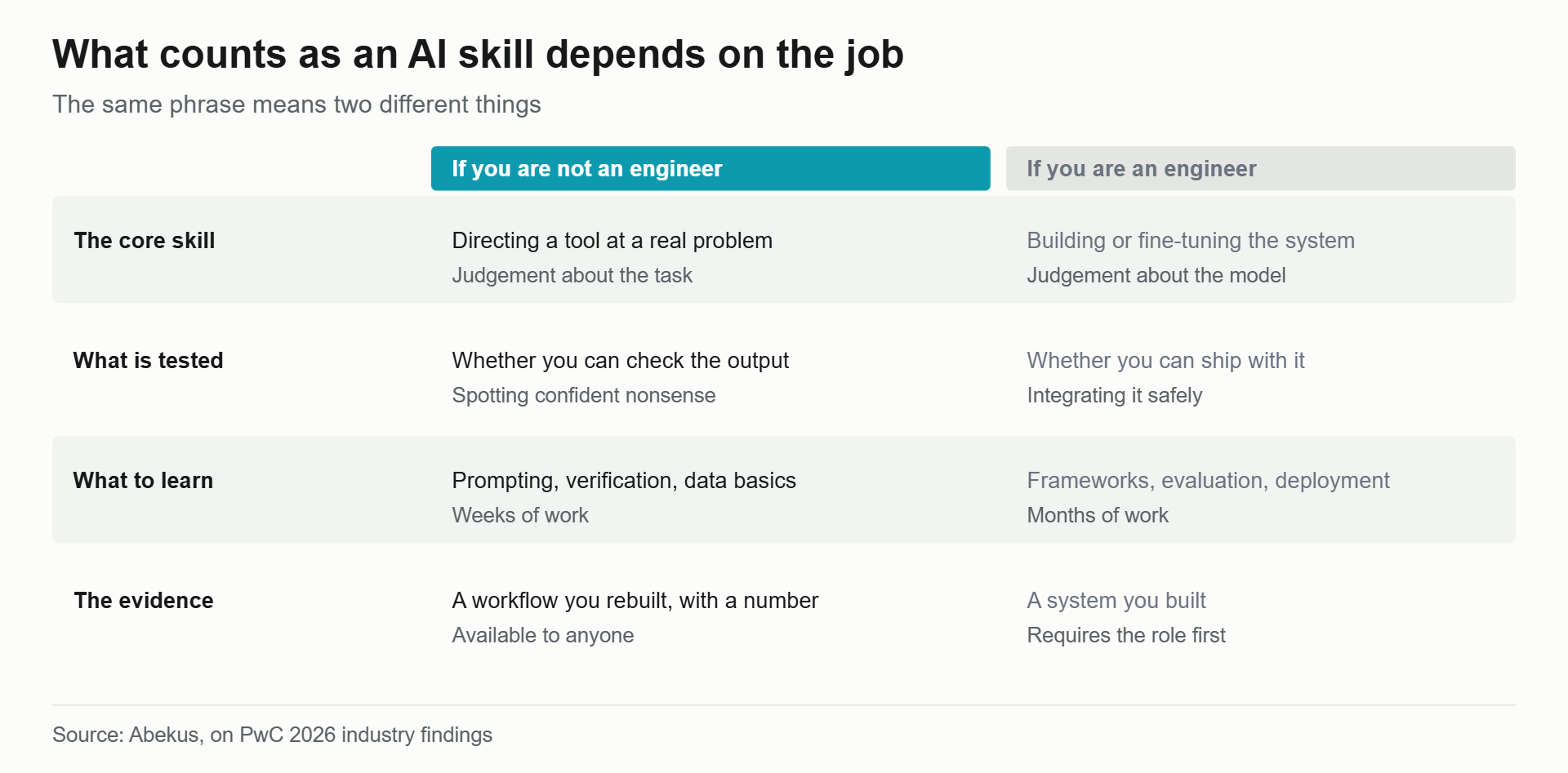
The phrase means two different things
When a job description asks an engineer for AI skills, it usually means building with models: frameworks, evaluation, deployment. That is months of work and it requires the role first.
When it asks anyone else, it means something much narrower and far more achievable: can you point a tool at a real piece of your job, and can you tell when the answer it gives you is confidently wrong.
Conflating those two is why so many people in non-technical roles conclude the door is shut. The door being described is not the one they need to walk through.
Why the premium exists outside engineering
Because the bottleneck in most non-technical work was never the typing. It was the checking, the deciding and the explaining.
A tool that drafts a policy document, summarises two hundred survey responses or reconciles a spreadsheet removes the slow part of those jobs. What it cannot do is know whether the output is right, because it has no stake in the outcome and no knowledge of your context. That judgement is what employers are paying more for.
It also explains why listing tool names earns nothing. Everyone can name the tools. Very few can say what they checked, what the tool got wrong, and what they did about it — and in India, where 82% of employers report difficulty filling roles with AI capability the hardest gap to close, that scarcity is the whole opportunity.
The three things worth learning first
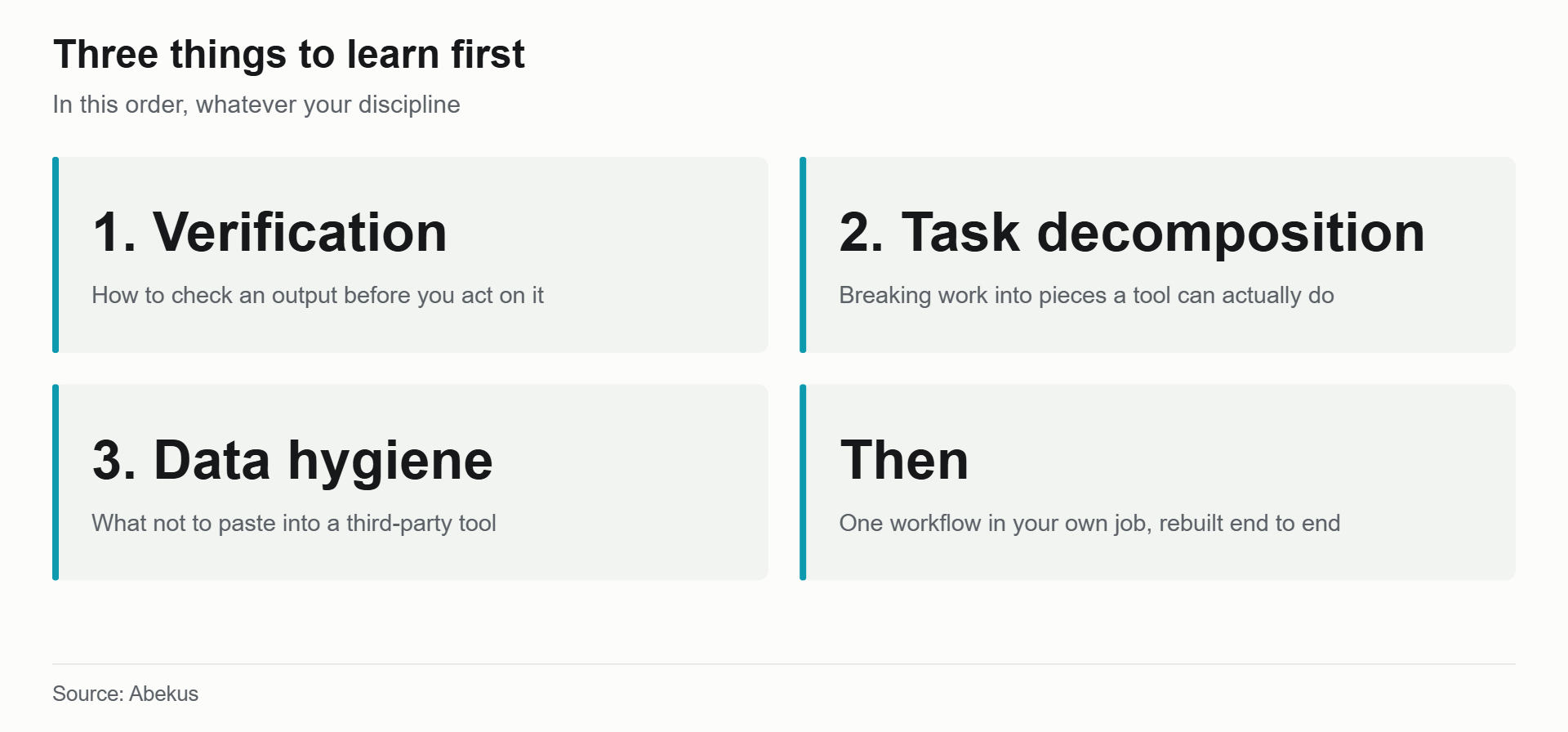
Verification. How to check an output before you act on it. For numbers, recompute one by hand. For summaries, read two of the sources and see whether the summary survives. For anything factual, find the claim in a primary document. This is the skill, and almost nobody practises it deliberately.
Task decomposition. Most poor results come from asking for the whole job at once. Breaking work into pieces a tool can actually do — extract, then classify, then draft, with a check between each — is most of the difference between people who get useful output and people who conclude it does not work.
Data hygiene. Knowing what not to paste into a third-party tool. Customer records, salary data, anything under a contract. This is unglamorous and it is the thing that gets people into genuine trouble, which is exactly why noticing it marks you out.
Notice that none of these is technical. They are judgement skills, applied to a new object.
What to actually build
One workflow in your own job, rebuilt end to end, with a number attached.
The monthly report that takes a day. The candidate screening that eats a week. The reconciliation nobody wants. Pick the one that annoys you most, rebuild it with a tool doing the slow part and you doing the checking, and measure what changed.
That single artefact does more for you than any certificate, because it answers the question employers are actually asking — not “have you used AI” but “can you get value out of it in a real context with real constraints”. It is also portable: the same story works in an interview for a different company doing similar work.
Keep the failures. The most persuasive part of this story is usually the place the tool was wrong and you caught it.
What not to bother with
Prompt engineering courses that teach phrasing tricks. The models change and the tricks stop working, while the underlying skill — being specific about what you want and how you will judge it — was never really about phrasing.
Learning to code, unless you want to. It is a large investment aimed at a different job, and it is the most common way people in non-technical roles spend six months not getting closer to what they were aiming at.
Most certifications. A certificate proves attendance, and the whole reason employers moved toward testing was that attendance stopped being informative. Use a course as a structure for practice if that helps, but the artefact you build is the thing that counts.
Where this leaves your actual job
Honestly: some of what you do now will be absorbed, and it will mostly be the parts you like least. The work that survives is the part requiring context, judgement and accountability — deciding what to measure, noticing when a number is implausible, explaining a trade-off to someone who has to act on it.
That is the same conclusion the wider data keeps reaching, and it is covered at market level in the skills AI cannot replace. The version specific to you is narrower and more actionable: get good at directing and checking, in your own domain, and you move from the part of the job that is shrinking to the part that is being paid more.
The people most at risk are not the ones without technical backgrounds. They are the ones who decided this was an engineering topic and stopped reading.
The short version
The premium applies in every industry, not just technology. For non-engineers the skill is directing a tool at a real problem and knowing when the output is wrong. Learn verification, task decomposition and data hygiene, in that order. Rebuild one workflow in your own job and measure what changed. Skip the prompt-trick courses and the certificates.
It is a few weeks of deliberate work, and it is available to you now without changing career.
Frequently asked questions
Can I learn AI skills without a technical background?
Yes. For non-engineering roles the skill is directing a tool at a real problem and judging its output, not building models. PwC found a wage premium on roles requiring AI skills in every industry it studied, and the underlying capability is judgement applied to a new object.
What AI skills should a non-engineer learn first?
Three, in order: verification, meaning how to check an output before acting on it; task decomposition, meaning breaking work into steps a tool can actually do; and data hygiene, meaning knowing what not to paste into a third-party tool.
Do I need to learn coding to work with AI?
Not for most non-technical roles. Learning to code is a large investment aimed at a different job, and it is a common way people spend six months without getting closer to what they wanted. The scarce skill is checking output, not producing it.
Are AI certifications worth it for non-engineers?
Rarely on their own. A certificate proves attendance, which is exactly why employers shifted toward testing. A course can be a useful structure for practice, but the thing that persuades an employer is one workflow in your own job rebuilt end to end with a number attached.
Will AI replace non-technical jobs?
It is absorbing parts of them, usually the repetitive parts. What survives is work requiring context, judgement and accountability: deciding what to measure, noticing an implausible number, explaining a trade-off. Moving toward that part of your role is the practical response.
Sources
- PwC, 2026 Global AI Jobs Barometer — wage premium on roles requiring AI skills across every industry studied. Accessed September 2026.
- ManpowerGroup, Global Talent Shortage Survey, India 2026 — 82% of Indian employers reporting difficulty filling roles, with AI capabilities hardest to find. Accessed September 2026.