

SnapQuiz


Scroll to Top
 Natasha C.
 vikash V.
 Krishan K.
Think you know the MERN stack? This is where you find out — 40 questions, 30 minutes, one clock.
The Fullstack Speedrun runs the full width of MERN: React components and hooks, Node.js and Express, MongoDB queries, and the JavaScript and ES6 that hold it all together. React carries the most weight, so front-end depth matters — but you'll need the whole stack to climb. Every answer comes with an instant explanation, so you leave knowing exactly which concepts you have solid and which need another look.
Beat the clock, top the board, and prove your full-stack fundamentals hold up under pressure.

 1,000
1,000 500
500 25010050
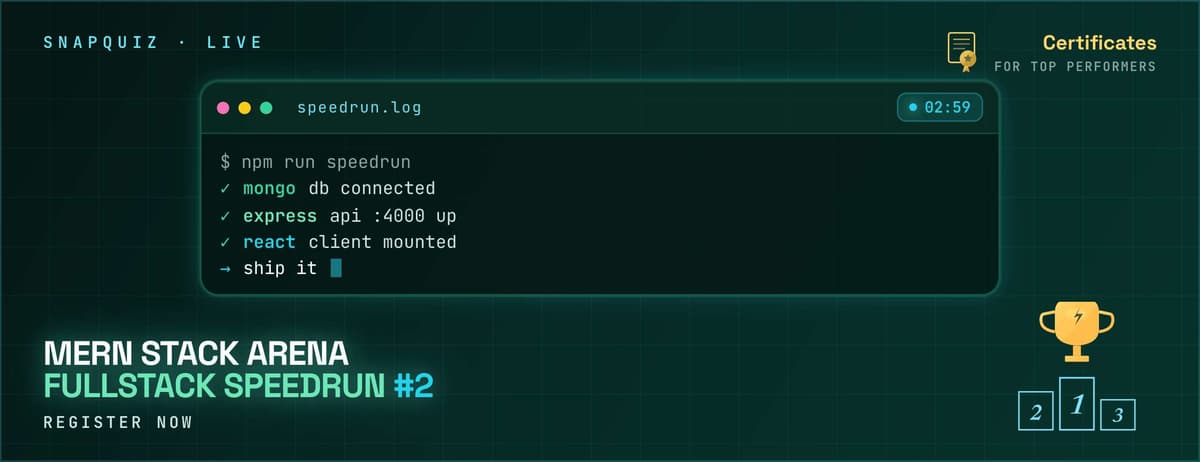
The MERN Stack Arena — Fullstack Speedrun #2 is a free MERN stack quiz that tests how well your full-stack fundamentals hold up under a clock. In one 30-minute sitting you answer 40 multiple-choice questions spanning React.js, Node.js, MongoDB, and the JavaScript and ES6 that tie the stack together — an entire MERN stack challenge online, scored against a live leaderboard, with an instant explanation after every question.
It isn't a course and it isn't a coding assignment. It's a fast, honest checkpoint: a way to test your MERN stack knowledge and see, in half an hour, which parts of the stack you truly own and which you've been getting by on. React carries the most weight, so front-end depth counts — but Node.js, MongoDB, and core JavaScript all show up, and the people who rank highest are the ones comfortable across the whole stack. If you've only ever worked one layer — all front end, or all API — this is where those blind spots surface.
This free full stack developer test is built for people who've already met the stack and want to measure themselves against it. Bootcamp graduates and self-taught developers use it to benchmark their React, Node.js, and MongoDB fundamentals before applying for jobs. Students preparing for campus placements use it as timed MERN stack interview practice. Front-end developers moving toward full-stack roles use it to test the backend half they touch less often — and backend developers do the reverse. If you've finished a MERN tutorial or project and want a scored, competitive checkpoint instead of another walkthrough, this is for you. It's equally useful whether you're weeks away from your first developer job or already working and want a quick, objective read on where your fundamentals sit.
Every correct answer earns points, and your total across the 40 questions decides your leaderboard position. The leaderboard updates live while the challenge is open, so you can watch where you stand against everyone competing in real time; once the challenge closes, the board settles and you see your own final rank. Because it's a single 30-minute attempt, both accuracy and pace matter — the strongest finishers know the material well enough to answer without second-guessing. There's no gotcha scoring to reverse-engineer: your score simply reflects how many of the 40 MERN stack MCQ questions you get right inside the window, and ranks map to the prize tiers shown on this page.
With roughly 45 seconds per question, the biggest mistake is over-thinking the easy ones and running out of clock before you reach the rest. Read each question fully — many MERN questions hinge on a single word, like whether state updates are synchronous or what an Express middleware returns — then commit to your answer and move on. If a question genuinely stumps you, make your best guess and keep going rather than burning two minutes on it; there's no penalty for a wrong answer beyond the point you'd have earned. Because you can't pause, set yourself up before you start: close other tabs, silence notifications, and pick a 30-minute block where nobody will interrupt you. Treat the instant explanations as feedback for later, not something to study mid-run — glance and continue, so your pace stays steady across all 40 questions.
React.js is the heaviest-weighted area. Expect questions on components and JSX, props versus state, the useState and useEffect hooks, conditional rendering, rendering lists and why keys matter, lifting state up, and what actually triggers a re-render. These are the day-to-day mechanics of building a React front end, and they're where most of your points are won or lost.
Node.js comes next. Questions cover the event loop and non-blocking I/O, the module system and how require/import resolve, building HTTP endpoints with Express, what middleware does and the order it runs in, and reading configuration from environment variables. This is the server-side backbone of a MERN app.
MongoDB covers the data layer: documents and collections, CRUD operations, filtering and projection in queries, when and why to add an index, and how a flexible document model differs from relational tables. You don't need to be a database administrator — you need to understand how a MERN app reads and writes its data.
JavaScript and ES6 tie everything together. The core JavaScript questions probe scope and closures, the behaviour of this, asynchronous code with callbacks, promises and async/await, and the type-coercion quirks that trip people up. The ES6+ questions cover arrow functions, destructuring, spread and rest, template literals, let and const, default parameters, and ES modules — the modern syntax every MERN codebase leans on.
This is a format difference, not a quality ranking. Coding judges like HackerRank and LeetCode test whether you can write and run code against test cases; the Fullstack Speedrun tests conceptual recall across the whole MERN stack under time pressure — the kind of rapid understanding that early interview screens and rapid-fire technical rounds actually lean on. Compared with a casual Google Forms quiz or an untimed practice set, every question here is scored against a live leaderboard and followed by an instant explanation. Use coding platforms to practise building; use this MERN stack quiz to check what you genuinely remember when the clock is running.
A short warm-up is the single best thing you can do to rank higher, and there's no downside — because it's a single attempt, you want to walk in sharp. Since React.js carries the most weight, start with the free React Fundamentals course. Then shore up the backend and data side with Node.js, and tighten your core language skills with JavaScript ES6+ Fundamentals. Each is a timed, question-driven Skill Builder course you can drill as many times as you like — and the topics map directly onto what the speedrun asks, so even half an hour of practice tends to lift both accuracy and speed on the day.
When you submit, your answers are scored immediately and your position appears on the live leaderboard while the challenge is still open. After it closes, the board settles and your final rank is locked in. Top-100 finishers receive their certificate — an achievement certificate for ranks 1 through 10, a participation certificate for ranks 11 through 100 — plus one month of Abekus Pro, and credit and gem rewards land in your wallet automatically based on your rank tier. Because the explanations appear as you play, you finish already knowing which topics you handled cleanly and which to revisit — a natural moment to jump back into the React, Node.js, or JavaScript courses and close the gaps before the next round.
Tips to get your best score
302520Salesforce Technical Architect, AI and Agentforce
NeuraFlash

Software Engineer (MANTL)
Alkami

Senior Technical SEO Specialist
Motive

Senior Full-Stack AI Engineer-2
DXC Technology

Full Stack Engineer
Bjak

Data Fabric Cloud Engineer
Hewlett Packard Enterprise


