On this page
Most Indian students still treat off campus placement as the consolation prize — the thing you fall back on when the campus drive does not work out. That framing is now wrong, and it costs people months.
The reality is that only a minority of graduates get hired through a campus drive that actually suits them. Some colleges get almost no serious recruiters. Many drives are for a single service company with one role and a bond. Plenty of good students clear nothing simply because three companies visited and all three wanted something else. If any of that describes your situation, off campus is not your backup plan. It is your plan.
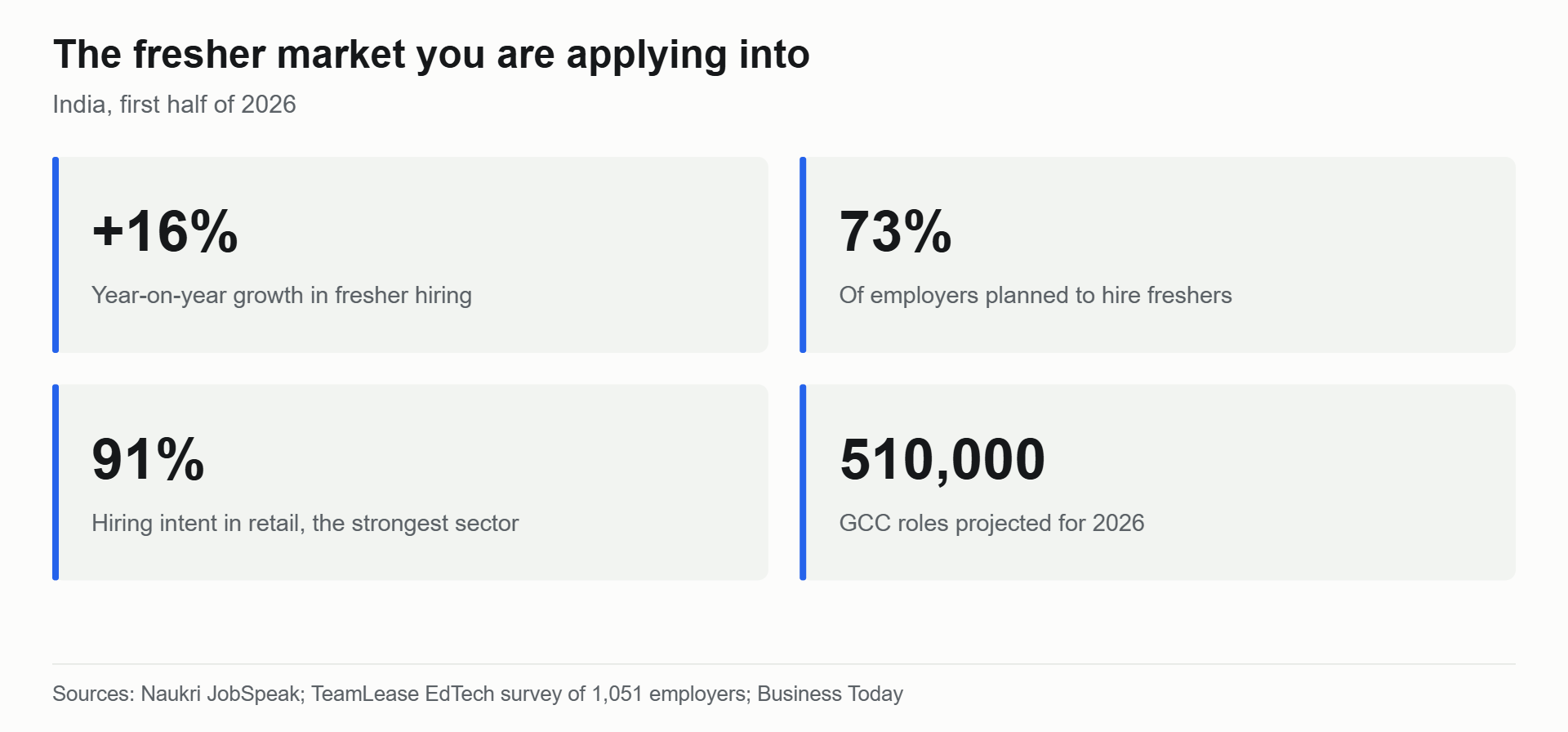
The good news is that the market is on your side more than it has been in years. Fresher hiring in India grew 16% year on year according to Naukri’s JobSpeak data, with the growth spread across metro and non-metro cities rather than concentrated in Bengaluru. A TeamLease EdTech survey of 1,051 employers put fresher hiring intent at 73% for the first half of 2026.
The bad news is that almost all off campus advice is a list of job portals, which is the least useful part of the process. What actually decides the outcome is timing and preparation. Here is the sequence that works.
Why off campus is the main route now, not the fallback
Three things changed at once. Companies that used to run large campus drives increasingly hire in smaller, rolling batches through the year, because they would rather hire twenty people they have assessed properly than two hundred they have not. Global Capability Centres, which are now the largest engine of white-collar hiring in India, mostly do not run traditional campus drives at all — they recruit continuously and they screen on demonstrated skill.
And the assessment itself moved online. Once the first round is a test rather than a room, there is no logistical reason to restrict it to students at a particular college. That is genuinely good for you if your college is not on anyone’s preferred list, and it is the single biggest structural shift in Indian fresher hiring in a decade.
What follows from that is a different kind of preparation. Campus placement rewards being available on the day the company visits. Off campus rewards being ready before you apply, because there is no queue to stand in and no second chance next semester — the application either clears the screen or it does not.
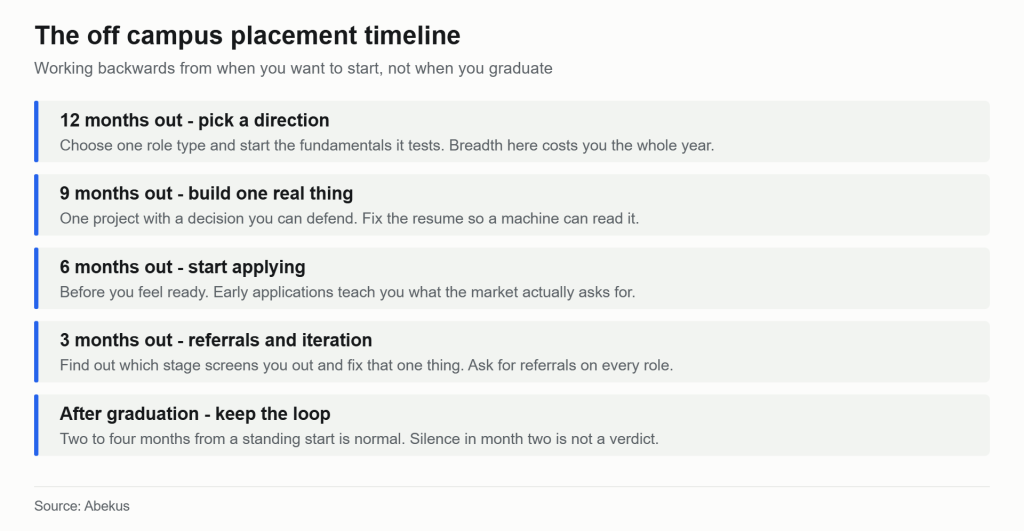
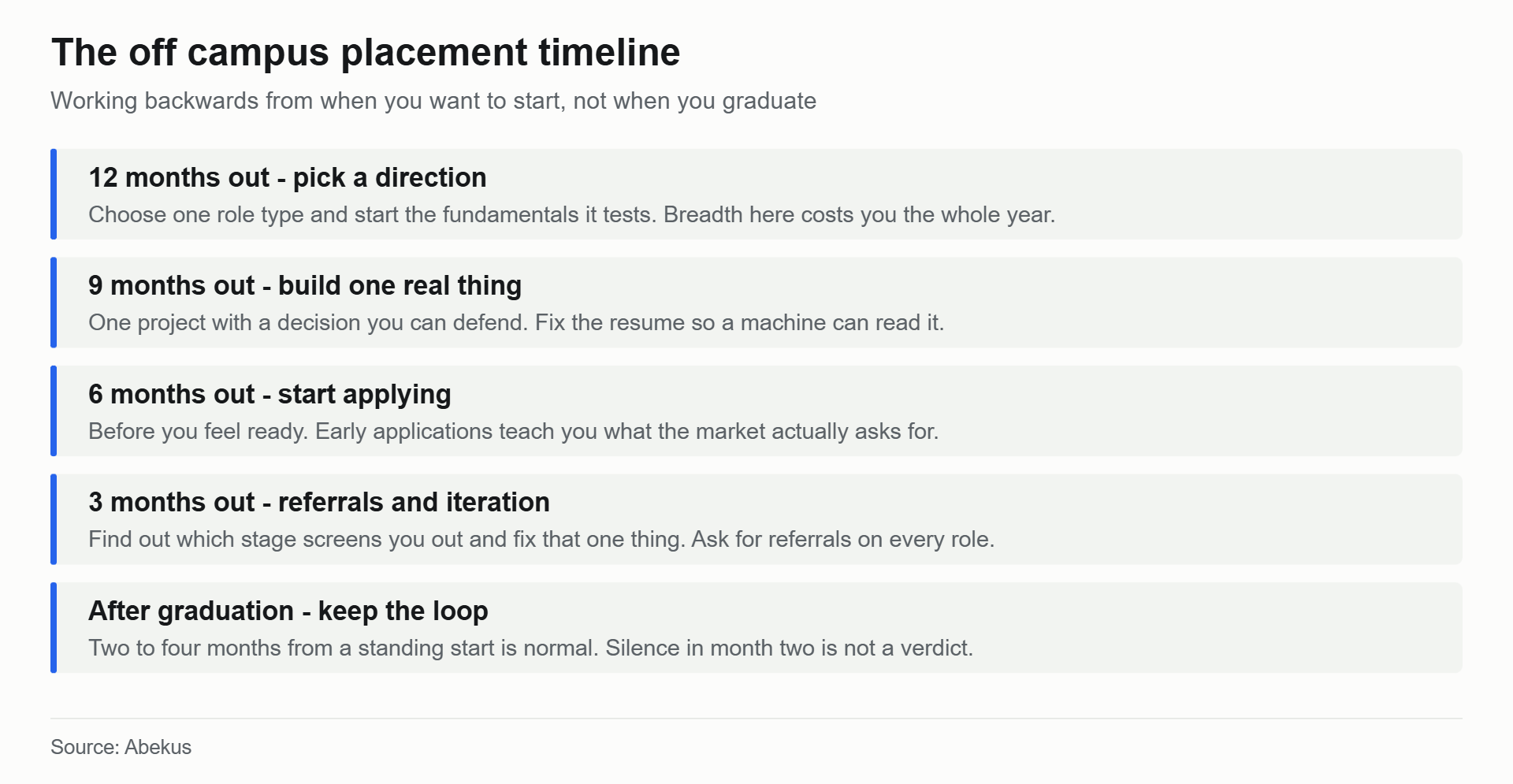
The off campus placement timeline
The most common mistake is starting too late. People begin applying in their final semester, when the roles they want closed their intake months earlier. Work backwards from when you want to start working, not from when you graduate.
What to have ready before you apply anywhere
Four things. Not a long list, but each one is a gate, and applying without them wastes the application.
A resume a machine can read. Single column, standard headings, no tables, no graphics, no photo. Skills named exactly as job descriptions name them — write SQL, not “database querying”. Save as PDF unless the form says otherwise. This is not about beating an applicant tracking system, which does not auto-reject people the way the internet claims; it is about a human recruiter finding what they need in six seconds.
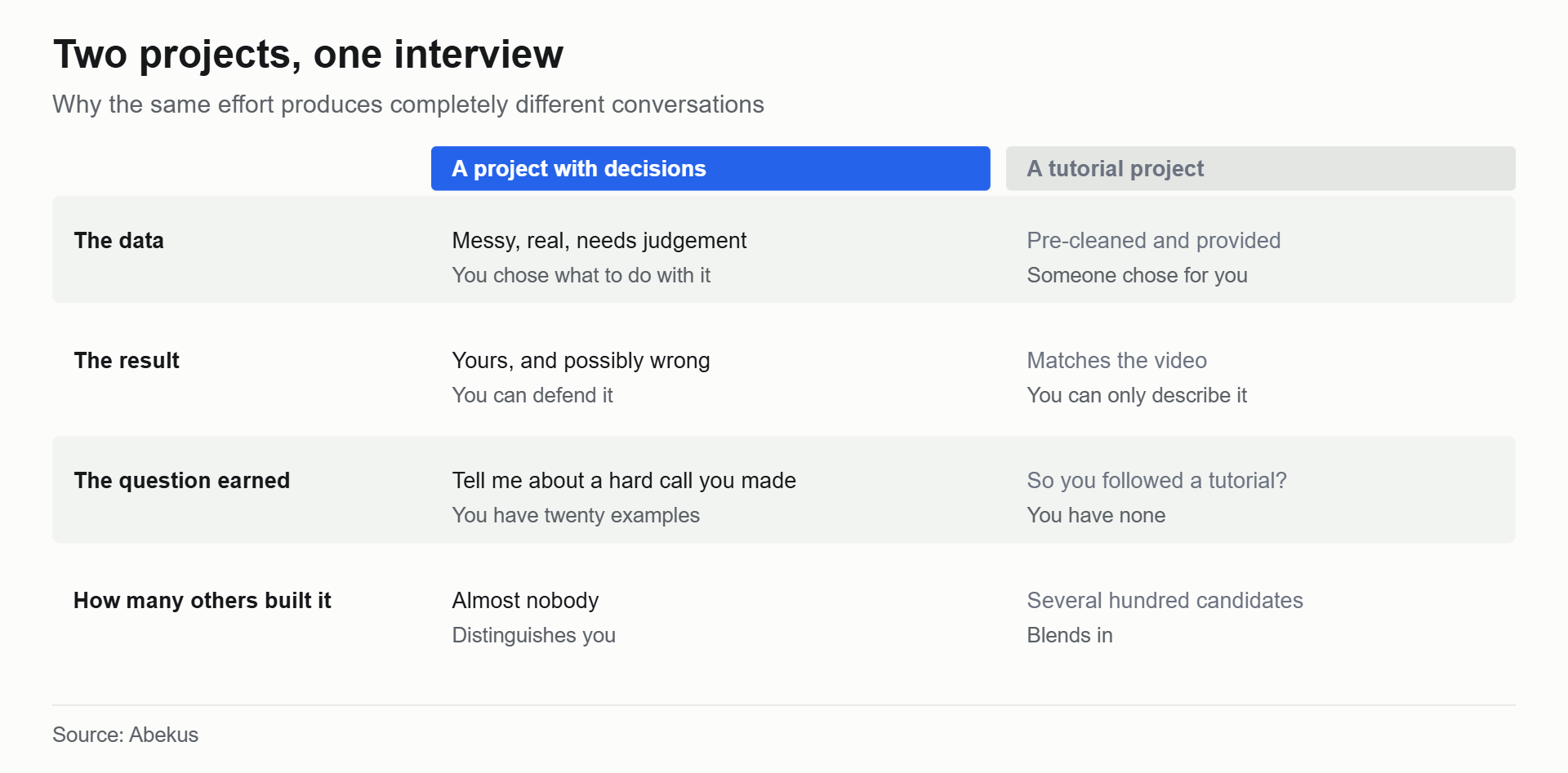
One thing you built that you can talk about for ten minutes. Not three half-finished tutorials. One project with a real input, a real output, and at least one decision you had to make and can defend. This is what separates you from the identical resumes around you, and it is the thing interviewers actually probe.
A LinkedIn profile that matches your resume. Recruiters check. A mismatch in dates or titles reads as carelessness at best. Fill the headline with what you do rather than “aspiring software engineer seeking opportunities”, which tells a recruiter nothing and appears on tens of thousands of profiles.
Evidence a stranger can verify in one click. A score, a ranked result, a repository, a live link. Anything that answers the question “is this claim true” without the recruiter having to take your word for it. In a market where a large share of applications are AI-assisted, this is the part that is genuinely scarce.
Where off campus jobs actually come from
Not all channels are equal, and most people spend their time on the worst one. Ranked roughly by how often effort turns into an interview:
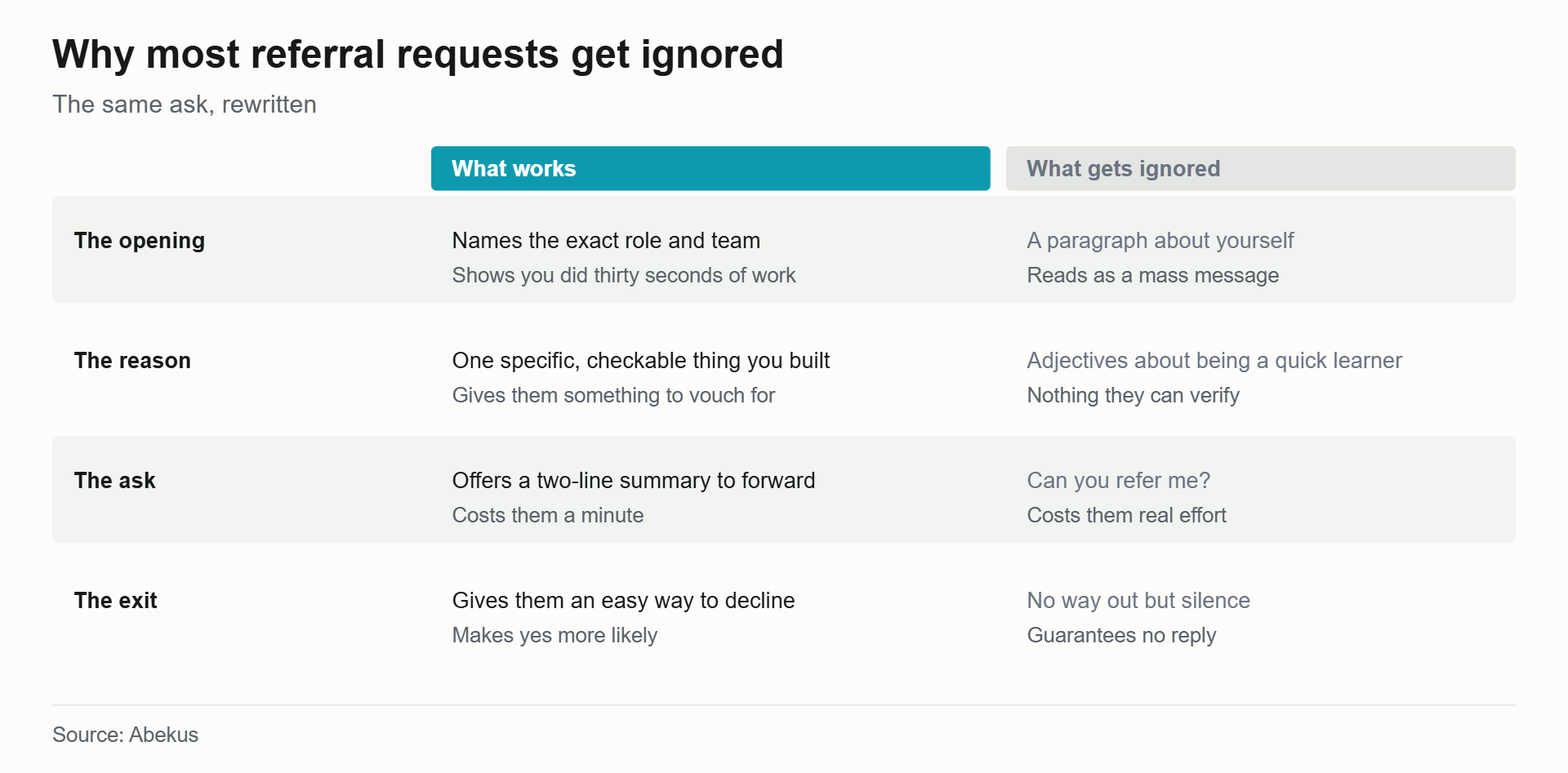
- Referrals. A referred application is read by a person, which no other channel guarantees. Widely cited industry analyses put referrals at a small share of applications but a large share of hires. This is the highest-return activity available to you and almost nobody does it properly.
- Company careers pages, applied to early. Roles get the most attention in their first 72 hours. A posting you find on day one is a different proposition from the same posting on day thirty.
- Hiring challenges and coding competitions. Several companies hire directly off results. The pool is smaller and self-selecting, and performance is the application, which removes the resume screen entirely.
- Off campus drives run by companies directly. Announced on their careers pages and LinkedIn, often with a fixed test window. Set alerts rather than checking manually.
- Job boards. Useful for discovery, poor for conversion, because everyone else is there too. Use them to find out a role exists, then apply through the company’s own site and look for a referral.
The general principle: the more a channel filters on what you can do, and the less it filters on who already knows you, the better it is for someone applying off campus.
The months where nothing happens
Every off campus search has a stretch, usually somewhere between weeks four and ten, where you have applied to plenty and heard nothing at all. This is the point where most people either give up or start spraying applications, and both are mistakes.
Some of that silence is not about you. A meaningful share of live listings are not real openings — they are pipeline-building or roles already filled internally, which is worth learning to spot before you apply rather than after. Some of it is volume. And some of it is that your application is not clearing a specific gate that you cannot see from the outside.
The productive response is to find out which. Ask one recruiter, politely, where you were screened out. Check whether you are getting tests but failing them, getting interviews but not offers, or getting nothing at all — because those three problems have completely different fixes and guessing wrong wastes a month. If you never reach a test, the problem is your resume or your channel. If you fail tests, it is your fundamentals. If you reach interviews and stop there, it is how you talk about your work.
Also worth knowing: an increasing number of first rounds are automated, and if you have never faced one, the format itself will cost you marks that your ability would not. It is worth understanding how to beat an AI interview before you sit one, not after.
A realistic set of expectations
Applying to more things faster is not the lever. Ten applications where you meet most of the requirements, have a referral, and can point to relevant evidence will beat two hundred sent blind, every time, and will take less of your week.
Expect the whole process to take two to four months from a standing start, and expect the first month to produce very little, because that month is mostly preparation whether you planned it that way or not. Expect to be rejected by companies that would have hired you six months later. That is not a verdict on you; hiring is lumpy, and timing does most of the work people attribute to merit.
And target the employers whose process can actually see you. Companies that put a test or a work sample early are the ones where not having a brand-name college stops mattering. That is the whole reason off campus is winnable now.
Frequently asked questions
What is off campus placement?
Off campus placement is getting hired directly by a company rather than through a recruitment drive at your college. You apply through the company careers page, a referral, a hiring challenge or a job board, and you are assessed on the same tests as everyone else regardless of which college you attend.
When should I start applying for off campus jobs?
Earlier than feels comfortable, ideally six months before you want to start working. Applications made before you feel ready are how you learn what the market actually tests for. People who wait until they feel prepared usually discover in month six that they prepared for the wrong things.
Is off campus placement better than campus placement?
Neither is better, but off campus gives you far more control. You choose the companies, the roles and the timing rather than accepting whoever visits your college. It requires more preparation up front because there is no queue to stand in and no second attempt next semester.
How long does an off campus job search take?
Two to four months from a standing start is normal, with the first month producing very little because it is mostly preparation. A quiet stretch somewhere between weeks four and ten is expected and is not a signal to give up or to start applying at random.
Can I get an off campus job from a tier 3 college?
Yes, and this is the route where college name matters least. Once the first round is an online test rather than a campus visit, there is no logistical reason to restrict it by college. Target employers who put an assessment early, because that is where your ability is what gets measured.
Sources
- Naukri, JobSpeak hiring report — 16% year-on-year growth in fresher hiring. Accessed September 2026.
- TeamLease EdTech, employer survey of 1,051 employers conducted November 2025 to January 2026 — 73% fresher hiring intent for the first half of 2026.
- Business Today, July 2026 — India GCC hiring volumes for 2026.