
On this page
- What changed since the 2024 list
- 1. Analytical thinking
- 2. AI fluency, meaning direction rather than familiarity
- 3. Data literacy
- 4. Explaining your work to someone who was not there
- 5. Resilience, flexibility and agility
- 6. Judgement under ambiguity
- 7. Learning velocity
- 8. Domain depth
- 9. Working across functions
- 10. Security and privacy instincts
- What to do with this list
- Frequently asked questions
- Sources
This list gets rewritten every year and most versions say the same comfortable things. This one is different from the 2024 edition on purpose: roughly half of what was on that list has either become an assumption rather than a skill, or been absorbed by tools.
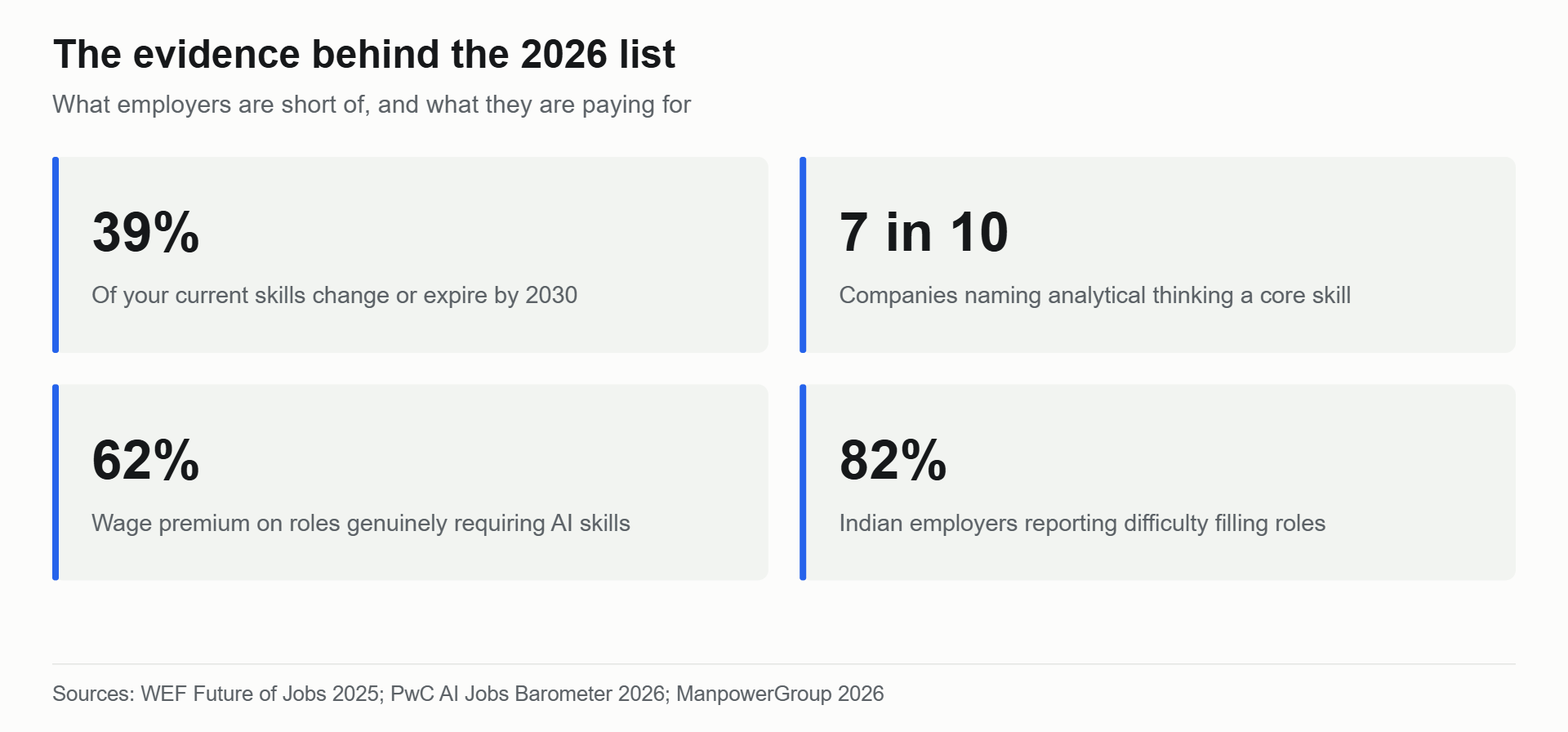
The honest framing for 2026 is that employers are not short of people who have heard of things. They are short of people who can decide, judge and explain — 82% of Indian employers report difficulty filling roles, against 72% globally, with AI capabilities the hardest to find.
What changed since the 2024 list
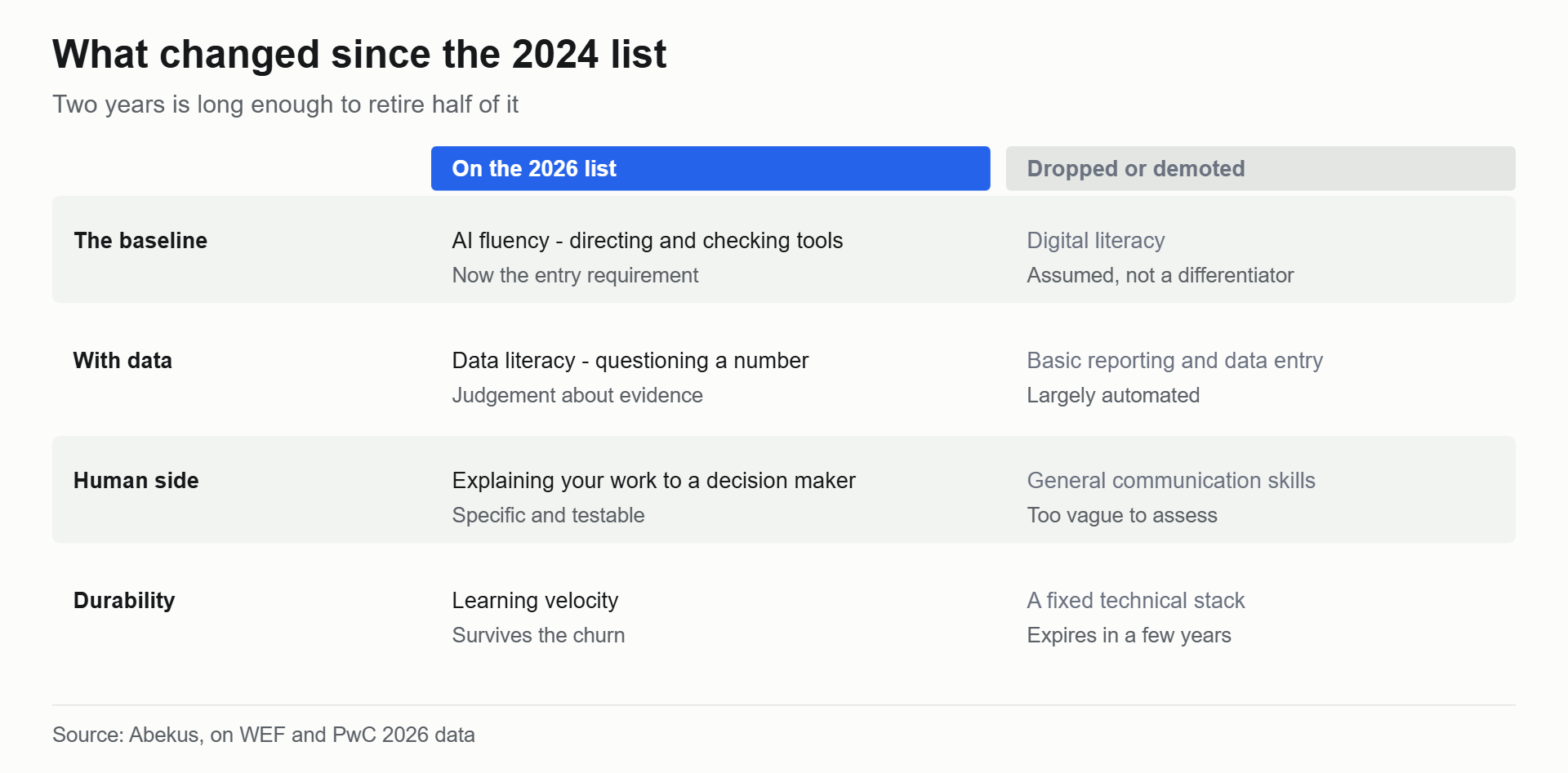
Two years ago “digital literacy” was a reasonable thing to put on a list. In 2026 it is the equivalent of listing punctuality — assumed, and slightly odd to mention. The same is true of basic reporting, which tools now do, and of “communication skills” stated generally, which is too vague for anyone to assess.
What replaced them is more specific and harder to fake. That is the pattern running through the whole list.
1. Analytical thinking
The World Economic Forum’s Future of Jobs Report puts this first, named as a core skill by roughly seven in ten companies. Concretely it means breaking a vague problem into parts you can actually test, and noticing which part carries the answer.
It is the most durable skill on this list because it does not depend on any tool. Show it by describing a problem you reframed — where the useful work was realising the question was wrong, not answering it faster.
2. AI fluency, meaning direction rather than familiarity
Roles genuinely requiring AI skills command a 62% wage premium according to PwC’s 2026 barometer. The word carrying the weight is requiring. Listing tool names earns nothing, because everyone lists them.
What is scarce is the ability to direct a tool toward a real problem and then check its output critically — knowing where it tends to be confidently wrong. Show it by naming something you built with AI assistance and one place it misled you.
3. Data literacy
Not building models. Reading a number and knowing whether to trust it: what the denominator was, whether the sample supports the claim, whether the average is hiding a distribution.
This has become more valuable precisely because generating charts is now trivial. When anyone can produce a figure in seconds, the scarce skill is recognising when the figure is meaningless.
4. Explaining your work to someone who was not there
Employers increasingly rank communication above raw technical ability when deciding between candidates, and this is the version they mean: taking something you understand deeply and making it usable by a person who has thirty seconds and a decision to make.
It is testable, which is why it beats “good communication skills” as a claim. If you can write four sentences explaining a trade-off you made, you have demonstrated it. Most people cannot.
5. Resilience, flexibility and agility
The WEF ranks this immediately behind analytical thinking, and it is less woolly than it sounds. It means continuing to work sensibly when the requirements change midway, the tool is deprecated, or the thing you built turns out to solve the wrong problem.
Employers screen for it by asking about something that went wrong. The answer that lands is specific about what you changed, not about how positive you stayed.
6. Judgement under ambiguity
Making a defensible call when the information is incomplete, and being able to say what you traded away. This is the single hardest thing to teach and the easiest to evidence, because every real project contains one.
It is also the skill AI is furthest from replacing, since a model will confidently produce an answer without any sense of what it cost to choose it.
7. Learning velocity
The WEF expects 39% of current skills to be transformed or outdated between 2025 and 2030. Against that rate, how fast you pick up something new matters more than the size of what you already know.
This is the meta-skill on the list, and the one with the clearest evidence: a short, finished learning cycle you can describe. The mechanics of keeping skills current are covered in more depth in the half-life of skills.
8. Domain depth
Knowing how one industry actually works — how lending decisions get made, why a particular kind of customer churns, what breaks in a supply chain under load.
Underrated because it is unglamorous, and increasingly valuable because it is the context AI tools do not have. It is also why people who stay in one sector often out-earn stronger technologists who keep switching.
9. Working across functions
Getting something done with people who do not share your assumptions, vocabulary or incentives. In practice this is most of what a job is after the first year, and almost none of what training prepares you for.
Evidence it with a specific instance: a time you had to translate between two groups, or extract a real requirement from someone who described the problem wrongly at first.
10. Security and privacy instincts
Not a security career — the basic reflexes. Recognising that a dataset contains personal information, that a credential does not belong in a repository, that a convenient shortcut creates an exposure.
This has moved onto the list because so much work now involves pasting data into third-party tools, and the people who pause before doing that are conspicuously rare.
What to do with this list
Do not treat it as ten things to acquire. Treat it as a diagnostic: pick the two where you are genuinely weakest and which matter most for the roles you want, and build evidence for those.
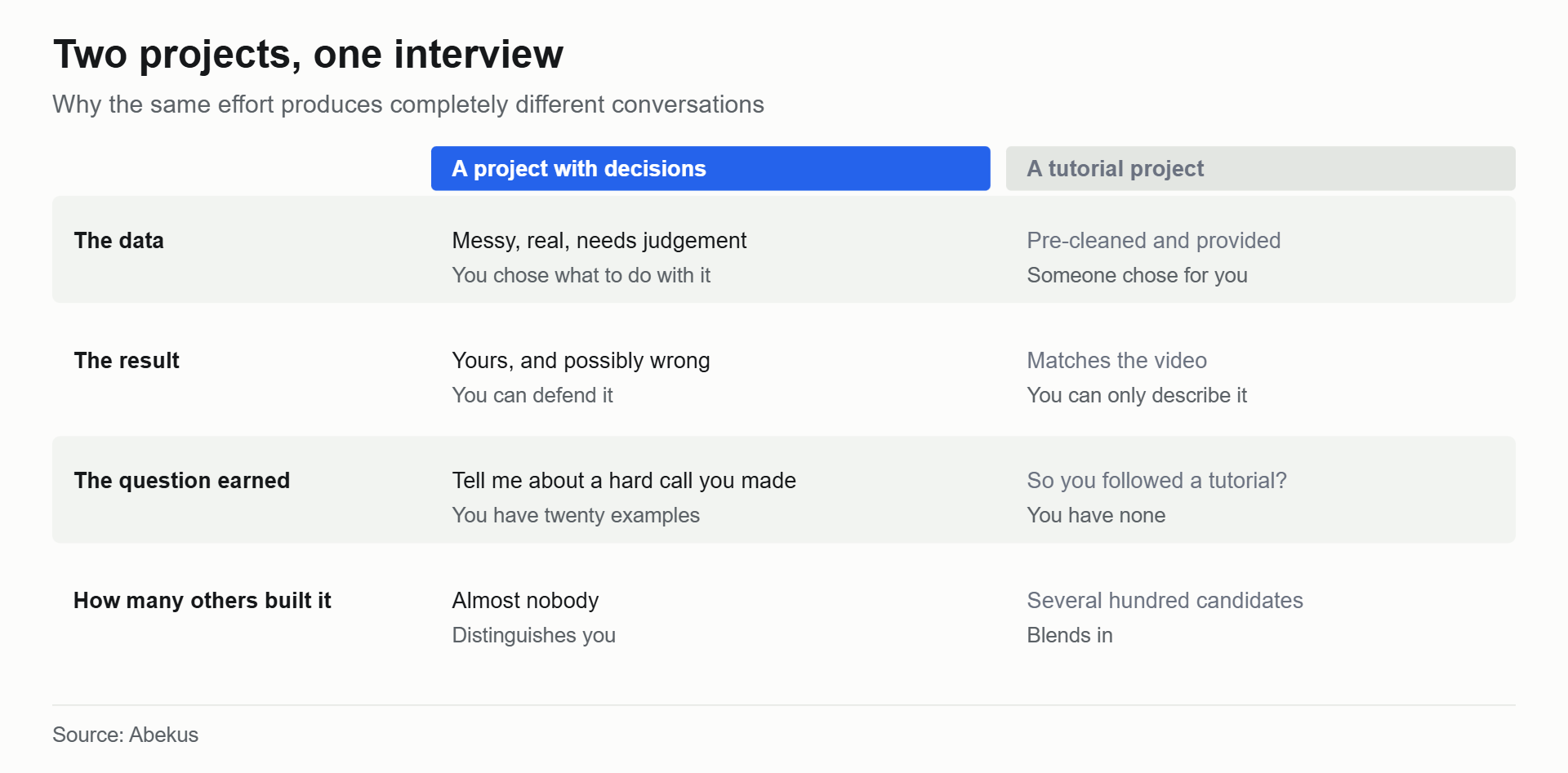
Evidence is the operative word. Every skill here is a claim anybody can make, and employers have stopped believing claims — which is the real story of the last two years and the reason the 2024 list aged so badly. What separates candidates now is not which skills they name but which ones a stranger can verify in thirty seconds.
If you are building that evidence from scratch, the practical sequence is in the off campus placement guide, and the wider argument for why human judgement is holding its value is in the skills AI cannot replace.
Frequently asked questions
What are the most in-demand skills for jobs in 2026?
Analytical thinking leads, named as a core skill by around seven in ten companies in the WEF Future of Jobs Report. It is followed by AI fluency meaning directing and checking tools rather than naming them, data literacy, explaining your work clearly, resilience, and judgement under ambiguity.
Are AI skills really the most valuable skill right now?
They carry the largest measured pay premium, 62% on average according to PwC 2026, but only on roles that genuinely require them. The premium attaches to demonstrated ability to direct and critically check AI output, not to listing tool names on a resume.
Which skills have become less valuable since 2024?
General digital literacy, basic reporting and data entry, and vaguely stated communication skills. None stopped mattering; they stopped distinguishing anyone. Digital literacy in 2026 is assumed the way punctuality is, and basic reporting has largely been absorbed by tools.
How many skills should I focus on learning?
Two. Pick the ones where you are genuinely weakest and which matter most for the roles you want, then build verifiable evidence for those. Naming ten skills on a resume persuades nobody, because every other candidate names the same ten.
How do I prove I have these skills?
With something a stranger can check in about thirty seconds: a scored assessment, a ranked result, or a project with a decision you can defend and a real number attached. Employers stopped believing self-reported skill claims, which is why unverifiable lists carry almost no weight.
Sources
- World Economic Forum, Future of Jobs Report 2025 — core skill rankings and the 39% skills transformation figure. Accessed September 2026.
- PwC, 2026 Global AI Jobs Barometer — the 62% wage premium on roles requiring AI skills. Accessed September 2026.
- ManpowerGroup, Global Talent Shortage Survey, India 2026 — 82% of Indian employers reporting difficulty filling roles. Accessed September 2026.
Updated September 2026. This article was originally published in August 2024 and has been substantially rewritten to reflect current hiring data.