

SnapQuiz


Scroll to Top
 Bangaru K.
 Srilatha P.
 Bolla H.
 Amrutya
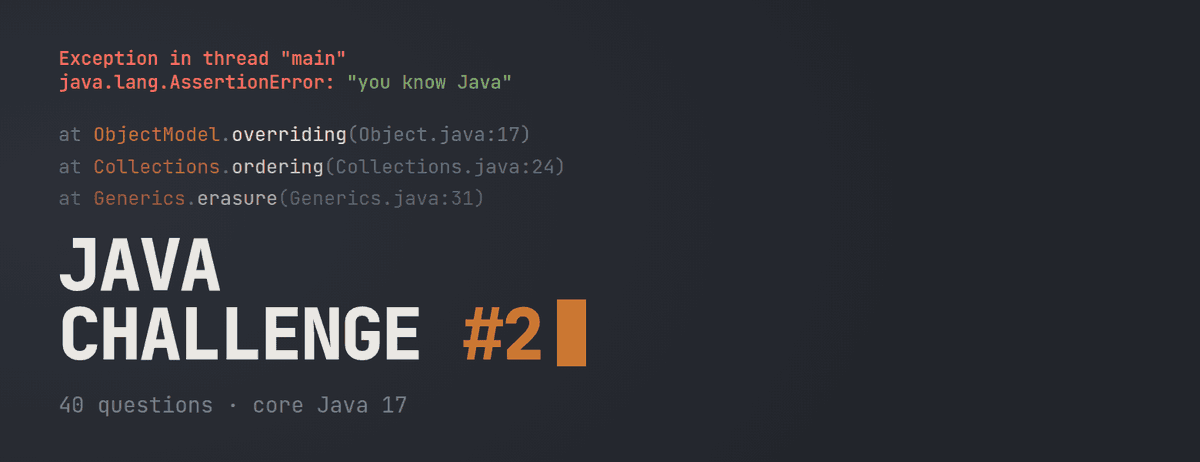
You can write Java. But can you say exactly what it does?
Forty questions run across core Java — the object model, collections, generics and erasure, exception flow, strings, streams and concurrency. Most put real code in front of you and ask what it prints, what it throws, or why it compiles when you expect it not to. Every answer comes with an instant explanation, so you leave knowing which corners of the language you have solid.
Sequel to Java Challenge #1. Trace carefully, commit early, top the board.


Java Challenge #2 is the sequel to a round that drew 540 entrants, and it moves the emphasis from recall to reasoning. Forty multiple-choice questions cover the parts of Java where confident developers are most often wrong — not because the syntax is hard, but because the behaviour is not what the code appears to say.
Object model and equality — inheritance and overriding versus hiding, constructor and initialiser order, the equals and hashCode contract, and what happens to a mutable key already inside a HashMap.
Collections — the ordering guarantees each implementation actually makes, iterator invalidation and ConcurrentModificationException, the difference between the List returned by Arrays.asList and List.of, and remove(int) versus remove(Object).
Generics — type erasure and what survives to runtime, bounded wildcards and why a List of a subtype is not a subtype of a List, and where an unchecked cast fails.
Exceptions — the order of finally against return, try-with-resources and suppressed exceptions, and which exceptions the compiler forces you to acknowledge.
Strings and numbers — interning and identity, immutability, integer overflow, integer division, floating-point comparison, and the autoboxing cache that makes small Integers compare equal by reference and larger ones not.
Streams and concurrency — laziness and short-circuiting, why a stream with no terminal operation does nothing, reduce and collect semantics, and the basic visibility and atomicity problems that make an unsynchronised counter lose increments.
Every question is timed on its own, sized to the reading and tracing it needs, so there is no global clock to manage. Harder questions carry more marks, and a wrong answer costs a third of them — so an honest skip beats a guess. Rewards are credits only, from 3,000 at rank 1 down to 40 at rank 10,000, with certificates for the top 100.
Tips to get your best score

Sr Engineer - Target India
Target
Software Engineer
New Era Technology

Senior Java Developer
Citigroup
Software Engineering L5, Open Connect Platform
Netflix
Java Fullstack Developer
Citigroup
Intermediate Software Engineer – Data Application Developer
Citigroup


